
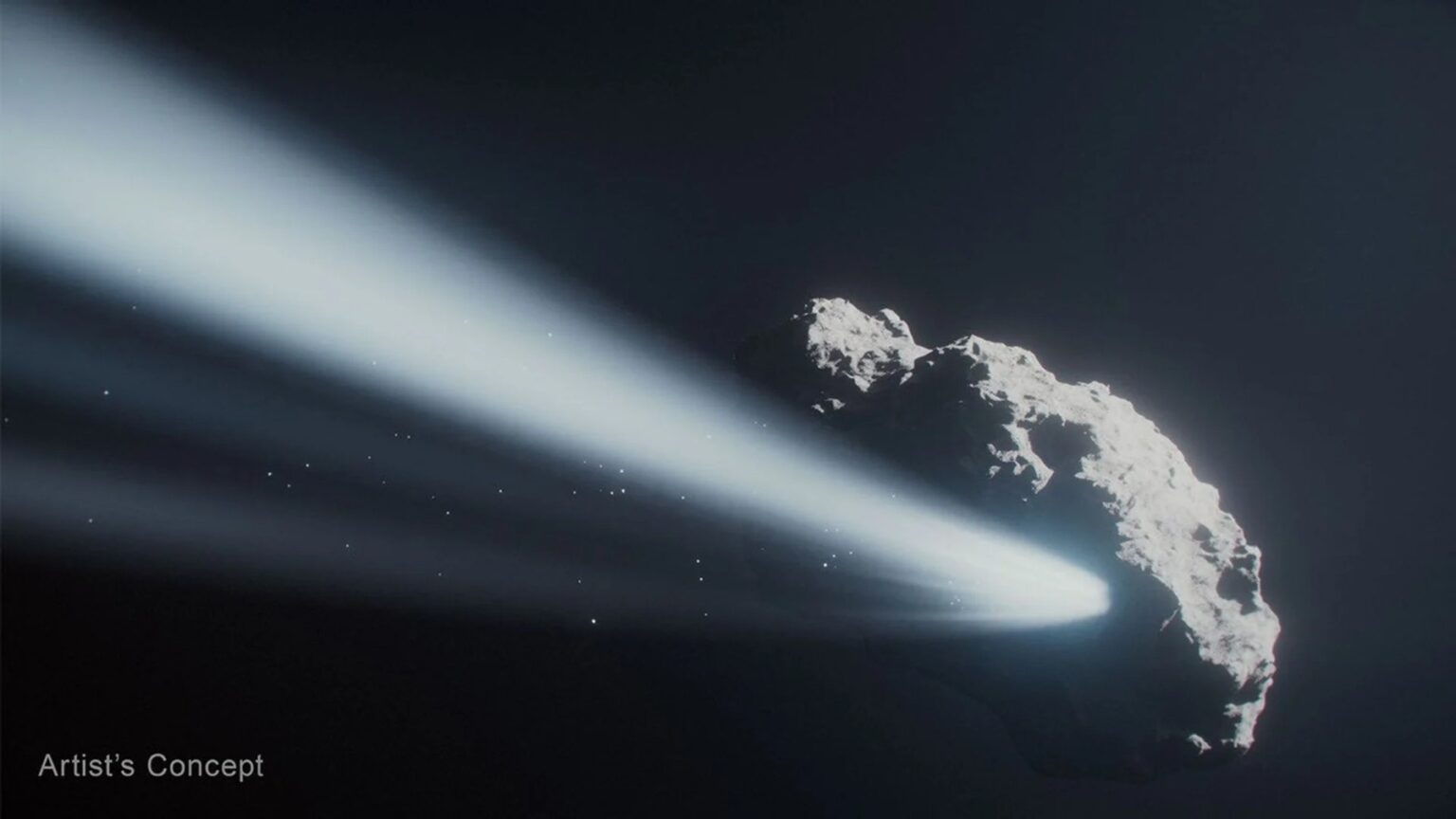
Japan’s space agency is planning to shoot a hole in a comet, dig out material frozen since before the planets formed, and bring it back to Earth. The target is 289P/Blanpain — a tiny, faint body lost to astronomers for nearly two centuries after its discovery in 1819. JAXA’s proposed Next Generation Small-Body Return mission would launch in 2034 and deliver those samples in 2048.
What’s buried beneath that comet’s surface may preserve the solar system’s original chemistry — untouched, and unlike anything retrieved before.
A comet lost for two centuries — and why JAXA chose it
289P/Blanpain has an unusual history. Discovered in 1819, it vanished from astronomical records and stayed missing until 2003. Even then, researchers initially catalogued it as a near-Earth asteroid — its activity was so faint it barely registered. A surprise outburst in 2013 finally confirmed its true cometary nature.
That low activity is precisely what makes it attractive. At roughly 160 meters in radius, 289P/Blanpain produces far less gas and dust than a typical active comet, making close-proximity operations considerably safer for a spacecraft.
The deeper case for targeting a comet comes down to preservation. Asteroids like Ryugu have spent billions of years absorbing solar radiation, sustaining impacts, and undergoing space weathering. Even a comet’s outer surface is altered by cyclic heating and outgassing. Beneath that surface, though — shielded from all of it — primordial ice and dust may have remained essentially undisturbed since the solar system’s earliest days.
Two scientific goals: stellar ancestry and the mystery of planet formation
NGSR pursues two distinct but connected questions. The first concerns where the solar system’s raw ingredients actually came from. Comets are expected to retain presolar grains — material forged inside stars that died before our Sun was born — in something close to their original state, whereas asteroids have been heated and altered too thoroughly to preserve these signatures reliably.
Among the most consequential things the mission might find are intact organic molecules, potentially including amino acids. If pristine presolar organics are recovered from beneath the comet’s surface, it would be direct evidence that life’s chemical precursors arrived from interstellar space rather than being assembled locally.
The second goal targets planet formation itself. Scientists still don’t fully understand how microscopic dust grains overcame physical barriers like gas drag to clump into kilometer-scale planetesimals. NGSR would deploy seismometers and use bistatic radar to probe the comet’s interior, searching for meter-sized voids that could preserve structural clues from that earliest aggregation phase — evidence that asteroid samples, broken apart and re-accumulated over time, can no longer provide.
Shoot, collect, freeze: how the mission would work
The spacecraft consists of two main components: a Deep Space Orbital Transfer Vehicle handling the long cruise phase, and a dedicated lander. After launching in 2034, the mission would reach 289P/Blanpain in 2041 and spend approximately 1.5 years in proximity operations.
During that survey phase, an optical navigation camera, LIDAR, and thermal infrared camera would map the surface in detail. Then comes the excavation — a Small Carry-on Impactor, the same heritage instrument used on Hayabusa2, would blast a crater and expose subsurface material that has never seen sunlight.
The lander touches down near the impact site, collects the excavated material, and analyzes volatile organics on the spot using an ultra-small mass spectrometer called MULTUM-sp. Only after that in-situ analysis are the samples freeze-dried and packaged for the journey home.
Getting the samples home — and keeping them pristine
Cometary samples present a preservation challenge that asteroid samples don’t. Highly volatile organics can degrade or escape over a years-long return trip, which is why both the in-situ analysis and the freeze-drying step are built into the mission design rather than treated as optional.
The Sample Return Capsule is expected to land on Earth in 2048, after which samples would transfer immediately to a purpose-built cryogenic clean room — a facility designed specifically to receive and store material this chemically sensitive.
The full mission spans 14 years from launch to sample return. That timeline and technical complexity place NGSR well beyond what Hayabusa2 attempted, though it builds directly on the engineering and operational experience JAXA accumulated from that mission and its predecessors.
What pristine comet dust could tell us about our origins
If subsurface organics — including amino acids — are found intact, the implications extend well beyond planetary science. It would be the strongest direct evidence yet that the chemical conditions for life were seeded from interstellar space, not generated solely within the young solar system.
Equally significant would be what the comet’s interior reveals about planetesimal formation. That earliest step in planet building remains one of the field’s most persistent open questions, and no mission has yet retrieved material capable of answering it.
NGSR is currently under assessment as a large-class JAXA mission for the 2030s, with a concept paper presented at the 2025 Lunar and Planetary Science Conference. If it clears that assessment and proceeds on schedule, the 2040s could bring the first samples that genuinely reflect what the solar system looked like at the very beginning — before anything had a chance to change them.