
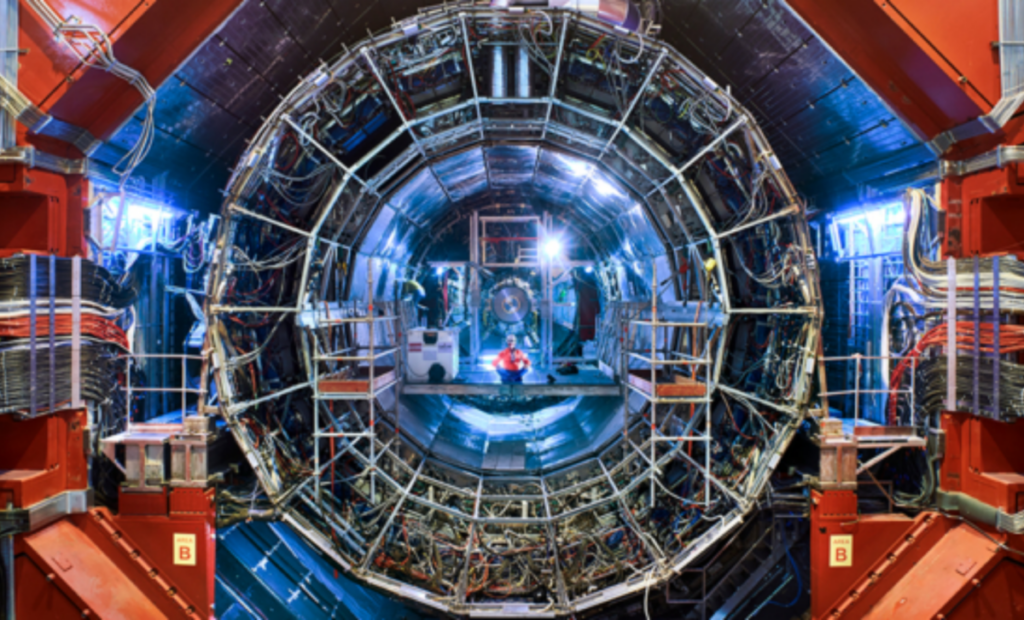
Scientists working with the Large Hadron Collider (LHC) have taken a giant leap forward in understanding the conditions that existed in the universe just moments after the Big Bang. Through an innovative experiment conducted by the ALICE (A Large Ion Collider Experiment) team, they’ve successfully recreated and observed quark-gluon plasma, one of the primordial forms of matter that filled the universe in its earliest moments. This discovery promises to provide unprecedented clarity on the formation of matter and how the universe’s building blocks were shaped in its infancy.
The Role of the ALICE Experiment in This Groundbreaking Discovery
The ALICE experiment is one of the most significant and ambitious scientific endeavors in the world today. Its primary goal is to recreate the conditions that existed immediately following the Big Bang, specifically by generating and studying quark-gluon plasma. This elusive state of matter, which existed only for a fraction of a second after the universe’s birth, is a vital piece in understanding the forces that shaped the cosmos.
For years, the focus of the ALICE team was on studying the collision of heavy ions like lead nuclei, which was thought to be the only way to recreate quark-gluon plasma. However, this new study, published in the journal Nature Communications. reveals a different side to these subatomic interactions, as scientists observed the flow of particles in proton-proton and proton-lead collisions. This marks the first time such observations have been made in these lighter collisions, paving the way for future discoveries.
David Dobrigkeit Chinellato, the Physics Coordinator of the ALICE experiment, explained the significance of the findings, noting,
“This is the first time we have observed, for a large interval in momentum and for multiple species, this flow pattern in a subset of proton collisions in which an unusually large number of particles are produced.”
His team’s breakthrough offers compelling evidence that quarks, the fundamental building blocks of matter, interact in ways that were previously unseen, even in smaller collision systems.
Quark-Gluon Plasma and the Mystery of the Universe’s Early Moments
Quark-gluon plasma is the hot, dense substance that existed in the very early universe, a chaotic soup of particles that was present during the first moments after the Big Bang. In the high-energy environment of the LHC, scientists can replicate conditions similar to those just after the universe’s birth. Understanding how quarks and gluons behaved in that early plasma state is crucial to unlocking the mysteries of the cosmos.
The new findings suggest that quarks in these early moments were bound together to form larger particles, an essential process for understanding how the universe evolved into its present form. One of the key discoveries was the observation of anisotropic flow, a signature pattern in the way particles are emitted from these collisions. As Chinellato remarked, “Our results support the hypothesis that an expanding system of quarks is present even when the size of the collision system is small.” This is a crucial step forward in understanding how quarks form more complex particles and how those particles ultimately coalesced into the universe as we know it.
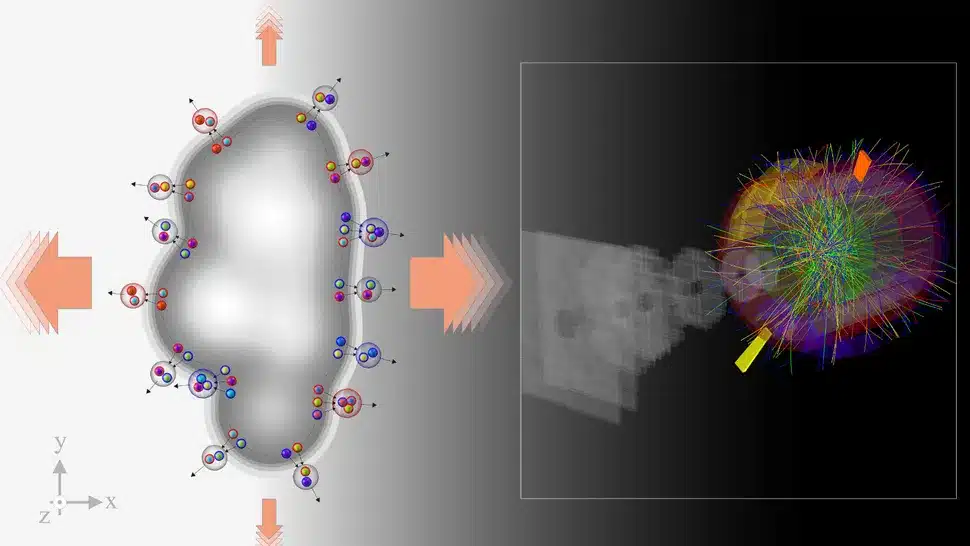 (Right) A proton–proton collision at the LHC in which many particles were created and tracked by the ALICE detector. (Left) Illustration of the anisotropic flow of mesons and baryons that ALICE has studied using data from such collisions, with the large arrows representing the preferred directions.
Image credit: CERN/ALICE Collaboration
What Comes Next: Oxygen Collisions and the Path Forward
As the ALICE team celebrates this breakthrough, they are already looking ahead to the next phase of their research. In 2025, they plan to conduct oxygen collisions, which are expected to bridge the gap between proton and lead collisions. This new phase of experiments will offer even deeper insights into the nature of quark-gluon plasma, helping scientists piece together a more complete picture of the early universe.
“We expect that, with the oxygen collisions that were recorded in 2025, which bridge the gap between proton collisions and lead collisions, we will gain new insights into the nature and evolution of the quark-gluon plasma across different collision systems,” said ALICE Spokesperson Kai Schweda.
These upcoming collisions will provide further clarity on how quarks and gluons behaved during the earliest moments of the universe and how they led to the formation of the matter that makes up everything around us today.