
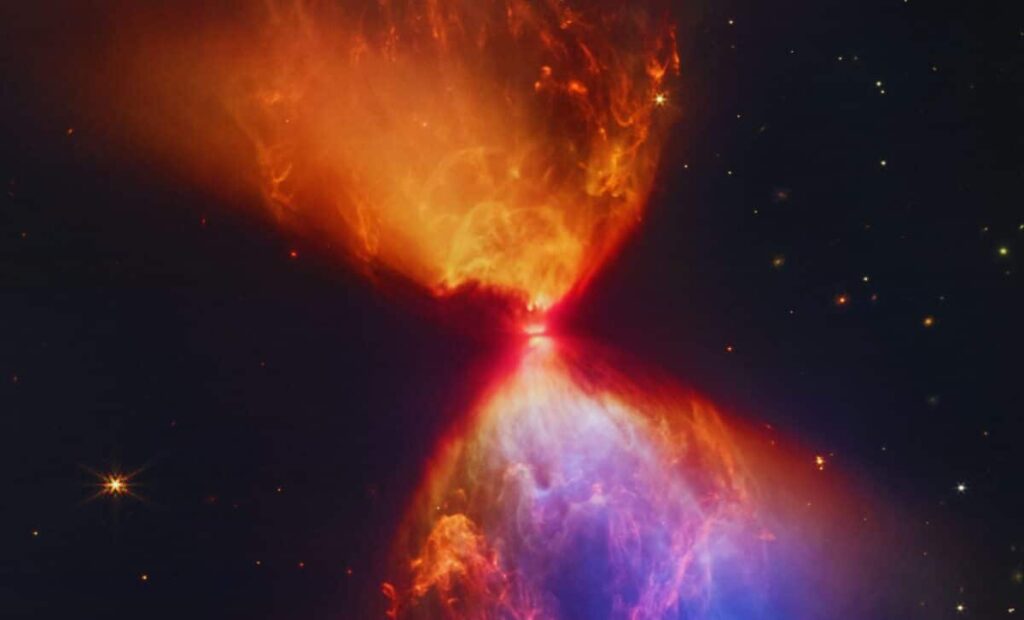
A protostar just 200 years old has been observed ejecting gas and energy in sudden bursts, a phenomenon astronomers liken to “sneezing.” Detected in the Taurus Molecular Cloud, this behavior could reshape understanding of how stars like the sun form and stabilize in their earliest moments.
The formation of stars remains one of the most persistent puzzles in astronomy. Scientists know that stars emerge from dense regions of gas and dust, where several solar masses collapse into a compact space smaller than 0.1 light-year. What happens immediately after ignition is still poorly understood.
Observing these early stages is difficult. Young stars remain embedded in thick protostellar disks that block much of their light. According to observations made with the ALMA Observatory in chile, researchers have identified new clues by studying objects in the MC 27 region, located about 450 light-years from Earth.
A Newborn Star Barely Switched On
The object at the center of this study stands out because of its extreme youth. While the Sun is about 4.6 billion years old, this star is estimated to have formed only around 200 years ago. The findings reported in The Astrophysical Journal Letters make it one of the youngest newly formed star ever observed.
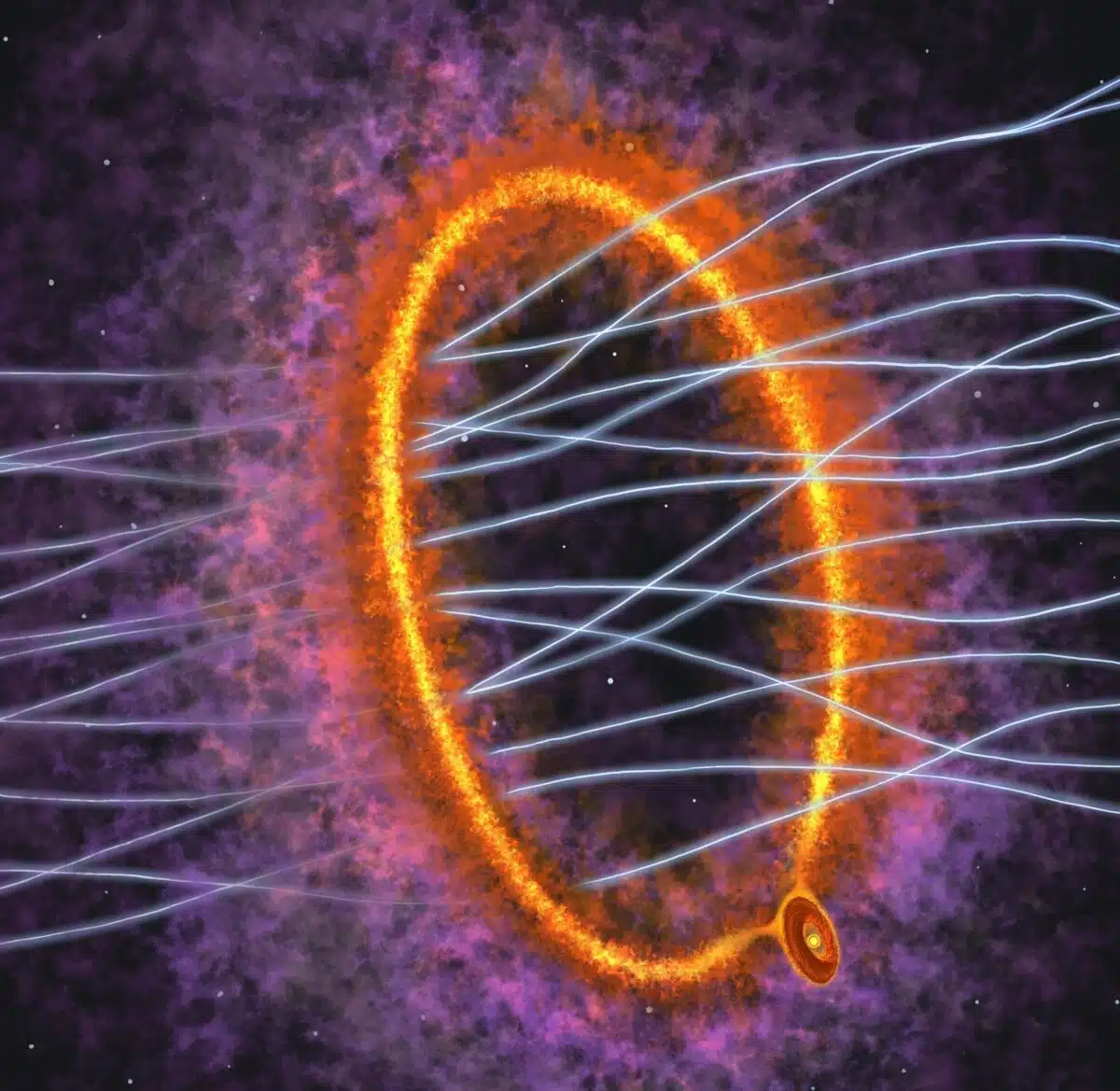 ALMA-based illustration of MC 27 with a young star and a magnetic ring of warm gas. Credit: The Astrophysical Journal Letters
Such a case is rare. Most newborn stars studied by astronomers are already around 100,000 years old. Here, researchers are observing a star almost immediately after its ignition phase.
“Thankfully, one of the most promising ways to get a clear view of protostars is to use the Atacama Large Millimeter/submillimeter Array (ALMA) in Chile,” said Professor Masahiro N. Machida of Kyushu University’s Faculty of Science. “This radio telescope lets us see the different materials that make up stellar nurseries.”
A Massive Ring Points To Energetic Outbursts
Using ALMA, the team detected a sharply defined gaseous ring extending roughly 1,000 astronomical units from the young stellar object. As noted by Kazuki Tokuda of Kagawa University, this structure appears slightly warmer than its surroundings, which suggests active processes.
“Our data showed that this ring is slightly warmer than its surroundings. We hypothesize that it is produced through a magnetic field threading the protostellar disk. In essence, the ‘sneezes’ we’ve observed in the past, but at a much bigger scale,” explained the author.
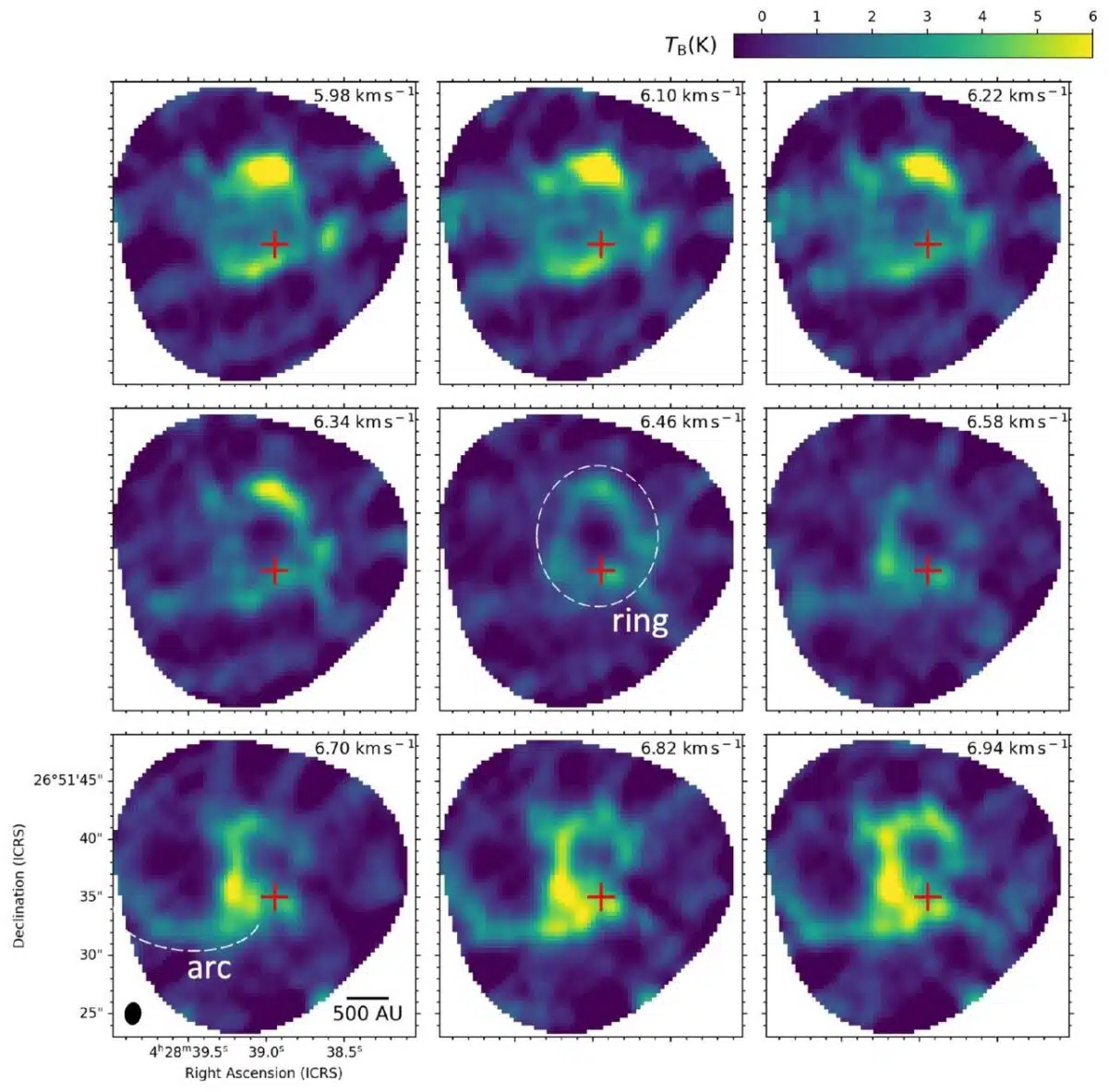 ALMA velocity-channel maps reveal a ring-like gas structure surrounding a young protostar in the MC 27 region. Credit: The Astrophysical Journal Letters
Earlier observations by the same team had revealed smaller structures of about 10 AU linked to magnetic activity within the disk. These were interpreted as brief expulsions of energy. The newly observed ring appears to reflect a similar process on a much larger scale.
“The warm ring we detected this time strengthens our hypothesis that baby stars undergo dynamic magnetic-gas redistribution shortly after birth, generating shock waves that warm the surrounding gas.”
Magnetic Fields and Shock Waves Just Took a Turn
The leading explanation involves magnetic fields interacting with the protostellar disk. As mentioned by the researchers, this interaction could generate shock waves that heat the surrounding gas and redistribute both matter and energy.
This process may help young stars release excess energy as they evolve. The hypothesis remains under investigation. Further high-resolution observations with ALMA will be necessary to explore the inner regions of these rings and better understand their origin.
“We will keep collecting data to strengthen our hypothesis. In the meantime, we welcome rigorous debate on our results so we can advance our field.” Machida added that: “the gas motion involved in star formation is generally ordered, yet very chaotic, appearing in different shapes and sizes. It took us a decade to reach these conclusions, and we look forward to doing more work to uncover the mysteries of the universe.”