
Florida lawmakers reacted to the announced ceasefire agreement with Iran, and NASA could face budget cuts if President Donald Trump’s requested budget is approved.

The White House on Wednesday said the U.S. is moving into a negotiating phase to put the “fine points” on an agreement to end the war in Iran, with talks set to be led by Vice President JD Vance. It follows President Donald Trump’s announcement Tuesday night that both sides agreed to a two-week ceasefire, which appeared fragile Wednesday.
Addressing reporters at a White House briefing, press secretary Karoline Leavitt said an initial 10-point proposal to end the war put forth by Iran was “literally thrown in the garbage” by Trump. However, as the president’s oft-cited 8 p.m. deadline Tuesday for Iran to agree to a deal or face decimation by the U.S. approached, Leavitt said, Tehran’s leaders followed up with “a more reasonable and entirely different and condensed plan” that the administration deemed as having potential.
“The new modified plan was a workable basis on which to negotiate and to align it with our own 15-point proposal,” Leavitt said.
She went on to insist that the president’s “red lines,” specifically that Iran cannot pursue enrichment, have not changed and said his negotiating team will hold talks over the next two weeks to work out a deal, as long as the Strait of Hormuz remains open.
Iran allowing passage through the strait — a critical waterway for the global supply of oil that Iran has been disrupting amid the war — was a key part of the ceasefire plan announced Tuesday, but there has been significant confusion surrounding it in the hours since.
Asked at the briefing about reports that Iran had closed it in response to Israeli attacks on Lebanon, Leavitt sought to make clear that the president expects and demands “that the Strait of Hormuz is reopened immediately, quickly and safely.” But she also said the strait has seen an “uptick of traffic” Wednesday and Trump has been told privately that the reports are “false.”
The ceasefire is prompting responses from a number of Florida lawmakers.
Sen. Rick Scott called the deal, “A strong first step toward holding Iran accountable and what happens when you have a leader who puts peace through strength over chaos and weak appeasement policies.”
Rep. Maxwell Frost said the result followed “reckless” decisions by the president.
“We should’ve never been in this illegal war. Trump is a dangerous warmonger who pushed us into this crisis and threatened to commit war crimes.”
NASA faces potential budget cuts
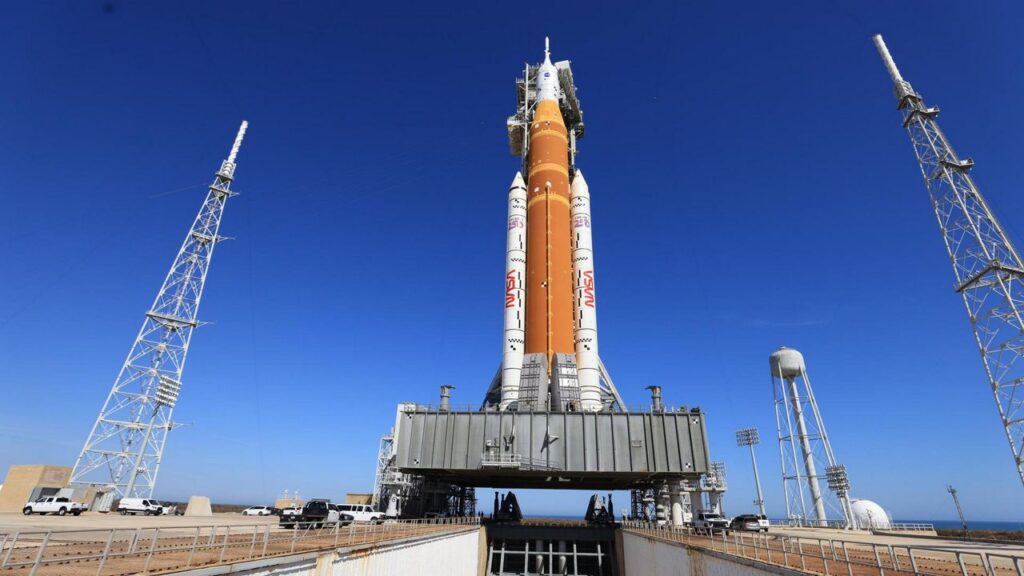
President Donald Trump’s proposed federal budget for the year beginning October 1 would slash NASA’s $24.4 billion by nearly a quarter to $18.8 billion. That would mean the end of some high-profile NASA programs.
“By cutting unnecessary and overpriced activities, the budget strengthens the National Aeronautics and Space Administration’s focus and ensures that every dollar spent propels America’s dominance in the final frontier,” the budget request said about the proposed cuts.
It reflects the Trump administration’s focus on landing astronauts on the moon before China does and establishing a long-term presence there.
“The moon base will not appear overnight. We will invest approximately $20 billion over the next seven years and build it through dozens of missions, working together with commercial and international partners towards a deliberate and achievable plan,” NASA Administrator Jared Isaacman said.
But the President’s proposal would cut $3.4 billion from NASA’s science program by terminating what it calls “over 40 low-priority missions,” including one to retrieve soil and rocks from Mars.
It also seeks to close NASA’s Office of STEM Engagement, a cut of $143 million.
“NASA will inspire the next generation of explorers through exciting, ambitious space missions, not through subsidizing woke STEM programming and research that prioritizes some groups of students over others and has had minimal impact on student outcomes,” the administration wrote in the budget request.
Science organizations like the American Association for the Advancement of Science are pushing back, calling it a mistake.
“Having big, big pieces of infrastructure are really important. But, you know, the most important thing is, when it comes to technology advancement—it’s people, it’s the American people. It’s making sure that the American people are studying science, are participating in science,” American Association for the Advancement of Science CEO Sudip Parikh said.
Last year, the president also sought major cuts to NASA’s budget and other science programs, but they were largely rejected by Congress.
“Last year, a remarkable group of collaborators and stakeholders and believers in science, like patient advocates and scientists and industry, they all came together and fought back, and that was really important, and Congress, in a bipartisan way, protected science. We’re going to hope to see that again,” Parikh said.
Congress faces a September 30 deadline to pass a budget for the next fiscal year.