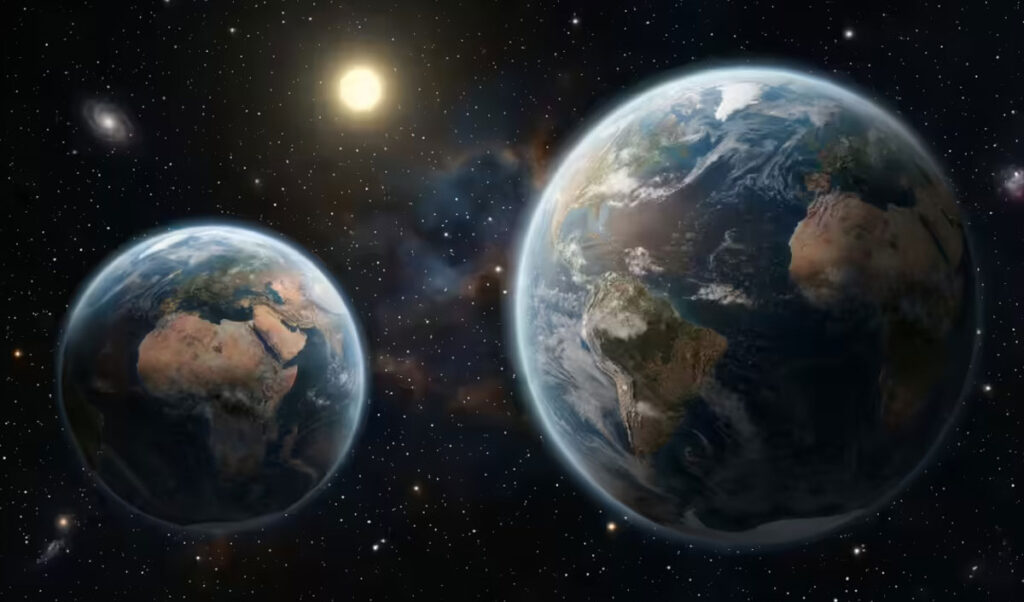
But much more alarming for science was the very “design” of the system: it contradicts the fundamental theories of planet formation, notes Times of India.
Until now, it was believed that planetary systems are formed according to a relatively clear scenario: closer to the star – rocky planets, farther away – gas giants. This order was considered almost a “law of nature”. The new discovery shows that this law may not be universal.
Impossible architecture
The system recorded by astronomers looks like it was “assembled” bypassing all the rules. The planets are not distributed as predicted by models, and the Earth-like worlds themselves are in conditions previously thought unlikely.
In fact, scientists have encountered what is known in the scientific community as an “anomaly”: an observation that does not fit into an existing theory.
As the researchers note, such configurations are either extremely rare or simply have not been recorded before. This means that either we are observing a unique case, or – which is much more serious – our picture of the formation of planets is initially incomplete, states the publication.
Why this could be a scientific “earthquake”
At first glance, the news looks like another cosmic discovery. But in fact, it is a potential trigger for a revision of the entire theoretical framework, scientists believe.
If such systems are indeed possible, it means:
– Planets may form in much more complex scenarios than thought;
– Earth-like worlds may be more widespread than scientists have predicted;
– the search for life in the Universe may accelerate dramatically – and become more complex at the same time.
In fact, we are talking about a situation when reality begins to “break” the theory. And such moments in the history of science have often been the beginning of major breakthroughs.
So today it looks like a curious anomaly. Tomorrow it may turn out to be the first proof that we misunderstand how planetary systems are organized in general.
And if that’s the case, the main conclusion sounds almost frightening:
The universe may be far less predictable than we thought.