
While most people check the time on their smartphones or wristwatches, physicists at Kyoto University are working with devices capable of detecting phenomena beyond ordinary perception. Their latest creation — ytterbium-based atomic clocks — does more than measure seconds: these clocks can register minuscule fluctuations in the universe that were previously undetectable.
The project is led by physicist Taiki Ishiyama. The core of the clock is an unusual orbital transition in ytterbium atoms, linked to the inner electron shells. This mechanism is extremely sensitive to subtle physical effects, but achieving stable and precise measurements has historically been a major challenge.
How the atomic clocks work
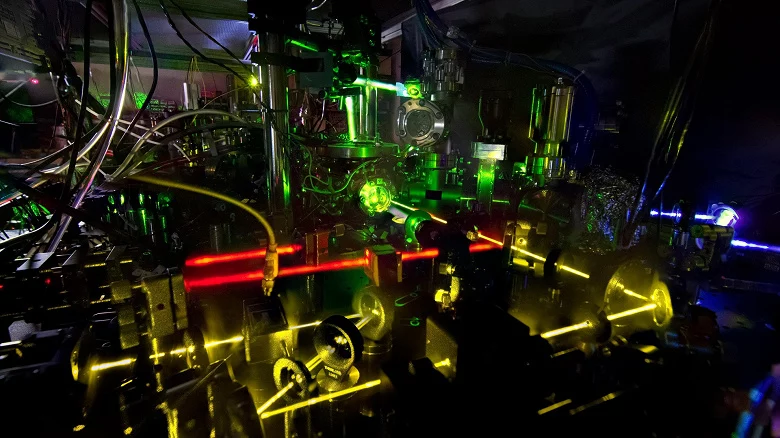
Traditional atomic clocks measure time through electron transitions between energy levels. Modern benchmarks, such as strontium optical clocks maintained by NIST, are so precise that they deviate by less than a second over tens of billions of years. Ytterbium clocks take this precision even further.
In earlier experiments, the lasers holding atoms in place created interference that distorted measurements. To mitigate this, the Kyoto team employed the “magic wavelength” method: at a specific laser frequency, the light barely affects the critical atomic energy levels. The atoms are arranged in a three-dimensional optical lattice and excited with a highly stabilized laser. This approach provides exceptional stability and enables the detection of effects beyond known physics.
Why humanity needs ultra-precise clocks
Why pursue a level of precision exceeding the age of the universe? The answer lies in fundamental research:
detecting potential effects of dark matter on atomic levels;
testing the stability of fundamental physical constants;
discovering new elementary particles and previously unknown interactions.
Beyond theoretical applications, such precision is crucial for practical technologies. Controlling atomic states at this level is essential for developing quantum computers and ultra-precise positioning systems, where milliseconds can determine the outcome of entire experiments.
Don’t miss interesting news
Subscribe to our channels and read announcements of high-tech news, tes