
An experiment on board a parabolic flight showed promising results suggesting that graphene, a thin sheet of carbon atoms, could be used to steer solar sails and adjust the position of satellites in space.
The European Space Agency (ESA) carried out a test of the innovative material in zero gravity to find out how it would perform in outer space. An international team of researchers boarded ESA’s parabolic flight in May 2025, which simulates space travel through short periods of weightlessness. The researchers packed graphene aerogels, a 3D material made of graphene sheets, and then hit them with a continuous beam of laser light during zero-gravity phases.
The three small cubes made of graphene aerogels shot forward immediately, displaying their ability to be propelled by light. “The reaction was fast and furious,” Marco Braibanti, ESA’s project scientist for the experiment, said in a statement. “Before you could even begin to blink, the graphene aerogels experienced large accelerations. It was all over in 30 milliseconds.”
The results, published in Advanced Science, could unlock the potential for propellant-free propulsion for future space missions.
Beam me up
Graphene, a human-made, two-dimensional material, is known for being light, flexible, and super tough, with exceptionally high resistance. The material is extracted from graphite, is made of pure carbon, and has a wide range of applications.
The ESA experiment used graphene aerogels, which combine graphene’s electric conductivity with the structural advantages of aerogel architecture to create an ultralight, highly porous material. Three cubes were placed inside a vacuum chamber on board the flight as researchers fired at them with lasers.
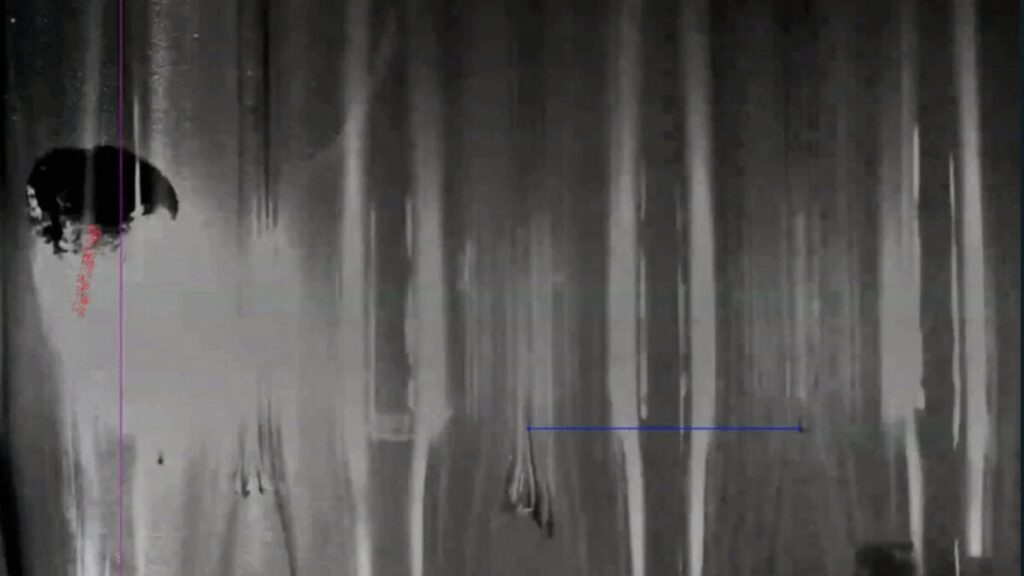
A high-speed camera captured the action through glass tubes as the laser beam propelled the graphene aerogels through the vacuum chamber. Each experimental run lasted 30 milliseconds; the video has been slowed down 10 times.
The experiment also showed that tuning the light beam controlled the propulsion—the stronger the laser, the greater the acceleration. “The laser pulse triggers a sharp acceleration peak, after which the aerogels slow down,” Braibanti explained.
On Earth, however, the aerogels barely move at all. That means that microgravity is the key to unlocking light propulsion for graphene aerogels in terms of velocity, thrust, and distance, according to ESA.
Material of the future
Graphene’s unique properties could potentially revolutionize several industries, including space travel. Solar sails—propellant-free spacecraft that rely on ultra-thin sheets to harness energy from the Sun—could rely on graphene in the future. The material could also be used on small satellites to adjust their attitude in space, while graphene aerogels could convert light into propulsion.
“We are opening the path to a propellant-free propulsion future,” Ugo Lafont, ESA’s materials’ physics and chemistry engineer, said in a statement. “Ultralight graphene aerogels are the perfect example of an innovative material created in the lab that could save us large amounts of fuel and hardware in space.”
The results from the recent experiment are fairly fundamental, but they do highlight the potential of using light to propel graphene aerogels through space as an alternative to regular propellant.