
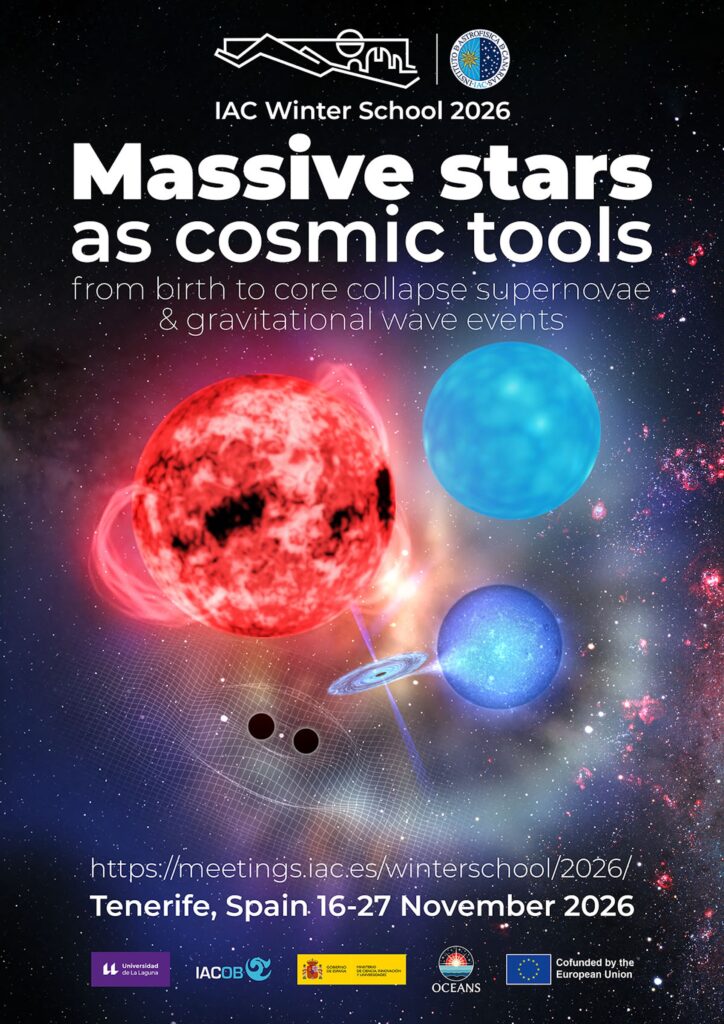
The XXXVII Canary Islands Winter School of Astrophysics, organized by the Instituto de Astrofísica de Canarias (IAC), focuses on Massive stars as cosmic tools: from birth to core collapse supernovae and gravitational wave events.
The school, to be held in San Cristóbal de La Laguna (Tenerife, Spain) from 16 to 27 November 2026, will admit about 75 advanced MSc students, PhD students and early career Postdocs.
In a relaxed environment, the school will give participants the opportunity to learn from world-renowned specialists through several topical lectures and hand-on sessions. In addition, the participants will have the opportunity to present their research in the form of online posters and pitch talks.
Deadline for the applications is 15 June 2026. Selected applicants will receive instructions by email on how to register and proceed with the registration fee payment.
Scientific Rationale
Massive stars are the driving engines of the Universe – in energy, momentum, and baryonic cycling through galaxies across cosmic time. Without them, the present Universe would not exist in its observed form.
Born with more than eight times the mass of our Sun, massive stars are the most powerful nuclear reactors in nature, capable of fusing progressively heavier elements until their final collapse and potential explosion as core-collapse supernovae. Throughout their evolution, they bridge key frontiers of modern astrophysics, linking processes that span from star formation within molecular clouds to the chemical and dynamical evolution of entire galaxies.
Massive stars act as the most active agents in galactic ecosystems
Their intense UV radiation and powerful stellar winds inject vast amounts of energy and momentum into the surrounding interstellar medium. During their lifetimes – from the early stages as hot, luminous blue stars to their more advanced evolutionary phases as red supergiants or Wolf–Rayet stars – they continuously shape their environment through photoionization, mechanical feedback, and chemical enrichment.
When they end their lives as core-collapse supernovae (CCSNe), these stars release the heavy elements synthesized in their interiors, enriching their host galaxies with key ingredients for planetary formation and life itself, such as oxygen, carbon, and phosphorus. These cataclysmic explosions may also trigger new episodes of star formation, while in other cases, they can sterilize planetary systems orbiting nearby solar-type stars through intense radiation and shock waves.
The paramount role of massive stars as cosmic engines began with the very first generation of stars in the early Universe
Simulations suggest that these primordial stars were extremely massive – tens to hundreds of solar masses – and contributed significantly to the reionization of the Universe. Since then, multiple generations of massive stars have populated every star-forming galaxy, becoming essential to our understanding of galactic evolution and a variety of astrophysical phenomena.
Massive stars have also been described as gifts of nature
Their extreme luminosities make them observable as resolved stellar populations in nearby galaxies, even several megaparsecs away, with current observational facilities. As individual objects, they are exquisite probes of present-day chemical abundances in the galaxies they inhabit. Their spectra complement – and often improve upon – the information derived from the analysis of emission-line spectra of associated H II regions, providing an independent, robust approach to measuring metallicities and abundance patterns in star-forming galaxies.
Also, their stellar corpses – neutron stars (NSs) and black holes (BHs) – provide unique laboratories for testing extreme physics. These compact objects allow us to probe the behavior of degenerate matter, strong-field gravity, and relativistic magnetospheres. Some NSs act as precise cosmic clocks in pulsar timing arrays, while the mergers of binary compact objects emit gravitational waves (GWs) detectable by current instrumentation from the ongoing LIGO-Virgo-KAGRA collaboration, opening a completely new window to the Universe. These GW events connect directly to the final evolutionary stages of massive binaries, linking stellar and binary astrophysics to multi-messenger astronomy.
Understanding massive star physics and evolution is of utmost importance for understanding the Universe across cosmic time
Because of their profound influence, accurate prescriptions for the physical properties and evolution of massive stars (both as individual objects and stellar populations) are essential ingredients in models of galactic evolution across cosmic history. Their spectra underpin the interpretation of star-forming regions observed at all redshifts.
Therefore, achieving a comprehensive understanding of the physical processes governing massive-star evolution – under different environmental and metallicity conditions – is of utmost importance. This understanding must incorporate not only the complex physics of single-star evolution, including rotation, stellar winds, and internal transport of chemical elements and angular momentum, but also the equally crucial impact of binary interactions. Observations have revealed that a large fraction – likely the majority – of massive stars are born in binary or higher-order multiple systems, and their interactions through mass transfer, mergers, or common-envelope evolution profoundly shape their subsequent fate.
Developing such a holistic understanding of massive-star physics requires not only theoretical insights but also the ability to gather and interpret high-quality observational data.
This Winter School aims to integrate different state-of-the-art observational, theoretical and computational techniques used in massive star research to aid the new generation of stellar astrophysicist to step forward in our understanding of the important role of massive stars in astrophysics.
For the new generation of stellar astrophysicists, it is crucial to acquire a solid grounding in the observational, analytical, and modeling tools that enable the empirical characterization of massive stars and their environments. Progress in the field depends on the combination of three key pillars:
high-quality observations across multiple wavelengths,sophisticated modeling of their stellar interiors and evolution, as well as their stellar atmospheres and emergent spectra, andadvanced techniques for quantitative spectroscopic analysis (QSA), both for single and binary systems.
Participants will learn how these objects connect stellar, galactic, and cosmological processes, serving as natural laboratories for physics under extreme conditions and as luminous beacons for probing the distant Universe. By combining theoretical lectures with practical sessions focused on data analysis and modeling, the school will train a new generation of researchers capable of using massive stars as powerful tools to decipher the Universe – from their turbulent births to their spectacular deaths as CCSNe and GW sources.
Outline of the school
The XXXVII Canary Islands Winter School of Astrophysics aims to combine a series of lectures on observational aspects of massive stars across different evolutionary stages – including their end products – with complementary sessions on the theoretical and modeling perspectives of stellar atmospheres, stellar winds, and the evolution of both single and binary systems. In addition, the WS will feature tutorials and hands-on sessions, enabling participants to gain practical experience with the most advanced techniques used by the massive-star community.
These sessions will provide postgraduate students with an integrated view of the field – from observations to models – ensuring that participants acquire not only a conceptual understanding of the physics of massive stars but also the practical skills to analyze and interpret real data. By benefitting from the IAC’s strong tradition and international leadership in stellar astrophysics, its proximity to world-class observatories, and its long-standing commitment to training the next generation of astrophysicists, the proposed WS will offer a unique and fertile environment for knowledge exchange. It will bring together experts and students at a moment when the synergy between observations, simulations, and multi-messenger data promises to redefine our understanding of massive stars – from their birth within molecular clouds to their final destinations as SNe and GW sources.
Main topics to be coveredBlock 1: ObservationsOB stars and red supergiants (optical/UV/IR)Binary systems (including black hole binaries)X-ray observations of massive stars and compact objectsGravitational-wave sources and their progenitorsSupernovae and other transient phenomenaBlock 2: Theory and Modelling:Stellar atmopsheresStellar evolution (single and binary)Population synthesisBlock 3: Tutorials and Hands-on SessionsModelling stellar atmospheres and stellar windsStellar structure and evolution modelingPopulation synthesis for single and binary starsQuantitative spectroscopic analysis of single and binary systemsPhotometric detection of black hole systems and massive binaries
The Winter School will take place in San Cristóbal de La Laguna (Tenerife, Canary Islands, Spain) from Monday, 16 November to Friday, 27 November 2026. The lectures (in English) will take place during the working days and will all be 45-mins long + 15-mins of discussion. The majority of them will take place during the morning. There will also be a series of tutorials, mostly concentrated after lunch. Links to the material used by the lecturers, as well as videos of the lectures, will be made available on the website of the school. Visits to the Teide Observatory in Tenerife will be scheduled as part of the activities on Wednesday, 18 November. A visit to the Roque de los Muchachos Observatory in La Palma will be offered optionally on Saturday, 21 November.
Those interested in attending the school should apply following the instructions provided in the application page by Monday, 15 June 2026. Selected candidates will be informed by late June / early July 2026.
Lectures and tutorialsBlock 1: ObservationsAn optical/UV/IR observational view of massive stars across cosmic time – Miriam García (Centro de Astrobiología, Madrid, Spain)Stellar mass black holes: an observational perspective – Jorge Casares (IAC, Tenerife, Spain)An X-ray vision of massive stars – Montserrat Armas Padilla (IAC, Tenerife, Spain)Observation and interpretation of gravitational wave events – Nadia Blagorodnova (ICCUB, Barcelona, Spain)An observational perspective of CCSNe and other type of transients connected with the end products of massive star evolution – Takashi Moriya (NAO, Japan)Block 2: Theory and modellingStellar atmosphere modelling of massive stars – Andreas Sander (ZAH-ARI, Heidelberg, Germany)Characterization of massive binary systems (including OB+BH/NS systems) – Michael Abdul-Masih (IAC, Tenerife, Spain)Physics of Massive star structure and evolution – Omar Benvenuto (Universidad de La Plata, Argentina)Evolution of massive stars in binary systems – Alejandra De Vito (Universidad de La Plata, Argentina)Population synthesis of massive stars and connection to GW events – Giuliano Iorio (ICCUB, Barcelona, Spain)Block 3: Tutorials and hands-on sessionsTutorial on the use of the stellar atmosphere codes – Andreas Sander (ZAH-ARI, Heidelberg, Germany)Tutorial on the computational modelling of single and binary star evolution – Pablo Marchant (Ghent University, Belgium)Tutorial on quantitative spectroscopy of massive single stars – Sergio Simón Díaz & Dr. Sara R. Berlanas (IAC, Tenerife, Spain)Tutorial on quantitative spectroscopy of massive binary stars – Michael Abdul-Masih (IAC, Tenerife, Spain)Tutorial on the use of population synthesis tool SEVN – Maite Echeveste (Osservatorio de Arcetri, Florencia)Tutorial on tools for analysis photometric variability – Gastón Escobar (IAC, Tenerife, Spain)School venue
The venue will take place at the IACTEC building, the headquarters of the technological and business collaboration space set up by the Instituto de Astrofísica de Canarias (IAC).
The lecture hall is located at a distance of about 3 km from the city centre of San Cristóbal de La Laguna (usually just called ‘La Laguna’) and is about a 1 km from the headquarters of the IAC. The venue is 5 km away from the island’s capital, Santa Cruz de Tenerife.
Organizing Committee