
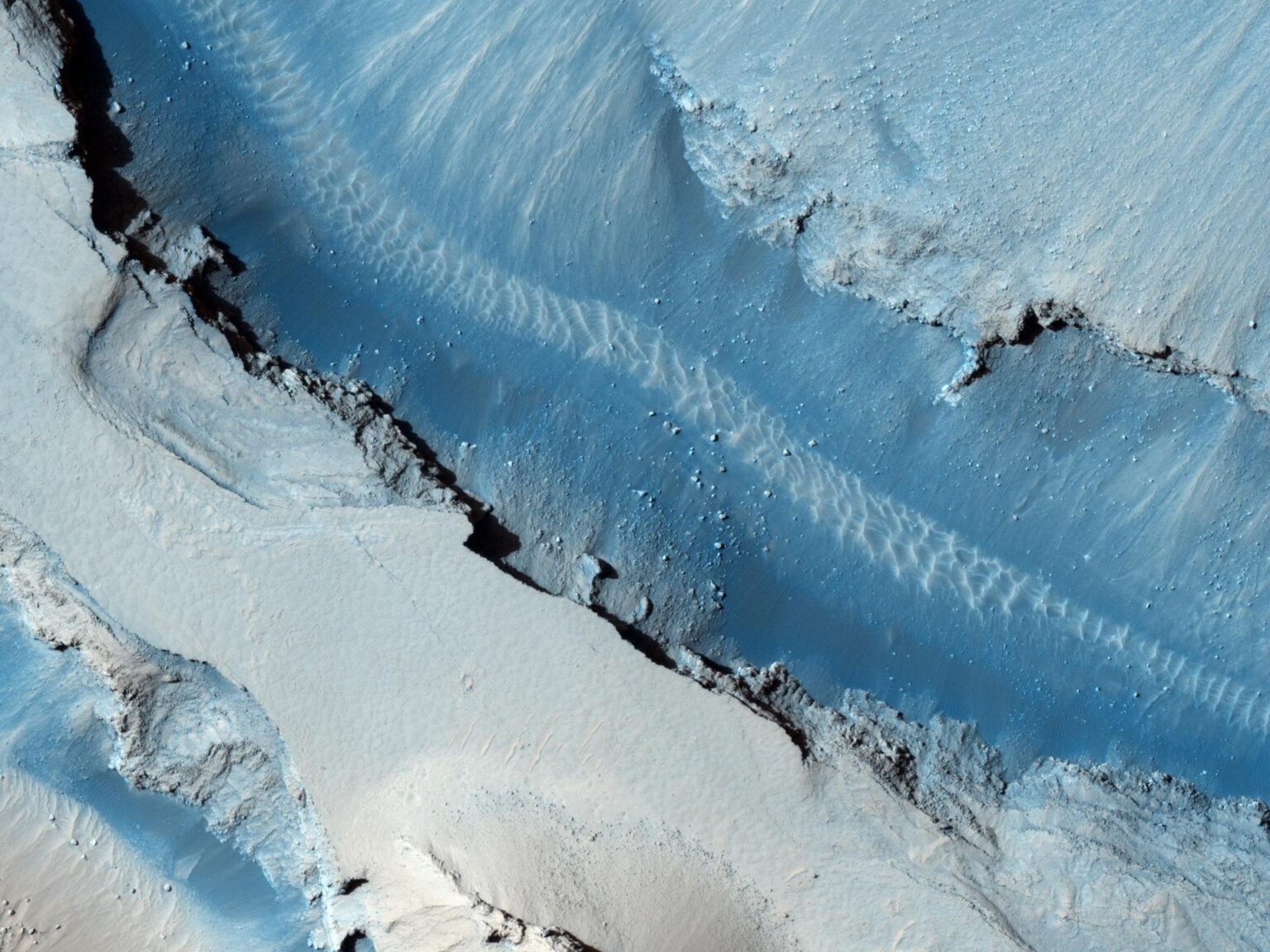
We’ve spent decades scratching the surface of Mars trying to uncover life there. But we’ve been searching a barren wasteland bombarded by radiation and bathed in toxic perchlorates. The entire time, it’s likely that it’s been too hostile to harbor extant life. So if we want a better shot at finding currently living life on Mars, we need to go underground. That is exactly the purpose of Orpheus, a proposed Mars vertical takeoff and landing (VTOL) hopper mission put forth by Connor Bunn and Pascal Lee of the SETI Institute at the 57th Lunar and Planetary Science Conference (LPSC).
In what might be the best naming reference for a space mission ever, Orpheus is named after the Greek hero who tamed the three-headed hound Cerberus to gain access to the Underworld. The actual mission aims to explore the deep volcanic fissures, pits, and cave vents of a region of Mars known as Cerberus Fossae. While there, it plans to unlock some of Mars’ origin story, as well as search for biosignatures that indicate the presence of extant life.
Finding something on another planet that is still alive is the single highest priority of the field of astrobiology. It’s the only way we can perform the protein and genetic analyses needed to prove that the life we found didn’t just hitch a ride from Earth on a meteorite billions of years ago. But so far, we’ve come up with nothing.
Fraser talks about different Mars Helicopter-like missions.
Cerberus Fossae, however, is a good place to look for it. It’s part of Elysium Planitia, and boasts some of the youngest known volcanoes and lava flows on the entire Red Planet. Young volcanoes are thought of as potential astrobiological gold mines – they hold better-preserved erupted materials, and, crucially, fresher biosignatures. Not to mention that life on Earth itself might very well have started next to volcanic fissures in the deep ocean.
Cerberus Fossae is also home to the Cerberus Fossae Mantling Unit (CFmu), a massive pyroclastic deposit that represents the most active eruptive volcanic activity ever identified on Mars. Most likely the eruption that caused it happened between 46,000 and 222,000 years ago – a blink of an eye in geological time.
But the terrain in this area is challenging to say the least. You can’t simply send a wheeled rover into a sheer volcanic pit. But a quadcopter would do just fine. Ingenuity, Perseverance’s flying companion that marked the milestone of the first powered flight on another planet, proved the idea of a VTOL system would work on Mars. Orpheus was conceived to follow in its footsteps, and into terrain that is too forbidding for traditional wheeled rovers.
Taking to the air on Mars is becoming more commonplace as a mission architecture – as Fraser explains.
Its flight path would begin at the CFmu and head southeast across the Zunil crater – a relatively young crater that might have been the cause of the eruption that created the CFmu. It will then traverse the “Cerberus Archipelago” – a linear chain of pits and mounds, to end up at a small, dome-shaped volcano called Cerberus Tholus 1 (CT1).
Near the summit of CT1 there are a series of five distinct pits and caves, which scientists believe to be volcanic vents. While lava tube skylights (i.e. collapsed ceilings of empty underground lava rivers) are popular targets for future exploration (and potential habitation), volcanic vents are arguably better targets for astrobiology. Unlike lava tubes, vents feature sustained heat and circulation that releases volatiles like water vapor and other gases as long as the volcano is active. In other words, they are the most likely spots for internal planetary heat to meet water – just like the vents in Earth’s ocean floor that might have given rise to the first life here.
Orpheus’ team is particularly interested in “Vent #5”, which is about 200 meters across and 50 meters deep. Most notably, it features a diffuse dark streak stretching 400 meters uphill from its rim. Researchers think this streak could be fresh, dark volcanic material that was put there by a recent eruption. Or it could be fresh subsurface material excavated by the wind. Either way, it’s most likely the site of the most recent activity on CT1, and therefore holds the most promise of finding something protected from the surface up until recently.
Fraser discusses another Mars helicopter mission concept
The hopper itself is designed to carry a specialized payload tailored to both astrobiological investigations and geological discovery. Its scientific instruments will include an omnidirection color camera, a near-infrared spectrometer, ground penetrating radar to find subterranean voids, and a dedicated biosignature detector, though the details on what precisely that will look like are still fuzzy.
That payload, along with the mobility package to get it there, might represent our best chance to find extant life on Mars in the near future. But, for now at least, there’s no plans to actually adopt or fund this mission. And given the recent challenges of the Mars Sample Return mission, it might be awhile before NASA picks another astrobiological mission to the Red Planet. But maybe another space agency will – and these early planning documents are exactly the type of preliminary ideas that could serve as the basis for a civilization-altering discovery.
Learn More:
C. Bunn & P. Lee – ORPHEUS: A HOPPER MISSION TO EXPLORE VOLCANIC PITS/CAVES IN CERBERUS FOSSAE, A REGION OF ONGOING SEISMIC ACTIVITY AND MOST RECENT VOLCANIC ERUPTION ON MARS
UT – Has NASA Detected Convincing Evidence Of Ancient Life On Mars?
UT – How Likely Is Life on Mars?
UT – Microbes Or Their DNA Could Survive In Martian Ice And A Future Rover Could Dig For It