
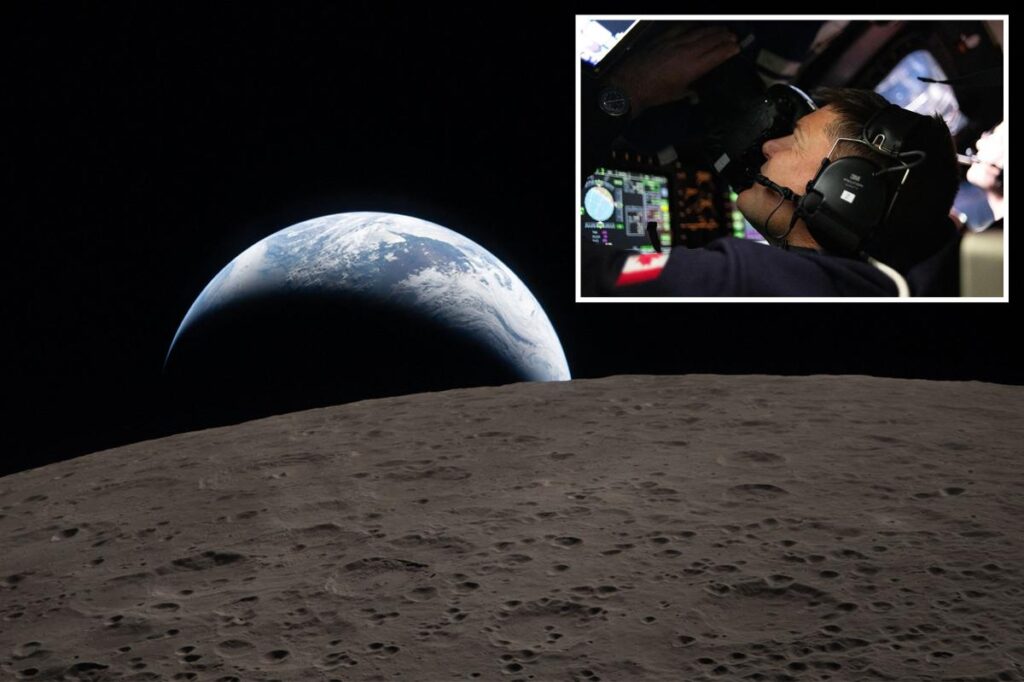
Most of the out-of-this-world photos being beamed home from Artemis II were taken with an old-model Nikon camera that can be bought for about $1,000.
NASA traded in the legendary Hasselblad model it used on Apollo missions years ago for the Nikon D5 DSLR — a classic digital single-lens-reflex camera first released in 2016.
The Nikon was carefully selected for its proven track record as a workhorse space camera, as well as its extraordinary ability to pick up detail even in extreme darkness, Nikon’s top NASA consultant told The Post on Tuesday.
This shot of Earth over the moon’s surface was taken with a 10-year-old Nikon DSLR, worth about $1,000 used. NASA/AFP via Getty Images
“It’s been tested for years,” said Mike Corrado, the senior manager of Nikon Pro Services who has spent more than four decades training NASA astronauts how to become photographers for missions.
“It’s proven technology.”
He said the Nikon D5 has been used successfully in space since 2017 — and “is still producing amazing images for them.”
One of the camera’s top-selling points for Artemis II was its incredible low-light capabilities, Corrado said.
Artemis II astronaut Christina Koch works with a Nikon digital camera, one of several that were brought onboard. NASA/James Blair
The camera is able to shoot at an ISO — or light-sensitivity rating — of up to 3.2 million.
By comparison, the light sensitivity of the film run through previous Apollo missions’ Hasselblad cameras was no higher than 160 ISO.
That means the Artemis II’s astronauts who wielded the camera were able to extract as much information from the shadows of the lunar surface as almost any modern camera allows.
The mission’s stunning first photos shot from the dark side of the moon showed a blue-and-white Earth peeking out from above the lunar body’s grayish-brown cratered face.
Other snapshots included a beautiful solar eclipse and selfies of the crew with their special cardboard and plastic eclipse glasses on watching it.
This shot of moon was taken with a Nikon Z9, the camera which is expected to be taken to the lunar surface in 2028. AP
Artemis II’s crew saw clear swaths of the far side of the moon for the first time and took stunning photos. via REUTERS
The Nikon D5 also has a proven record of being resistant to the high levels of radiation constantly flying through space, which can destroy the electronics and sensors needed to make a digital camera work and which Artemis II was particularly susceptible to in the deeps of space.
NASA rigorously tests out its cameras to make sure they can handle such demands — a process which can take years to pass.
The D5 had those tests well under its belt after its time on the International Space Station.
All of that made the old D5s the obvious choice for Artemis II.
The astronauts brought 17 handheld cameras to the moon with them on Artemis II’s 10-day space journey. Nasa/UPI/Shutterstock
“Certification happens on all different levels, like the battery has to be tested — I mean, it could take four years for the battery to be approved.” Corrado said.
“They want to check and balance everything and anything that could be a possible problem. And they they’re very, very diligent about that.”
The D5 is a long walk from the days of Apollo, when some of history’s most iconic photos were taken on medium-format Hasselblad cameras equipped with huge magazines of film.
All that film took up valuable space and weight on the spacecraft, while Artemis II is able to store just as many and more photos on memory cars about the size of a postage stamp.
Nikon began supplying digital cameras for NASA around 2000 and has been sending cameras to space since 1971, when 35mm Nikon Fs joined the Hasselblads as part of the crew’s standard photography kit.
Apollo 12 astronaut Alan Bean had a Hasselblad film camera strapped to his chest on the lunar surface in 1969. Getty Images
The Apollo missions relied on specially designed Hasselblad cameras loaded with massive magazines of film. AFP via Getty Images
But more changes are afoot.
Nikon’s most advanced camera — the Z9 — is expected to be onboard Artemis IV when its astronauts make their predicted 2028 moon landing.
One was brought onboard Artemis II to undergo its deep space certification, Corrado said.
“Reid [Wiseman] is up there testing and evaluating as we speak,’’ Corrado said of the current mission’s commander.
“A lot of what’s going to happen is the camera will come back, and we’ll evaluate what the results were,” he said. “So far, what we’re seeing are phenomenal.
“After this mission, it should be Z9. They won’t go back to the D5 after this,” he said. “Once they fully test and continue to test, the Z9 will be the camera going to the moon.”
Artemis II brought a total 32 cameras onboard for their 10-day mission.
Fifteen were mounted on the spacecraft, and 17 were handheld cameras the crew operated while peering out the cabin windows during their historic flyby of the lunar far side.
They’ve even been taking photos with their iPhones, and have logged thousands of photo files which they’ve been able to beam back to Earth almost instantly.