
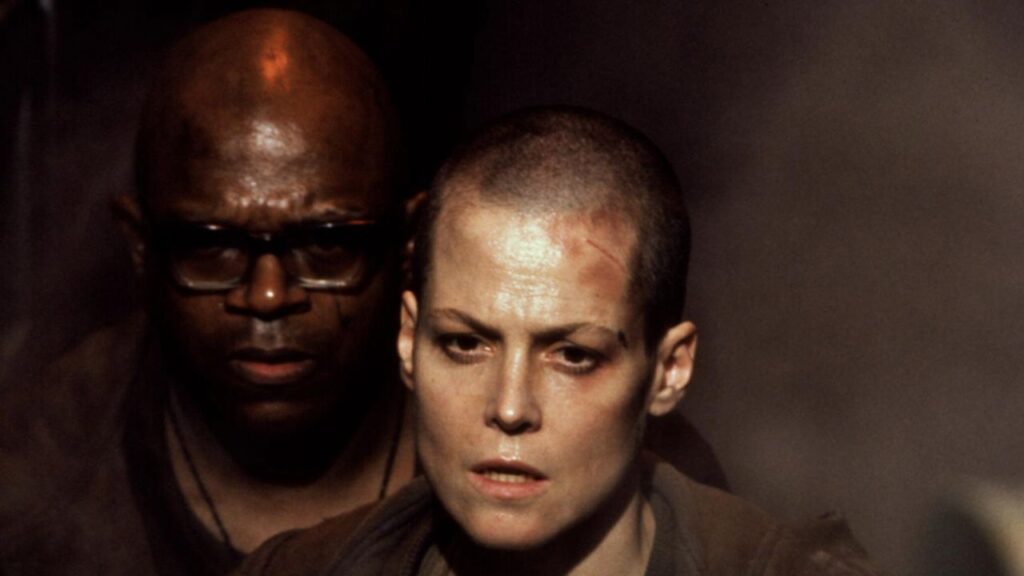
The story is mostly the same: Ripley (Sigourney Weaver), having survived the harrowing events of Aliens alongside a makeshift family unit of man, child, and droid, crash lands on Fiorina 161, nicknamed “Fury” (did this movie inspire Vin Diesel’s timeless character Richard B. Riddick?!) – a male-only prison planet housing assorted murders and rapists. Hitching a ride with Ripley: a facehugger alien that quickly implants within a handy mammal (a dog in the original version; an ox in the assembly cut), bursts forth, and wreaks havoc upon the already-slim population. Ripley and the prisoners must band together to stop it.
The extra running time is largely given over to characterization of the prisoner characters, further delaying the full emergence of the xenomorph, which aligns the movie a little closer with the 1979 original. In the theatrical cut, the prisoners are difficult to tell apart, further exacerbated by one character who disappears from a gutted third act. Frankly, there are still too many vaguely-written bald British white dudes in the assembly cut, without the instant tang of James Cameron’s tough-cornball dialogue to immerse us in their relationships and personalities the way Aliens did. Or maybe it’s just that familiar faces like Pete Postlethwaite and especially Charles S. Dutton dominate the rest of the new cast in a way that renders the group a little lopsided.
Dutton is one of the characters who does benefit from extra screen time in the assembly cut. He plays Dillon, a reluctant leader of the group, more comfortable leading the men in prayer for their apocalyptic fundamentalist religion than charging into battle. Like all Charles S. Dutton performances, especially from his 1990s prime, it makes you wonder why the hell more movies don’t bring him in as a clutch player: He is simply a fantastic presence, blessed with a voice of great authority and a steely stare, even from behind a pair of spectacles that he wears through much of this movie. Dillon manages to convey religious fervor and practical-minded rationality, fused together by a righteous anger. He deserves to be as beloved by the Alien fandom as any non-Ripley character in the series, and the assembly cut adds some additional grace notes to Dutton’s performance. It also adds back an entire plot turn with Golic (Paul McGann), an especially disturbed prisoner who becomes obsessed with the creature, and functions in the longer version as an irrational flipside to Dutton’s makeshift preacher. His freeing of the trapped xenomorph and subsequent death is eliminated from the shorter cut.
Story-wise, those moments don’t add much. But Dillon’s apocalyptic preachings yoked together with Golic’s doom-courting delusions accentuate the film’s Fincher-y sensibility. This is a dark, dank, forbidding movie, with lots of browns, sweaty oranges, blacks, steam and smoke, wet tunnels, and dripping gunk. It looks like it’s taking place in the bowels of your plumbing. (I wonder if it eats away at Fincher that his successor, Jean Pierre-Jeunet, made the greenest Alien movie with his fourth installment.) The film is sometimes more evocative than exciting, a quality emphasized by the menacing grandeur of Elliot Goldenthal’s score, which is most memorable at the beginning and the end, rather than during the sometimes-confusing chase sequences.