
The study of black hole growth is crucial for understanding the evolution of galaxies and the formation of stars.
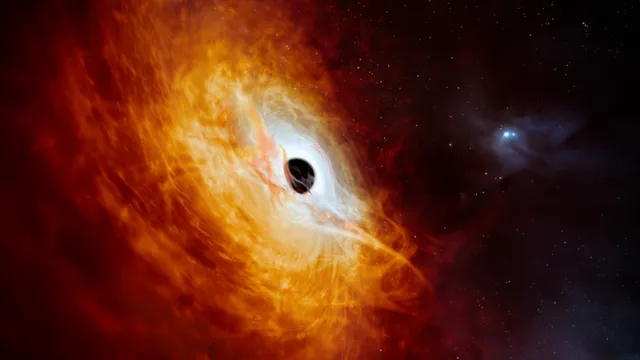
The growth of the largest black holes in the Universe began to slow down as early as around 10 billion years ago, and the reason for this may finally have been clarified—they are simply starting to run out of gas.
For years, astronomers have sought to understand why the growth of the most massive black holes declines significantly after a period of rapid development. Data cited by Live Science suggest that the key to this mystery lies in the decreasing amount of available matter for accretion.
Supermassive black holes possess extremely strong gravitational forces, which allowed them, in the first billions of years after the Big Bang, to reach masses millions and even billions of times greater than that of the Sun. After the so-called “cosmic noon”—a period when the Universe was less than a quarter of its current age—their growth gradually began to slow.
The scientific community has long investigated whether an external force might be limiting this process. A new study published in The Astrophysical Journal offers a more compelling explanation. “It turns out that each black hole is accreting significantly less matter,” explains astronomer Fan Zou of the University of Michigan.
The study of black hole growth is crucial for understanding the evolution of galaxies and the formation of stars.
Supermassive black holes and their host galaxies evolve in tandem, with their size closely linked to stellar mass and the dynamics of galactic central regions.
The analysis is based on data from nine extragalactic surveys, including both wide-field observations of nearby regions of the sky and highly detailed observations of smaller areas. Leading X-ray space telescopes were used, including NASA’s Chandra, the European Space Agency’s XMM-Newton, and the German-Russian eROSITA.
Scientists examined 1.3 million galaxies and approximately 8,000 actively growing supermassive black holes. The results show that the slowdown in their growth is due to the decreasing availability of cold gas, a trend that began as early as the period of “cosmic noon.”
The study further indicates that the number of supermassive black holes is unlikely to increase significantly. “We do not expect the emergence or substantial growth of many new supermassive black holes in the future. As early as 2024, we found that their number had largely stabilized around 7 billion years ago and is likely to remain so,” Fan Zou noted. | BGNES