
Reading time: 2 minutes The NASA competition challenges university teams to develop innovative technologies for future lunar and space missions. (Graphic credit: NASA)
Among the finalists in a national NASA competition focused on advancing technologies for future space exploration is a student-led engineering team from the University of Hawaiʻi at Mānoa and UH Hilo.
Team RoSE (Robotic Space Exploration) is one of 14 university teams selected for the 2026 Revolutionary Aerospace Systems Concepts–Academic Linkage (RASC-AL) Competition. The challenge invites students to develop innovative concepts supporting sustained human activity on the Moon, Mars and beyond.
Powering lunar operations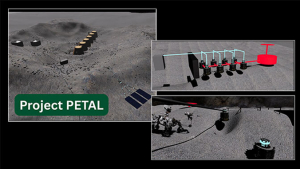 Project PETAL aims to design a scalable power system combining nuclear and lunar-soil energy storage to support long-term Moon missions.
The team’s proposal, Project PETAL (Power Energy Transfer Architecture for the Lunar), centers on building a scalable power management and distribution system for lunar operations. The concept integrates multiple energy sources and storage methods, including nuclear power and energy stored using lunar soil, to support long-term missions and lays the groundwork for future applications on Mars.
As a finalist, Project PETAL received a $7,000 award to support participation in the RASC-AL Forum, scheduled for June 1–4, in Cocoa Beach, Florida. During the forum, students will present their work to NASA engineers and industry professionals while refining their concepts through technical feedback. The top-performing teams will be recognized for technical merit, innovation and presentation excellence.
“Being part of this project has shown us what it takes to develop a concept that could be considered for future lunar and Mars missions,” said Nathan Chong, project manager of Project PETAL and UH Mānoa computer engineering freshman. “It’s been incredibly rewarding to collaborate across campuses and push ourselves to think at a much higher level.”
The project also aligns with broader UH efforts supporting NASA’s Artemis missions, including a lunar rover instrument being developed at UH Mānoa that is slated to fly as part of the Artemis 5 mission. The work creates opportunities to connect student-led projects such as PETAL with real-world systems headed to the Moon.
Space science and engineering initiative
Project PETAL members are primarily from engineering and related STEM disciplines at UH Mānoa and UH Hilo. The interdisciplinary effort emphasizes hands-on design, systems integration and real-world problem-solving. Faculty advisors supporting the project include Matthew Siegler and Marvin Young from UH Mānoa, and Branden Allen from UH Hilo.
Project PETAL is part of UH’s Space Science and Engineering Initiative, which aims to expand space technology development and hands-on student training. Launched in 2024, the initiative provides students with opportunities to work on advanced space systems while building Hawaiʻi’s capacity in aerospace engineering and instrumentation. It is a collaboration among UH Mānoa’s College of Engineering, the Institute for Astronomy and UH Hilo.
Team RoSE is one of more than 20 Vertically Integrated Projects at UH Mānoa, which seek to foster long-term, in-depth, project-based learning to engage students and better prepare them for future careers.
More about Project PETAL