
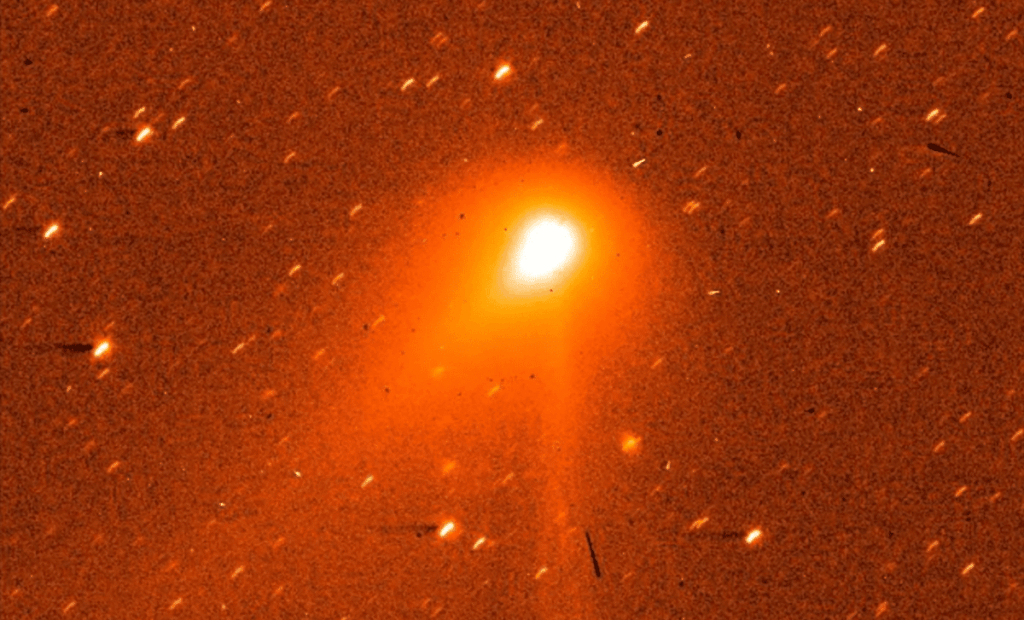
The European Space Agency’s JUICE spacecraft, en route to explore Jupiter’s icy moons, made an unexpected scientific breakthrough by studying the comet 3I/ATLAS. This rare comet, which journeyed from another star system, provided an invaluable opportunity for scientists to study material possibly older than our solar system. The unprecedented data gathered from this cosmic encounter is already revolutionizing our understanding of interstellar objects, with ongoing analysis revealing remarkable insights into the comet’s behavior and composition.
JUICE’s Unlikely Encounter with Comet 3I/ATLAS
In late 2025, a comet named 3I/ATLAS, hailing from beyond our solar system, passed through the inner reaches of the solar system. It was an event that took scientists by surprise. At the same time, the ESA’s JUpiter ICy moons Explorer (JUICE) spacecraft, which had been traveling toward Jupiter for years, was in the perfect position to capture the comet’s behavior during its approach to the Sun.
Initially, JUICE was not designed to study comets. Its mission, launched in 2022, was intended to investigate Jupiter’s moons, particularly Europa, Ganymede, and Callisto. Yet, in an unexpected twist of cosmic fate, JUICE found itself with a rare opportunity. The comet’s path aligned perfectly with the spacecraft’s trajectory, allowing scientists to reorient JUICE’s instruments and begin observations.
“3I/ATLAS is a rare and unexpected visitor, its arrival came as a complete surprise,” said Olivier Witasse, ESA Juice Project Scientist. The comet’s passage through the solar system provided a chance to study an object that had traveled billions of miles across interstellar space. This wasn’t just any comet; this was a fragment of another star system, offering clues about the materials and conditions that shaped a distant part of the universe.
 JANUS sees Comet 3I/ATLAS in different colours.
Credit: ESA
Unprecedented Data on Water Vapor and Tail Formation
One of the most striking findings from JUICE’s instruments was the detection of a powerful water vapor signal. As 3I/ATLAS approached the Sun, its icy surface began to heat up, causing gas and water vapor to escape into space. JUICE recorded an astounding 4,400 pounds (2,000 kilograms) of water vapor being released every second, equivalent to 70 Olympic-sized swimming pools each day.
This rate of release was significant, but not entirely unusual for a comet. Some comets expel less vapor, while others release far more. What stood out, however, was the steady nature of the outflow. Even days after the comet’s closest approach to the Sun, the water vapor flow remained remarkably consistent.
Furthermore, scientists discovered that the water didn’t escape evenly from the comet’s surface. The vapor streamed mostly from the side facing the Sun, indicating how heat directly affects the comet’s activity. But even more fascinating was the realization that much of the water vapor may not have come directly from the solid core. It likely originated from tiny icy dust grains surrounding the comet, which were also releasing gas as they heated up.
These findings provide a deeper understanding of how comets behave as they interact with the Sun’s heat, and the data is a critical piece in the puzzle of how these ancient objects evolve over time.
The Long Tail and Chemical Clues
Another remarkable observation was the comet’s tail. As 3I/ATLAS moved through the solar system, it left behind a trail of gas, dust, and atoms, stretching an impressive 3.1 million miles (5 million kilometers) from its core. This extensive tail is typical of active comets, but its sheer size still impressed researchers. The tail was composed of a mixture of hydrogen, oxygen, and carbon, elements crucial to understanding the comet’s origins.
The tail’s formation is caused by the combined forces of sunlight and solar wind. These forces push the gas and dust away from the comet, creating the glowing trail we associate with comets. The extent of the tail also provided scientists with important insights into the chemical composition of the comet, which is believed to hold clues about the early solar system and even the conditions of the interstellar space it came from.
Surprisingly, despite its interstellar origin, comet 3I/ATLAS behaved in ways that were strikingly familiar to researchers. High-resolution images revealed a classic comet structure: a bright, cloud-like atmosphere surrounding the hidden core, and two distinct tails. “Observing the comet was challenging, with no guarantee of success, but in the end, it turned into a great bonus for Juice during its journey to Jupiter,” said Witasse.
A Unique Opportunity for Science and Planetary Defense
One of the most valuable aspects of this study was the unexpected role of JUICE’s camera. Originally designed to help the spacecraft navigate Jupiter’s moons, this camera also provided a rare and valuable view of 3I/ATLAS from 37 million miles (60 million kilometers) away. By combining this perspective with data from Earth-based telescopes, scientists were able to map the comet’s trajectory with remarkable precision.
This tracking not only contributes to the scientific study of comets, but it also plays a key role in planetary defense. Understanding how comets move and how gas and dust jets can alter their trajectory helps scientists better predict the paths of potentially hazardous objects. This study serves as a reminder of how the unexpected can often lead to the most groundbreaking discoveries.