
No audio available for this content.
With the first manned Artemis mission to the Moon underway, the European Space Agency reminds us it has already accomplished testing of a GNSS receiver for Moon missions.
News from the European Space Agency
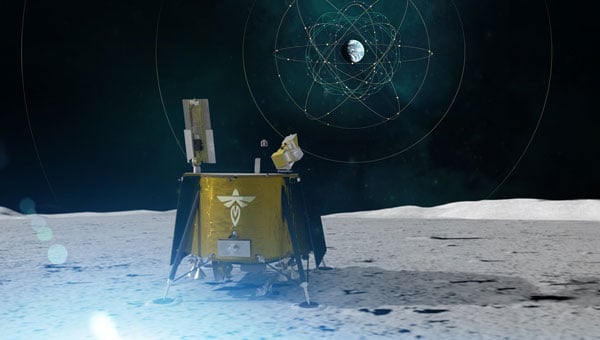
In 2025, history was made as a navigation receiver on the Moon determined its position in real time using signals from approximately 410,000 km away. The receiver, called the Lunar GNSS Receiver Experiment (LuGRE), acquired signals from four navigation satellites orbiting Earth: two Galileo satellites and two GPS satellites.
The mission also tested Galileo’s Emergency Warning Satellite Service (EWSS) on the Moon, demonstrating the robustness and reach of the planned service.
With an increasing number of lunar missions planned by space agencies and private companies in the coming decades, accurate lunar navigation will be a key component of sustainable lunar exploration and the development of a lunar economy.
LuGRE, the joint Italian Space Agency (ASI) and NASA mission, showed that existing terrestrial satellite navigation systems can be used for positioning, navigation and timing on the Moon. Transported to the Moon by Firefly’s Blue Ghost, LuGRE was the first navigation receiver to operate beyond low Earth orbit.
After arriving at the Moon on March 2, 2025, LuGRE maintained connections with Galileo and GPS satellites, in double frequency, for a lunar day (14 Earth days) before powering down. The success of LuGRE laid a foundation for future navigation systems on the Moon by demonstrating the feasibility of using navigation satellites orbiting Earth to determine positions on the Moon.
Emergency warning on the Moon
In early March 2025, Qascom, the company that developed LuGRE for ASI, proposed an additional joint demonstration to test the Galileo EWSS on the Moon during the LuGRE mission. This demonstration involved ESA, the European Commission (EC), the European Union Agency for the Space Program (EUSPA) and the Centre National d’Etudes Spatiales SAR Galileo Data Service Provider (CNES/SGDSP).
With less than two weeks from proposal to execution, the partners swiftly coordinated their efforts to make the demonstration possible.
On March 13, 2025, a simulated emergency warning message alerting astronauts to seek shelter due to high radiation exposure was disseminated via select Galileo satellites and received by LuGRE’s receiver on the Moon as part of the data collected and downloaded to Earth.
LuGRE was the idea candidate for this off-world test because it was designed to receive navigation signals. The emergency warning message of the EWSS is sent via the same signal frequency as satellite navigation signals, so LuGRE was also able to pick up and process the EWSS test signal.
The success of this demonstration on the Moon showcases the robustness and reach of the Galileo EWSS, which will enter service later this year. It also highlights the collaboration between European institutional and industrial partners, a strong example of cross-agency collaboration enabling innovation in global navigation services.
Stepping towards lunar navigation
With lunar exploration expected to increase in the coming years, ESA’s Moonlight program is developing navigation and telecommunications services for use on the Moon. By providing a unified lunar navigation and communication system, Moonlight will allow missions to focus on core activities, facilitating a long-term presence on the Moon and exploration of the Moon and beyond. Due to its compatibility with other planned lunar navigation systems, Moonlight will increase the future lunar service provision for many institutional and private users.
Newly approved at ESA’s Ministerial Council in 2025, NovaMoon will develop the first station on the Moon for high accuracy navigation. It will enhance the navigation services of Moonlight by providing an advanced geodetic and timing station on the Moon.