
 Since time immemorial, the sea has been a realm of intrigue, and many of the species within possess skills that border on the supernatural. One such species is a fish that employs a unique method of predation that has been likened to the movements of an unidentified flying object due to its stealth, sophistication, and near-imperceptible nature. Instead of speed and sheer strength, this animal employs a clever form of camouflage to sneak up on its quarry. Researchers have finally been able to uncover the mechanism behind this animal’s ability to become invisible, shedding light on the mysterious world of marine predators.
UFO-like camouflage: How fish become invisible
Hiding becomes difficult for open-water fish because there is nothing to camouflage against. However, these creatures have come up with ingenious ways of disappearing from view. Some fish play with light and reflect or bend it to create the illusion of blending into the background. According to the research “Ultra-black Camouflage in Deep-Sea Fishes,” there are some types of fish which change the reflection of light on their skins so they could “blend into the water itself.”The deep-sea fish have ultrablack skin, which can absorb more than 99% of light falling on their body, making them look like holes within the body of water. It helps in reducing visibility, therefore making the fish invisible until they are within striking range.Translucency is yet another strategy employed by fish living in the open waters. They become transparent such that light passes through their body, making them invisible within the water.
Ghost hunting: The “shadowing” technique explained
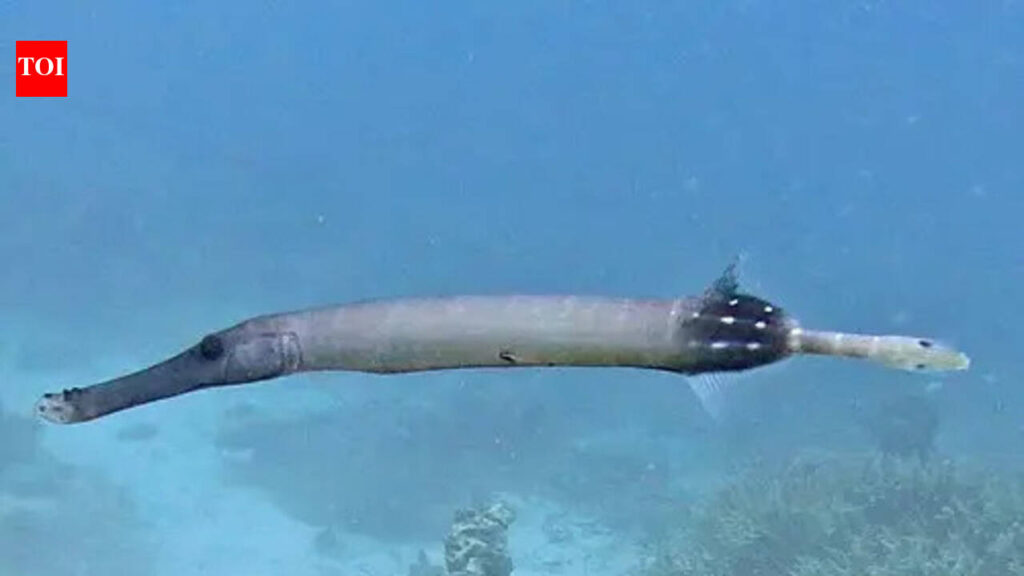
One of the most fascinating findings involves the predatory capabilities of the trumpetfish, an elongated marine predator. This fish not only relies on camouflaging itself but actually utilises other species for cover. Researchers refer to the practice as “shadowing,” wherein the predator follows a harmless species in order to stalk its victim.As researcher James Herbert-Read says, “Shadowing behaviour of the trumpetfish seems like an advantageous method to increase its hunting efficiency.” By relying on the nonthreatening species, the predator can lessen the chances of scaring away the prey.Field experiments done to test the effectiveness of ‘Predatory trumpetfish behavioural patterns’ have proven that this tactic works in reducing detection from prey, thus making the predator a “ghost hunter.” No other examples have been found before of a creature that employs another living thing as its camouflage.
Science behind the illusion: Research and evolution
Camouflage in the ocean goes beyond aesthetics because it is based on physics, biology, and behaviour. According to one study previously mentioned, a reduction in reflectance can make fish much harder to see in a bioluminescent world.Moreover, certain species of fish can use polarisation, making their camouflage up to 80% better than mirror-like camouflage. This research shows how nature has optimised camouflage for a highly effective scientific tool.In a world where the key to survival lies in observing while not being observed, these adaptations are incredibly important. Whether it is using light, being transparent, or simply using the shadows as cover, the fish are experts in disguise.The end product of these innovations is a fish that swims like a ghost, looking like a UFO, and hunting like a phantom.