
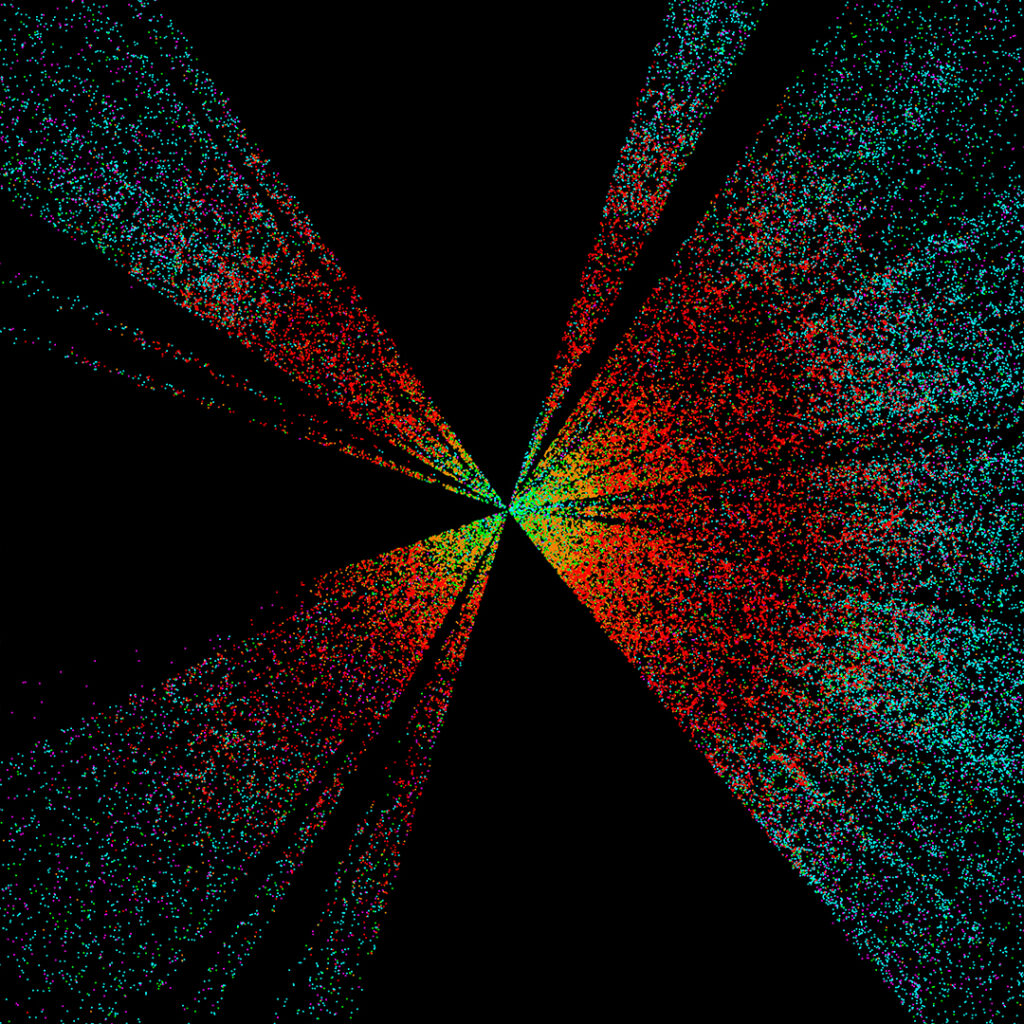
A key insight from spacetime is that when you are moving, you experience time and space differently from someone who is stationary and observing you. For example, if you were to observe someone traveling at a speed close to that of light, and you could somehow peer at their wristwatch, it would appear to be ticking slower than usual. If they were moving fast enough, their time would appear almost frozen from your perspective. This apparent slowing of time, known as time dilation, works from the opposite direction as well. For the person speeding past, you would appear to be moving in fast-forward.
Additionally, the person you are watching would appear squashed flat like a pancake, but only in the direction of their travel. Bizarrely, they would be completely unharmed and look normal if viewed head-on. This effect is known as length contraction.
Importantly, these relativistic effects aren’t observed by the person or object in the middle of them. If you were ever in a situation where relativistic effects were significant—say, on a high-speed rocket journey—you wouldn’t notice anything strange inside the rocket. Your watch would still tick one second per second. You would appear normal in profile. Your personal experience of time and perception of your own size and shape never change within your own reference frame. The time measured in your own frame is called your proper time, and your size is your proper length.
Because of time dilation and length contraction any two observers moving relative to each other will never agree on the timing between two events or the precise space between two locations. Everyone measures their own time and space as constant. They perceive events occurring in a certain order at a specific rate with a given size. Essentially, everyone is correct about what is happening within their own frame of reference.
This disagreement leads to a profound realization: if we cannot agree on the sequence of events, then someone’s past could be in someone else’s future.
While this challenges our very notions of reality, one fundamental concept remains constant: causality. Even if two observers have different perceptions of space and time, they would still agree on the order of events. We can never witness causally connected events in the wrong order. Regardless of our relative speeds, we could never see a lightbulb illuminate before its switch is flipped.
By containing one measurement that all reference frames can agree upon, spacetime allows us to find common ground. We might not agree on the distance between two points or the time between two events, but we can define what is known as a spacetime interval. Every observer, regardless of their reference frame, will measure the spacetime interval between two events the same.
Instead of a past, present, and future, you can think of an event in spacetime as a point in a four-dimensional space that represents the event’s specific time and location. Imagine a series of photographs. Each photograph represents a moment in time. Instead of being lined up in chronological order, they are stacked on top of each other. If we printed our pictures on clear plastic sheets, we could visualize the time evolution of events by looking from the bottom of the pile to the top.
When we say that two observers disagree on events in space and time (in the traditional sense), it’s because they “see” this stack of pictures differently. This stack of pictures provides a visual metaphor for time dilation and length contraction.
Lastly, spacetime helps us understand the fact that there is no preferred reference frame in the universe. As a result, we are led to the conclusion of a universal speed limit for causality. This speed limit happens to be the speed of light.
Essentially, spacetime is a mathematical model of the universe that enables us to make accurate predictions. If you find it challenging to visualize or fully grasp a four-dimensional spacetime, you are certainly not alone.
DOE Office of Science: Contributions to Spacetime Research
The Department of Energy (DOE) Office of Science supports fundamental research that explores the nature of spacetime. It focuses on areas where classical notions of space and time break down and relativistic effects become prominent. This work is critical for advancing our understanding of the universe at its most fundamental level. It’s foundational for analyzing everything from the behavior of elementary particles to the evolution of the cosmos.
For example, the Fermilab Accelerator Complex, a DOE Office of Science User Facility, accelerates particles to speeds very close to the speed of light. At these velocities, relativistic effects on spacetime, such as time dilation and length contraction, become highly significant. In fact, scientists can precisely measure these effects. These measurements allow scientists to rigorously test the predictions of special relativity and explore its implications for particle interactions.
Similarly, DOE-supported researchers are crucial participants in experiments at the CERN Large Hadron Collider in Switzerland, including the ATLAS and CMS collaborations. These experiments probe the fundamental structure of matter and energy at extreme conditions. These projects are providing further insights into the spacetime fabric at the smallest scales.
Furthermore, DOE-supported research in cosmology and astrophysics contributes significantly to our understanding of spacetime on cosmic scales. This research includes investigations into the expansion of the universe, the large-scale structure of the cosmos, and the mysterious nature of dark energy and dark matter. These topics are deeply intertwined with the structure and dynamics of spacetime.
DOE scientists are integral to several astrophysics collaborations. The Dark Energy Spectroscopic Instrument precisely maps the universe’s expansion history. The LSST Dark Energy Science Collaboration leverages data from the NSF-DOE Vera C. Rubin Observatory to study cosmological parameters and the nature of dark energy.
Scientists on these efforts are using observational techniques and computational modeling to refine theories of gravity and explore how spacetime itself evolves and is shaped by the universe’s constituents.
Fast Facts Light always travels at the same speed for all observers. Regardless of an observer’s motion, the speed of light in a vacuum remains constant. This forms the universal speed limit within spacetime.Spacetime is four-dimensional. It combines the three dimensions of space (length, width, height) with one dimension of time.Technologies like the Global Positioning System (GPS) rely on precise calculations that account for both special and general relativistic effects on spacetime to ensure accuracy.In 1908, mathematician Hermann Minkowski (one of Einstein’s former professors) recast the spacetime interval as a geometrical idea rather than purely algebraic.Resources
Scientific terms can be confusing. DOE Explains offers straightforward explanations of key words and concepts in fundamental science. It also describes how these concepts apply to the work that the Department of Energy’s Office of Science conducts as it helps the United States excel in research across the scientific spectrum.