
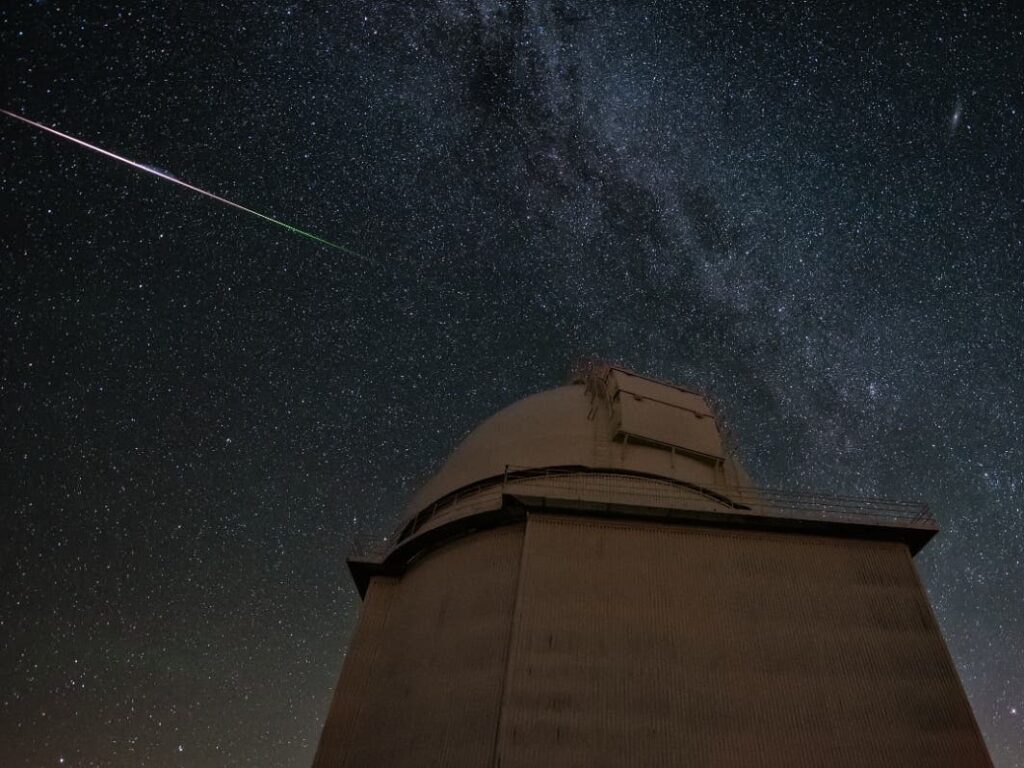
Shooting star season is returning.
The Lyrid meteor shower, which runs from April 14 to 26, peaks overnight April 21-22. The Lyrids only offer 10 to 18 shooting stars at the peak, but they’re known for bright dust trails that last for several seconds.
The waxing crescent moon shouldn’t be a problem. It will be about 22 percent illuminated and sets just after midnight, offering dark skies in the predawn hours, the best time to watch for shooting stars.
A nearly full moon for the second meteor shower of spring could be more problematic. The Eta Aquariids, which run from April 19 to May 28, peak overnight May 5-6.
Unfortunately for stargazers, the moon will be more than 90 percent illuminated, appearing very bright and shining throughout the night.
Under ideal conditions, about 30 Eta Aquariid meteors can be seen per hour during the shower’s peak, but this year’s nearly full moon could reduce the number of visible meteors to about 10.
The Eta Aquariids are fast meteors that leave glowing “trains” (incandescent bits of debris in the wake of the meteor) that last for several seconds to minutes.
Meteor showers will pause after the Eta Aquariids until summer, when the Southern Delta Aquariids and Alpha Capricornids both peak on July 30-31. The star of summer shooting stars is the Perseid meteor shower, which peaks Aug. 12-13.
What Causes Meteor Showers?
Meteor showers occur when Earth passes through trails of dusty debris left behind by comets and, sometimes, asteroids. As these tiny, icy, and rocky particles enter Earth’s atmosphere at high speeds, they burn up, creating the streaks of light we call shooting stars.
The Lyrids are produced by dust particles left behind by the comet C/1861 G1 Thatcher.
Comet Haley is the parent of the Eta Aquariids meteor shower, which has been observed since ancient times.
Surprising Comet Discovery 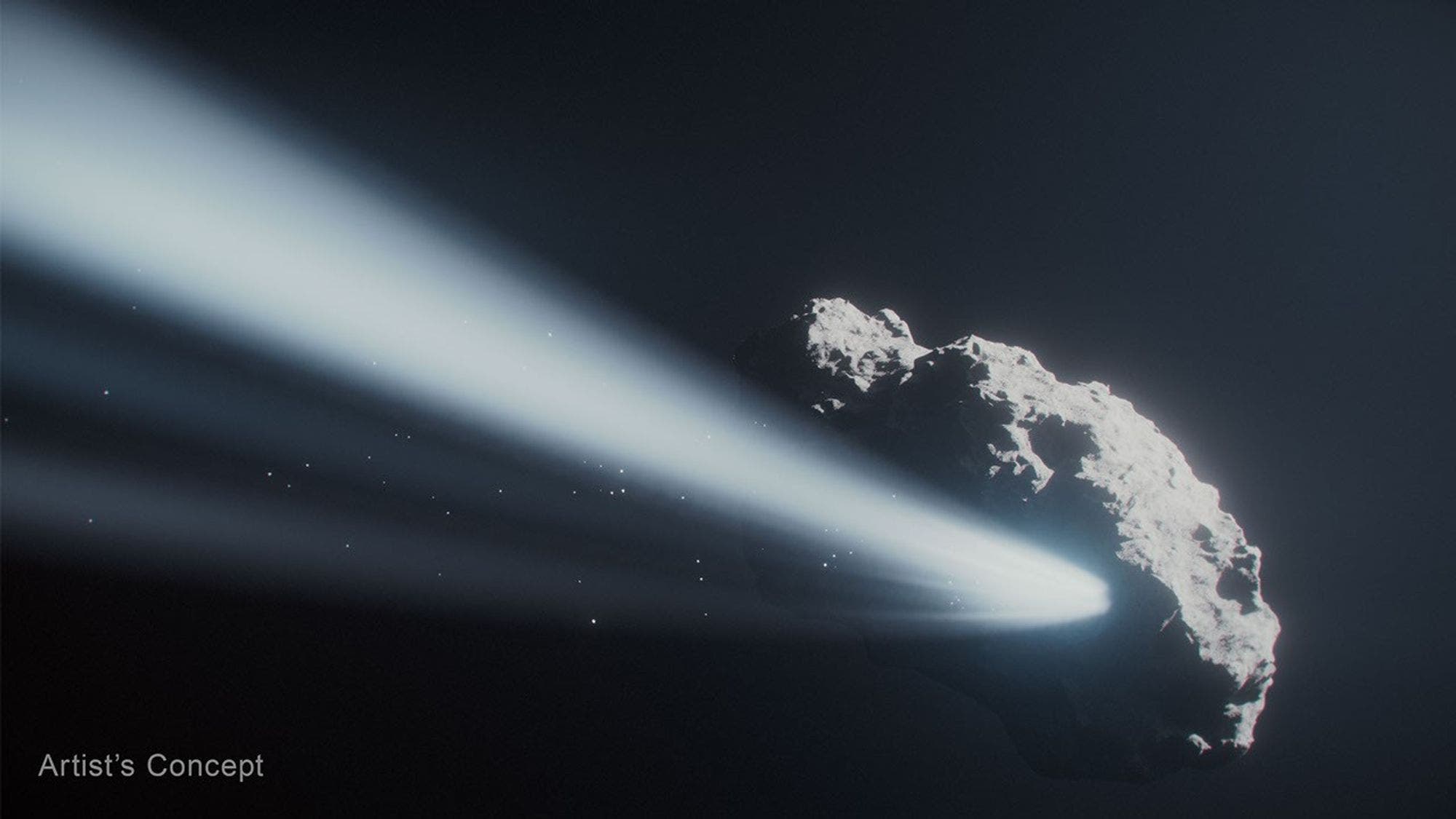 This artist’s concept depicts comet 41P, a tiny Jupiter-family comet, as it approached the Sun and frozen gases began to sublimate and shoot material off into space. Illustration/NASA, ESA, CSA, Ralf Crawford (STScI)
Speaking of comets, astronomers have documented the first-ever evidence of a comet dramatically altering its spin — potentially even reversing direction — according to NASA.
Using archival images from the Hubble Space Telescope, researchers found that comet 41P/Tuttle-Giacobini-Kresák slowed its rotation in 2017 from about 20 hours per spin to more than 40 hours, likely entering an unstable state. Over time, continued forces may have pushed it toward a reversal.
“It’s like pushing a merry-go-round,” David Jewitt of the University of California at Los Angeles, the author of a science paper published in The Astronomical Journal, said in a NASA statement. “If it’s turning in one direction, and then you push against that, you can slow it and reverse it.”
Scientists say the most likely cause is outgassing — jets of gas and dust released as the comet heats up near the sun. These jets act like thrusters, gradually altering the comet’s rotation. Because the comet is so small, about 0.6 miles wide, it is especially vulnerable to these forces.
Researchers believe continued changes in its spin — over an orbit it has likely followed for roughly 1,500 years — could eventually cause the comet to break apart, offering a rare opportunity to observe comet evolution on a human timescale.
Many similar comets likely undergo such changes but are either too distant to study closely or are destroyed before they can be observed in detail.
The study also suggests the comet’s activity has declined significantly over time. During its 2001 pass near the sun, 41P was unusually active for its size, but by 2017 its gas production had dropped substantially.
Modeling indicates that ongoing rotational changes could eventually lead to structural instability. If the comet spins too quickly, centrifugal forces may overcome its weak gravity and cohesion, potentially causing it to fragment or disintegrate. As Jewitt put it, the comet may ultimately “self-destruct.”