
🚀 HISTORIC FLYBY: Special guest and former NASA Chief Astronaut Robert Gibson joins FOX Weather to share his expert insight on the latest updates about the Artemis II mission as they prepare to orbit around the other side of the moon. Stay with FOX Weather for the latest:
The Artemis II mission achieved groundbreaking results before even entering the moon’s orbit, which makes you appreciate how far the spacecraft has come since the first mission in 2022.
During the first Artemis I mission in 2022, the un-crewed spacecraft encountered technical issues with the heat shield, which have since been resolved.
This was the first of a series of increasingly complex missions that will eventually set the stage for astronauts to return to the surface of the moon and establish a base.
NASA’S ARTEMIS PROGRAM: PAVING THE WAY FOR HUMANKIND’S RETURN TO THE MOON AND BEYOND
“Our early Artemis flights are a test campaign, and the Artemis I test flight gave us an opportunity to check out our systems in the deep space environment before adding crew on future missions,” Amit Kshatriya, deputy associate administrator of the Moon to Mars Program Office, NASA Headquarters in Washington, said.
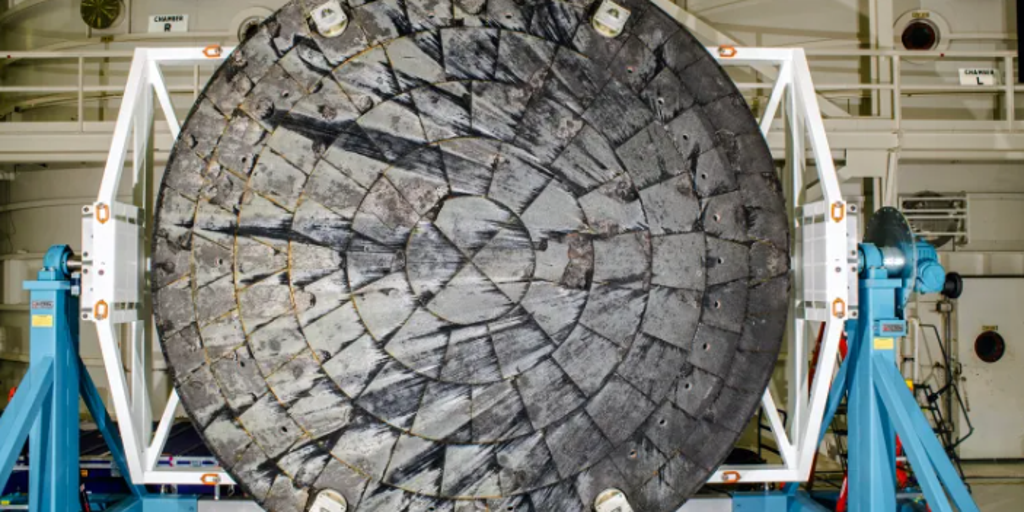
During this mission, the Orion spacecraft experienced an unexpected char loss across the ship’s heat shield, according to NASA. Engineers determined that gases generated inside the Orion’s heat shield were not able to vent and dissipate as expected through the shield’s outer material called Avcoat.
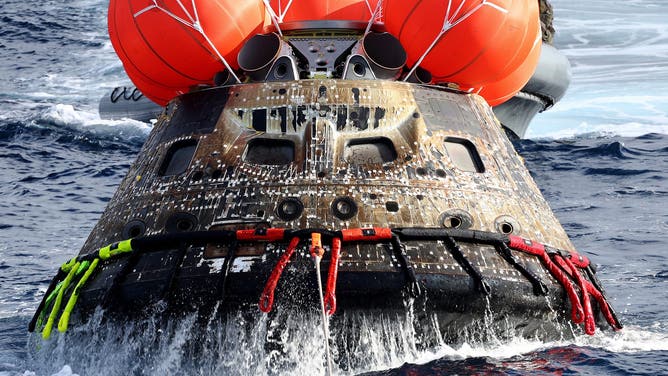
NASA’s Orion Capsule is drawn to the well deck of the USS Portland following a successful uncrewed Artemis I Moon Mission after it splashed down in the Pacific Ocean off the coast of Baja California, Mexico, on December 11, 2022. Orion was launched November 16 on the Artemis rocket for a 25-day mission to the Moon. The main goal of this mission was to test Orion’s heat shield — for the day when it is humans and not test mannequins riding inside.
(Mario Tama / POOL / AFP / Getty Images)
“The Apollo crew module’s heat shield relied on a material called Avcoat to beat the heat,” a statement from NASA reads. “It’s an ablator, meaning it burns off in a controlled fashion during reentry, transferring heat away from the spacecraft.”
MEET THE ASTRONAUTS PREPARING FOR HUMANITY’S RETURN TO THE MOON ON THE ARTEMIS II MISSION
Using data from the Avcoat material, a NASA investigation team was able to replicate the same environment in which the Orion experienced during its trajectory to Earth and experienced significant char loss.
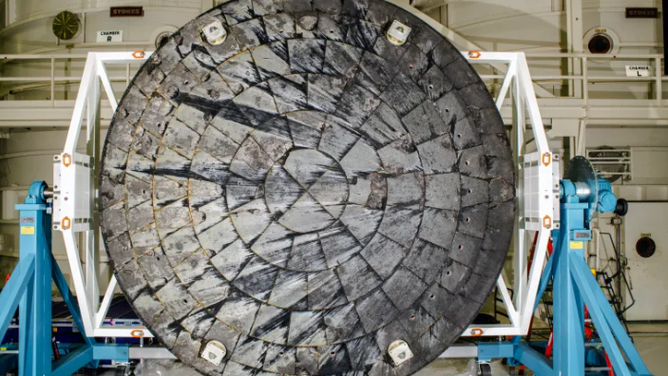
NASA’s Artemis I heat shield being removed and inspected by experts for analysis in 2022.
(NASA)
Experts discovered that during the trajectory to Earth, there were periods of dips through the atmosphere, causing heat rates to decrease and thermal energy to build up within the Avcoat heat shield material.
“This led to the accumulation of gases that are part of the expected ablation process,” NASA officials explained. “Because the Avcoat did not have permeability, internal pressure built up, and led to cracking and uneven shedding of the outer layer.”
🚀 RECORD BREAKING 🚨: Check out the record-breaking moment the Artemis II mission surpasses the Apollo 13 space team for the farthest distance humans have ever traveled from Earth. Stay with FOX Weather for the very latest on this historic journey.
The result was a dark, charred spacecraft bearing the scars of its unmanned journey back to our world.
This issue resulted from scientists initially testing the spacecraft at much higher heating rates than those that actually occurred during the mission. The unexpectedly less severe heating observed during the Artemis I reentry into Earth slowed char formation while still generating gases within the char layers.
TIMELINE: A DAY-BY-DAY GUIDE TO THE 10-DAY ARTEMIS II MISSION TO BRING HUMANITY BACK TO THE MOON
Gas pressure built up to the point of cracking and releasing parts of the charred layer, as the Orion ship suffered some damage.
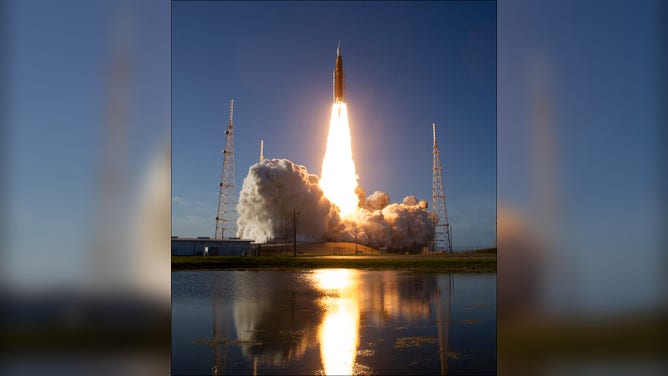
NASA’s Artemis II Space Launch System rocket carrying the Orion spacecraft lifts off from Launch Complex 39B at Kennedy Space Center on April 1, 2026 in Cape Canaveral, Florida.
(@nasahqphoto / X)
NASA said the extensive investigation and tests to find the root of the issue and to ensure safety going forward are the top priority, with approximately 200 Avcoat samples removed from the ship for analysis.
A heat shield is one of the basic parts of the reentry process back to our planet, and it would be impossible to sustain life inside without it, with temperatures as high as 7,000 degrees at the surface of the spacecraft.
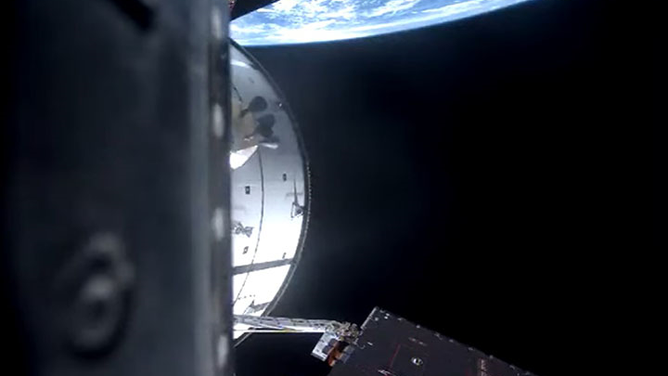
Camera mounted to Orion spacecraft.
(NASA / FOX Weather)
“The process was extensive,” Howard Hu, manager of the Orion Program, said. “We gave the team the time needed to investigate every possible cause, and they worked tirelessly to ensure we understood the phenomenon and the necessary steps to mitigate this issue for future missions.”
After extensive tests and analysis of the immense amount of data collected from Artemis I, officials are confident in the safety of the heat shield upon the crew’s return to Earth.