
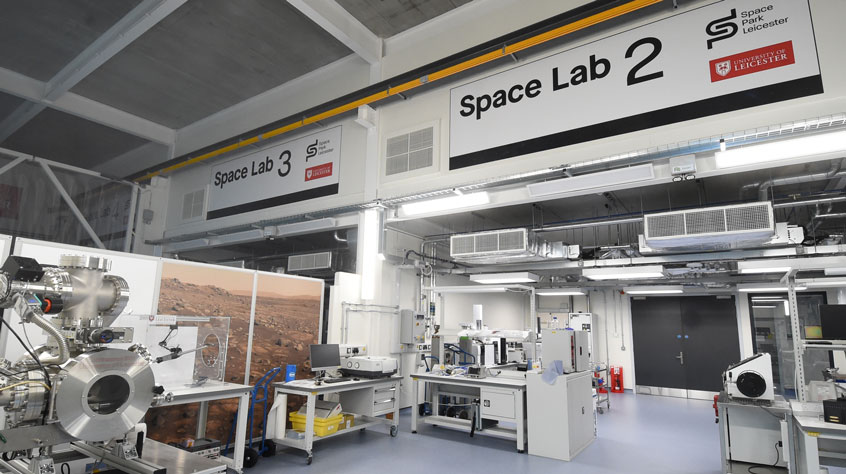
A robotic laboratory designed to handle Moon and Mars samples has been demonstrated to NASA and ESA (European Space Agency). The system, developed by the University of Leicester at Space Park Leicester, could support future missions such as lunar sample return campaigns under NASA’s Artemis programme.
Ultra-Clean Robotic Lab Designed for Space Samples
Scientists at the University of Leicester have built a compact ultra-clean facility called the Double-Walled Isolator (DWI). The system stores, handles, and analyses extraterrestrial material without contamination. The laboratory uses sealed containment technology and robotics to manipulate samples with high precision. This reduces the need for direct human contact.
NASA and ESA Visit Leicester Facility
Experts from NASA and ESA visited Space Park Leicester to observe the system in action. During the demonstration, engineers unpacked, weighed, and repackaged a simulated sample inside the system.
The visit also included meetings with two London-based project partners. The first one is the Natural History Museum, which focuses on sample curation. And the second is the Francis Crick Institute, which provides expertise in high-containment biological research.
Preparing for Future Moon and Mars Samples
Researchers originally developed the DWI for Mars sample return missions. However, they say it could also play a role in future lunar programmes, including Artemis missions. According to Dr John Holt, principal investigator at Space Park Leicester, NASA’s interest reflects the growing need for advanced sample handling systems. He said NASA is expected to return new lunar samples in the coming years. These samples will require rapid cataloguing and early scientific analysis.
Planetary Protection and Contamination Control
A key function of the system is planetary protection — preventing contamination between Earth and extraterrestrial material. Researchers say even microscopic Earth organisms could interfere with the detection of potential signs of past or present life in space samples.
The containment system also prevents any potential extraterrestrial material from posing a risk to Earth’s biosphere.
Robotics Improve Precision and Speed
The laboratory’s robotic handling system is designed to outperform manual processes by improving precision and reducing contamination risks. Researchers say automation could also accelerate the time needed to process samples and share results with the global scientific community.
Published by Space Enthusiast
An amateur rocket enthusiast with a keen interest in all space-related activity. Looking forward to the day when the UK starts launching rockets into space and I’m able to watch launches (from a safe distance of course).