
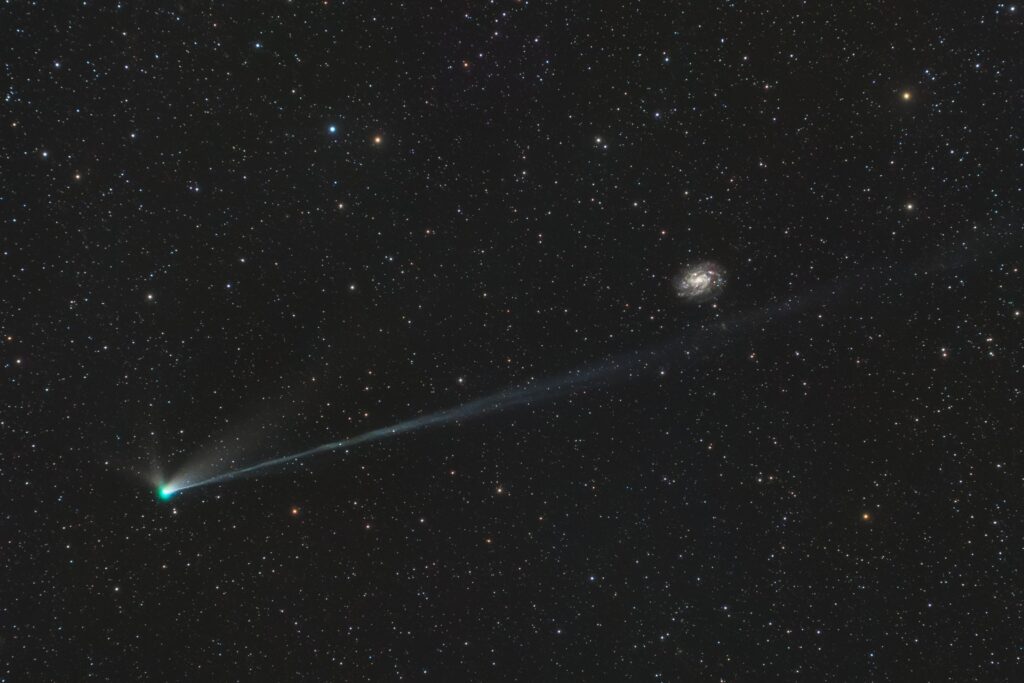
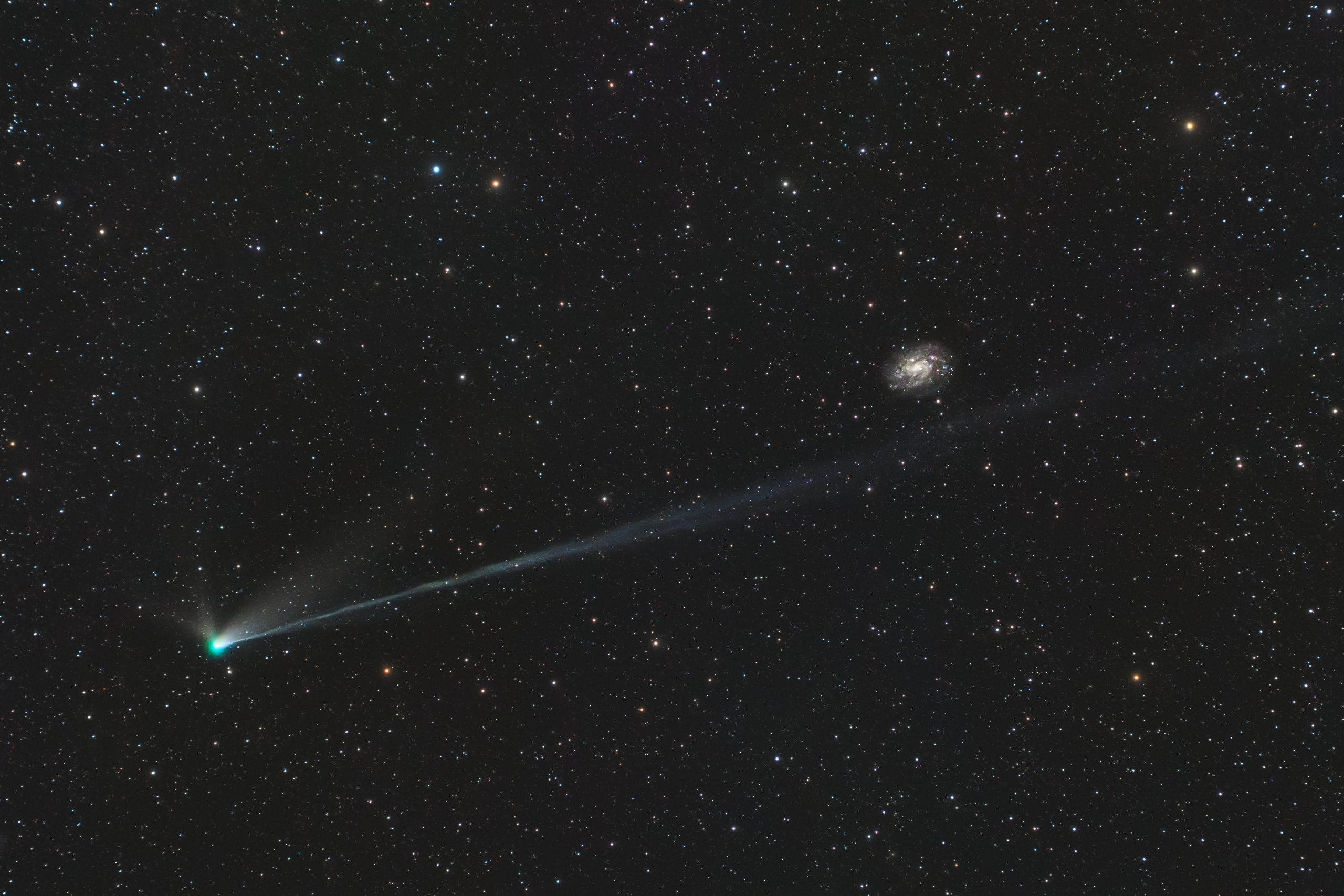
A multi-tailed Comet C/2024 E1 (Wierzchoś) passes spiral galaxy NGC 300 in a stunning shot from February 2026. Credit: José J. Chambó

Sky This Week is brought to you in part by Celestron.
Friday, April 3
Mercury reaches greatest western elongation at 7 P.M. EDT this evening, standing 28° from the Sun. However, the planet is only currently visible in the predawn sky. You can catch it in the east shortly before sunrise either this morning or tomorrow morning. It’s low, though — only about 4° high half an hour before sunrise — so you’ll need a clear horizon to spot it. Getting to an observing site slightly above your surroundings may also help.
On the other end of the spectrum, the solar system’s largest planet, Jupiter, is visible in the evening sky, still high above the horizon after sunset. This evening, observers in the eastern half of the U.S. can catch the start of a shadow transit as the shadow of the Galilean moon Callisto falls on the jovian cloud tops, beginning at 9:14 P.M. EDT.
At that time, Jupiter — in Gemini — is still 60° (or more, depending on your location) above the horizon in Gemini the Twins, hanging in the west for East Coast observers and southwest for those farther west. You’ll see it shining brightly below the constellation’s two standout stars, Castor and Pollux.
Through a telescope, as the transit begins you’ll see only one moon to Jupiter’s east. It may be tempting to think that’s the one casting the shadow on the planet’s eastern limb, but it’s not. The moon to the east is Io, while Callisto — the moon whose shadow is moving across the cloud tops — is the closest of the three moons to Jupiter’s west. Farther west of Callisto is Europa, and beyond that, Ganymede.
It takes more than four hours for Callisto’s shadow to transit, so even parts of the U.S. that didn’t get to see the event start can watch it progress. During that time, the moons remain in the same configuration, all moving westward. The shadow transit ends at 1:32 A.M. EDT (now the 4th in the Eastern and Central time zones), with Jupiter getting quite low for observers in the Eastern time zone.
Sunrise: 6:40 A.M.
Sunset: 7:27 P.M.
Moonrise: 9:29 P.M.
Moonset: 7:05 A.M.
Moon Phase: Waning gibbous (96%)Times for sunrise, sunset, moonrise, and moonset are given in local time from 40° N 90° W. The Moon’s illumination is given at 10 P.M. local time from the same location.
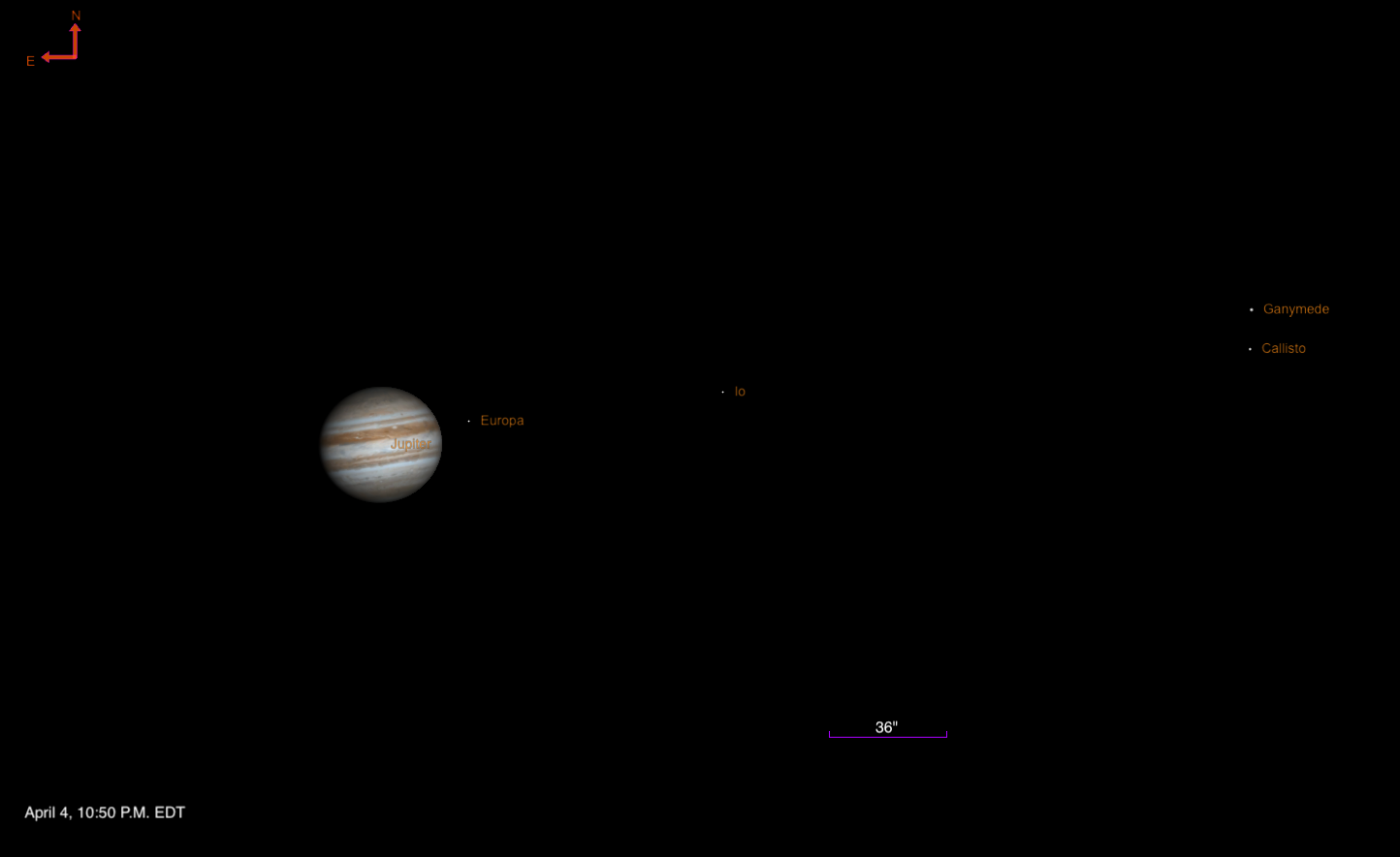
Shortly before 11 P.M. EDT, Callisto and Ganymede stand in a north-south line as Europa prepares to disappear in an occultation behind Jupiter’s limb. Credit: Alison Klesman (via TheSkyX)
Saturday, April 4
We’re back at Jupiter again tonight as Europa, now having reached the far western end of its orbit and heading back toward the planet, disappears in an occultation behind the disk at 11:30 P.M. EDT.
If you can, get your telescope on the planet at least 40 minutes before that — shortly before 11 P.M. EDT, Callisto stands due south of Ganymede, both far to Jupiter’s west. Closer to the planet is Io, while Europa is even closer, closing in on the western limb. After this, Callisto and Ganymede pull apart, with Callisto moving away from the planet and Ganymede toward it. That’s because Callisto’s orbit is wider than Ganymede’s, so the former has not yet reached its greatest western extent.
Meanwhile, Europa takes some three hours to cross behind Jupiter but emerges into the planet’s shadow, staying invisible even once it has moved past the limb. Only observers in the western half of the U.S. will be able to catch its eventual reappearance, some 35” east of the eastern limb around 2 A.M. PDT on April 5.
Sunrise: 6:39 A.M.
Sunset: 7:28 P.M.
Moonrise: 10:32 P.M.
Moonset: 7:31 A.M.
Moon Phase: Waning gibbous (91%)
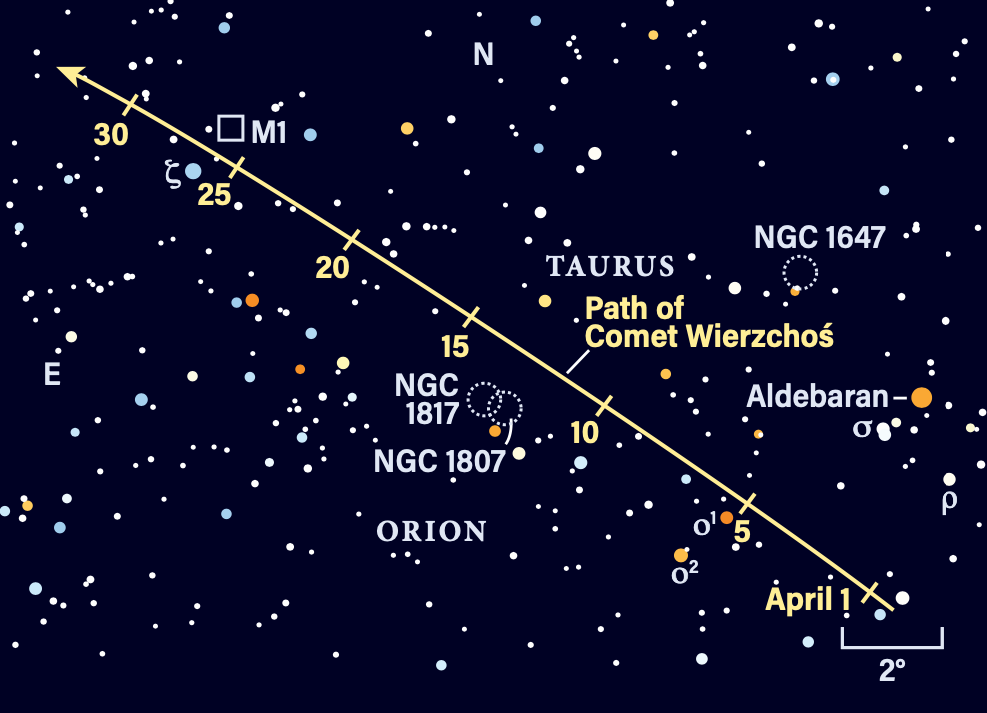 Comet Wierzchoś is fading on its way through Taurus, though it still offers a nice photo op with M1 late in the month. Credit: Astronomy: Roen Kelly
Sunday, April 5
After rounding the Sun in January, Comet C/2024 E1 (Wierzchoś) is now headed back out to the depths of the solar system. This may be your last chance to see it, too, especially as it’s fading fast following a possible disruption of the nucleus in early March. Observers with dark skies and big scopes can try to catch it, now sinking in the west after sunset in the far northwestern corner of Orion, near the Hunter’s border with Taurus.
You can use bright Aldebaran, the Bull’s eye and alpha star, to guide you to the comet tonight. From Aldebaran, Wierzchoś is just a 4.1° slide to the southeast. It also lies just 1.2° northwest of 4th-magnitude Omicron2 (ο2) Orionis in the curve of Orion’s bow.
Last reported around 13th magnitude and fading, Wierzchoś will be a difficult target. However, there’s another comet on the scene that is brighter than expected: C/2025 R3 (PanSTARRS). Visible in the early-morning sky, we’ll try for this one later in the week, so don’t be discouraged if Wierzchoś has fallen out of your range.
Sunrise: 6:37 A.M.
Sunset: 7:29 P.M.
Moonrise: 11:36 P.M.
Moonset: 8:01 A.M.
Moon Phase: Waning gibbous (85%)
Monday, April 6
The Moon passes 0.6° south of Antares at 4 P.M. EDT, with the two visible together in the early-morning sky prior to the passage.
Look south around 5 A.M. local daylight time to find the waning Moon already embedded within Scorpius the Scorpion’s front claws. It lies just to the lower right (west) of Antares, also cataloged as Alpha Scorpii and a lovely red giant star whose color you can admire through binoculars or a telescope. That color is what has gained it its name — it is often called the Rival of Mars because it looks to so many observers like the Red Planet.
Shining at magnitude 1.1, Antares is an M-class star that is much more massive than the Sun, weighing in at some 15 to 18 times more, according to the late stellar expert Jim Kaler. Although it’s now much cooler than the Sun, Antares shines about 10,000 times brighter than our star, albeit from some 550 light-years away.
Antares is also a known double star, with a magnitude 5.5 companion visible just 3” away. Although this companion is a hot, blue-white star, it is one of a few stars that sometimes appears green to observers, thanks to the way human eyes see it in contrast with nearby ruddy Antares.
Sunrise: 6:36 A.M.
Sunset: 7:30 P.M.
Moonrise: —
Moonset: 8:37 A.M.
Moon Phase: Waning gibbous (78%)
Tuesday, April 7
Glowing more brightly than expected, Comet C/2025 R3 (PanSTARRS) is flying near the Square of Pegasus early this morning. Even with a waning gibbous Moon in the sky, let’s try for it.
Recently reported around 6th magnitude, this comet should be within the range of most amateur scopes. It’s expected to brighten at least two more magnitudes this month, although comets don’t always do as astronomers predict.
Rising around 3:40 A.M. local daylight time, give PanSTARRS an hour or so to climb above the horizon before searching it out. Around 4:45 A.M. local daylight time, it’s reached an altitude of 10° in the eastern sky. It lies close to the western side of the Square of Pegasus, between the stars Alpha (α) and Beta (β) Pegasi, also known as Markab and Scheat, respectively. From Markab, which is lower in the sky than Scheat, shift your scope 5° north-northwest to land on the comet.
Even as this comet brightens, it will become less visible as it sinks quickly toward the horizon each night. As we near the end of the month, it will no longer be visible in the Northern Hemisphere, instead gracing only Southern Hemisphere skies.
The Moon reaches apogee, the farthest point from Earth in its orbit, at 4:31 A.M. EDT. At that time, our satellite will stand 251,637 miles (404,970 kilometers) away.
Sunrise: 6:34 A.M.
Sunset: 7:31 P.M.
Moonrise: 12:35 A.M.
Moonset: 9:21 A.M.
Moon Phase: Waning gibbous (69%)
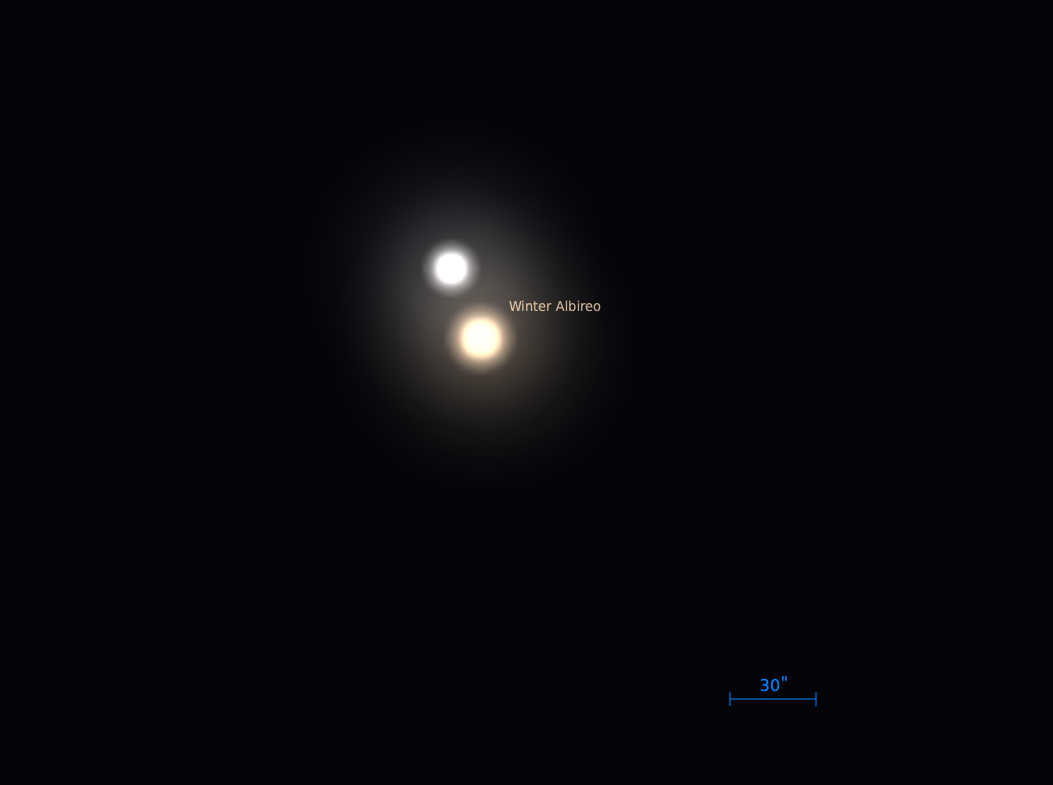
The lovely double star 145CMa, also called the Winter Albireo, is now setting a few hours after sunset. Catch it before we lose it for the season. Credit: Stellarium
Wednesday, April 8
Before we lose sight of Canis Major in the nighttime sky, get in a last good look at the Big Dog’s famous double star, 145 Canis Majoris, sometimes called the Winter Albireo.
Two hours after sunset, once the sky is dark, find Canis Major’s bright star, Sirius — the brightest star in the sky — some 20° above the southwestern horizon, to the left of Orion’s Belt. Sirius typically represents the front end or nose of the Big Dog; over above his back, near his tail, is where we’re looking tonight. From Sirius, slide your telescope about 10° to the left (southeast), keeping it at the same height above the horizon. There, about 3.6° north-northeast of Wezen (Delta [δ] CMa), lies 145 CMa.
This lovely pair is separated by just over 25”, making both stars easy to spot in many scopes. If Antares’ companion was a challenge the other night, this will be a much easier and more rewarding target. Like Antares and Albireo, the star that lends this pair its nickname, the two suns of 145 CMa have contrasting colors, appearing orange and blue.
The “real” Albireo, which lies in Cygnus and is cataloged as Beta Cygni, is a staple of the summertime sky. Once it’s visible in the evening in a few months, make sure to visit it and compare the view.
Sunrise: 6:32 A.M.
Sunset: 7:32 P.M.
Moonrise: 1:30 A.M.
Moonset: 10:12 A.M.
Moon Phase: Waning gibbous (60%)
Thursday, April 9
Moonless spring evening skies are great for galaxy hunting. Leo is well known for its trio of bright galaxies (M65, M66, and NGC 3628), but the Lion has many more extragalactic targets to offer as well.
One such target is M96, for which the M96 galaxy group — also called the Leo I Group — is named. Glowing at magnitude 9.2, this bright spiral is already some 60° above the southeastern horizon by 9:30 P.M. local daylight time. It’s located near the back feet of the Lion and just east of Regulus, the bright, 1st-magnitude star that serves as both Leo’s “heart” and the base of the Sickle asterism.
Center Regulus in your scope, then slide about 9.4° east to land on M96. The galaxy’s bright center, which is visible even in small telescopes, spans some 6’. Larger telescopes should start to reveal structure in the galaxy’s arms — look especially for a fainter arm that arcs up and away from the core. Large scopes may also show the galaxy’s faint outer ring, as well as the way highly concentrated dust on one side of the galaxy than the other carves a small notch out of the core.
Sunrise: 6:31 A.M.
Sunset: 7:33 P.M.
Moonrise: 2:17 A.M.
Moonset: 11:10 A.M.
Moon Phase: Waning gibbous (51%)
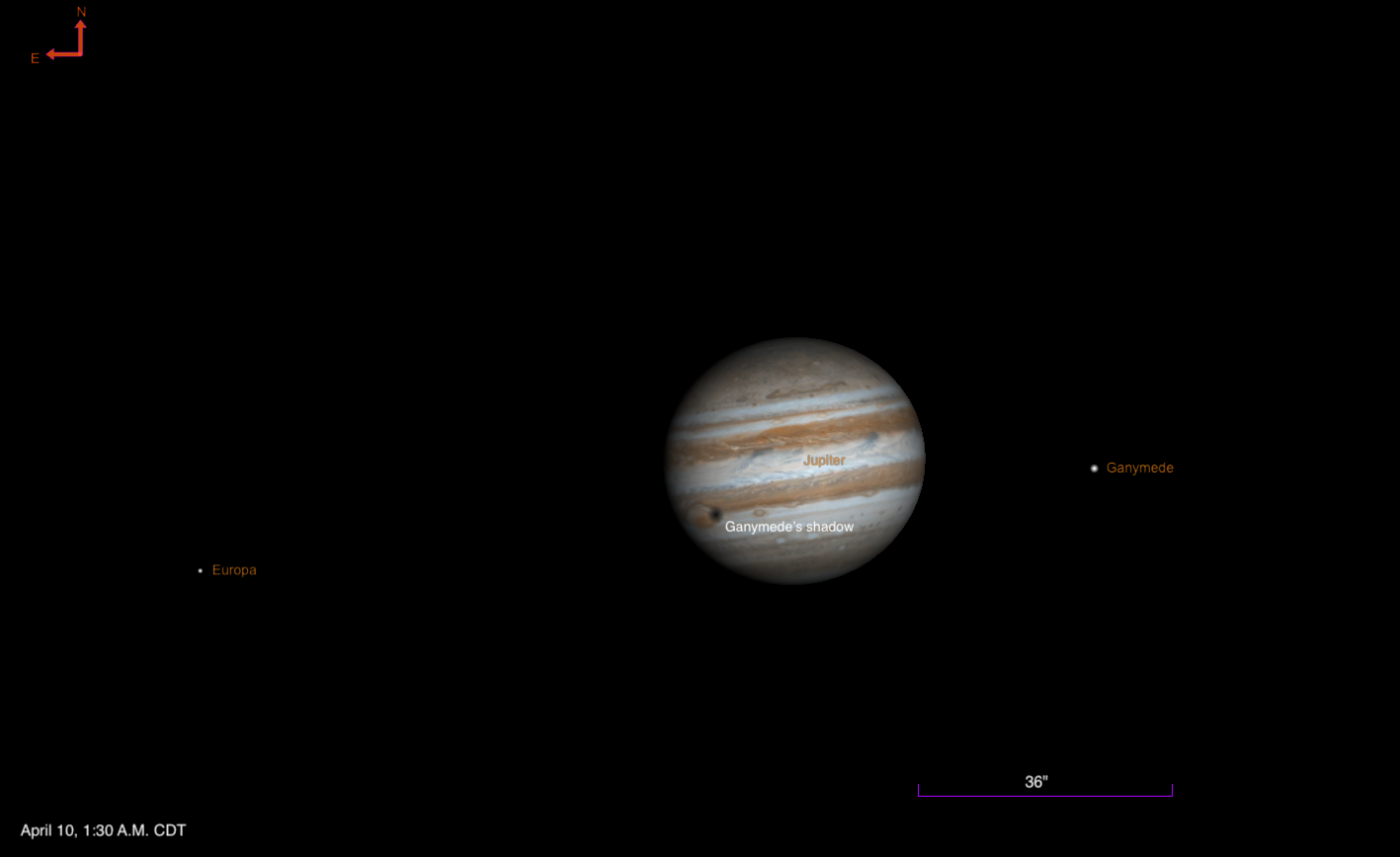
By 1:30 A.M. CDT on April 10, Ganymede’s large shadow is readily visible on the jovian disk for observers in the western two-thirds of the U.S. Io and Callisto lie farther west, outside this field of view. Credit: Alison Klesman (via TheSkyX)
Friday, April 10
Last Quarter Moon occurs early this morning at 12:52 A.M. EDT.
If you’re up after midnight on the 9th in the Central time zone (early-morning hours of April 10), you can catch the start of another shadow transit this week at Jupiter. The giant planet remains in central Gemini, below the bright stars Castor and Pollux and just 2.5° west of magnitude 3.5 Wasat (Delta Geminorum). It’s easy to point a telescope to the planet, as it’s by far the brightest light in the western sky, much brighter than Castor or Pollux.
Ganymede’s large shadow is crossing from east to west, slowly sliding onto the cloud tops beginning at 12:57 A.M. CDT. The planet is too low (less than 3° high) at this time to view the event from the East Coast, but the western two-thirds of the U.S. can watch as a dark notch starts to form at Jupiter’s southeastern limb, taking roughly 8 to 10 minutes to fully appear. Ganymede itself is just west of the planet; Europa is alone to the east, although as earlier this week, don’t be fooled into thinking this is the source of the shadow. Io and Callisto lie farther west, beyond Ganymede.
Ganymede’s shadow takes more than three hours to cross the giant world; Jupiter will set across the U.S. with the transit underway.
Sunrise: 6:29 A.M.
Sunset: 7:34 P.M.
Moonrise: 2:58 A.M.
Moonset: 12:12 P.M.
Moon Phase: Waning crescent (41%)