
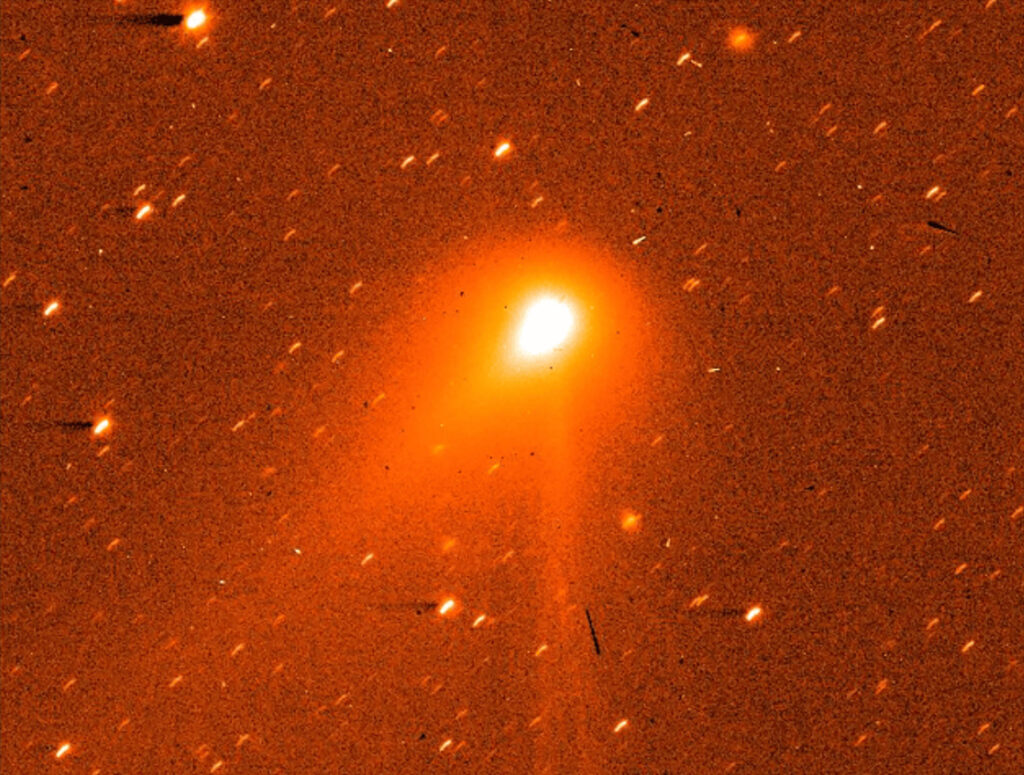
A comet passed through our solar system in late 2025, but it wasn’t from here. It came from another star system. Scientists named it 3I/ATLAS. It swung past the Sun and then continued back out into deep space.
By pure luck, it crossed paths with a spacecraft already on its journey. That gave scientists a rare chance to study something billions of years old – possibly even older than our solar system itself.
Right time, right place for Juice

The spacecraft, called Juice, wasn’t meant to study comets. It’s heading to Jupiter to explore icy moons.
But in November 2025, it happened to be in the right place at the right time. Teams quickly turned on five instruments and aimed them at the comet as it approached the Sun.
The data took three months to reach Earth. Once it arrived, scientists started analyzing images, light, and chemical signals. The work is still ongoing, but some early findings are already clear.
Water vapor from comet 3I/ATLAS
Juice picked up a very strong water signal. As comet 3I/ATLAS moved closer to the Sun, its icy surface heated up and released gas.
They detected about 4,400 pounds (2,000 kilograms) of water vapor every second. That equals around 70 Olympic-sized swimming pools each day.
This level is high but not unusual for comets. Some release less, while others release much more. It depends on the comet’s size and distance from the Sun. What stood out was how steady the flow remained, even days after its closest approach.
Sunlight shapes the flow
Most of that water didn’t escape evenly. It streamed mainly from the side facing the Sun. That tells scientists something about how heat drives activity on the comet’s surface.
Even more interestingly, a large portion of the water may not come directly from the solid core. Instead, it likely comes from tiny icy dust grains floating around the comet in a hazy cloud. These grains heat up and release gas on their own, adding to the total output.
Researchers are also studying different types of water in the comet. Some early findings from other telescopes suggest an unusual chemical ratio – one that hints the comet formed in an extremely cold and ancient region of space.
Comet 3I/ATLAS has a very long tail
The comet didn’t just release gas. It carried a long trail of dust and atoms behind it. Observations show that this material stretched more than 3.1 million miles (5 million kilometers) from the comet’s center.
That’s not surprising for an active comet, but it’s still impressive. These long comet tails form when sunlight and solar wind push material away, creating a glowing trail that can extend for millions of miles.
In this case, scientists detected oxygen, hydrogen, and carbon spreading across that vast distance.
 GIF of Comet 3I/Atlas switching between orange and blue views of a bright, glowing object sitting slightly above the center of the image, with a soft, teardrop-shaped head and a long, faint tail streaming downward. The orange view also has a tail pointing to the lower left. Credit: ESA. Click image to enlarge.Surprisingly familiar behavior
Despite its origins beyond our solar system, comet 3I/ATLAS didn’t behave like an outsider. High-resolution images showed a classic comet structure. A bright cloud surrounded the hidden core, with two distinct tails trailing behind.
One of the comet’s tail pointed away from the Sun, shaped by solar radiation. The other followed the comet’s path through space.
Subtle patterns within these features suggest ongoing interactions with solar particles and magnetic fields. Even so, everything looked strikingly familiar.
That similarity matters. It suggests that the basic processes shaping comets may be common across different star systems.
Tracking helps protect Earth
One instrument on board wasn’t meant for science at all. It was meant to help the spacecraft move around Jupiter’s moons. But during this moment, it ended up doing something different.
From about 37 million miles (60 million kilometers) away, its camera tracked the comet from a view Earth-based telescopes didn’t have. By combining those views, scientists were able to map the comet’s path more accurately.
This kind of tracking helps with planetary defense. It gives scientists a better idea of how objects move, especially when they’re hard to see from Earth. It also reveals how jets of gas and dust can slightly alter a comet’s course over time.
Multiple teams, many instruments
The work involves teams across multiple instruments, each focusing on a different piece of the puzzle. As the data came together, the significance of the moment became clear.
“3I/ATLAS is a rare and unexpected visitor, its arrival came as a complete surprise,” said Olivier Witasse, ESA Juice Project Scientist.
“But when we realized that Juice would be close to the comet around its closest approach to the Sun, we realized what a unique opportunity this was to collect a once-in-a-lifetime dataset.”
“Observing the comet was challenging, with no guarantee of success, but in the end, it turned into a great bonus for Juice during its journey to Jupiter.”
Looking ahead to Jupiter
The Juice spacecraft itself continues its long trip toward Jupiter, where it will arrive in 2031. Along the way, its instruments will be tested again during future flybys.
“The data we are already seeing from Juice’s instruments is really promising,” said ESA co-Project Scientist Claire Vallat.
“We are getting more excited about how well they work and how much we will reveal about Jupiter and its icy moons in the 2030s.”
For now, 3I/ATLAS has already left its mark. It offered a rare glimpse into material formed in another star system, and it did so in a brief window that scientists were ready to seize.
—–
Like what you read? Subscribe to our newsletter for engaging articles, exclusive content, and the latest updates.
Check us out on EarthSnap, a free app brought to you by Eric Ralls and Earth.com.
—–