
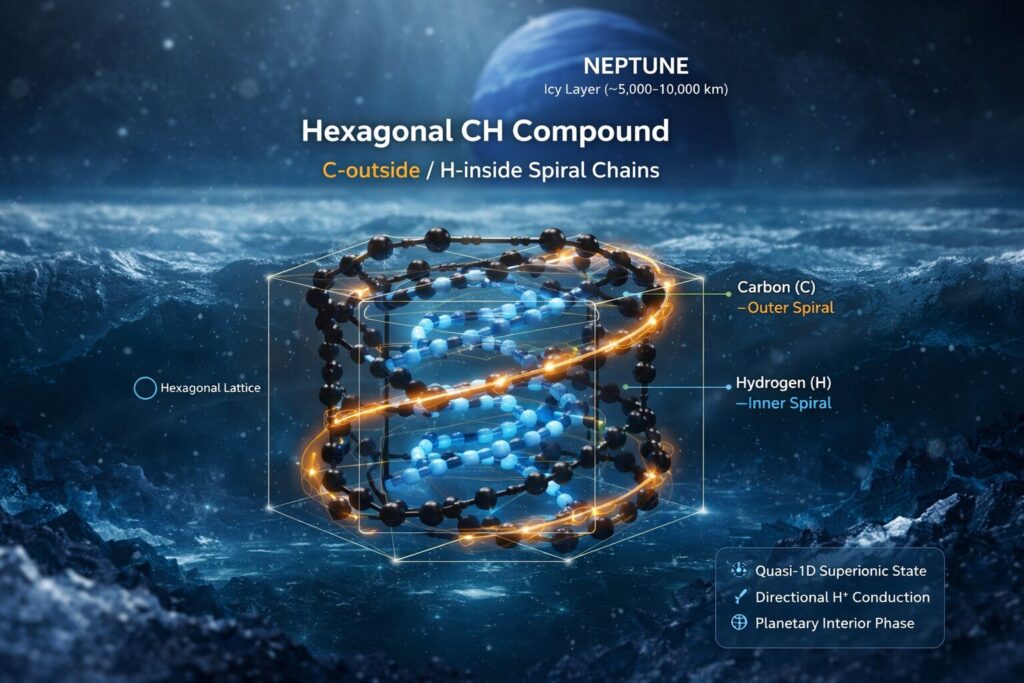
According to new computer simulations conducted by Cong Liu and Ronald Cohen of the Carnegie Institution, a previously unknown state of matter may exist deep within the icy giant planets, such as Uranus and Neptune. In their paper, the researchers suggest that under the extreme pressure and temperature conditions prevailing in the depths of these bodies in the outer Solar System, a quasi-one-dimensional superionic state of carbon hydride exists.
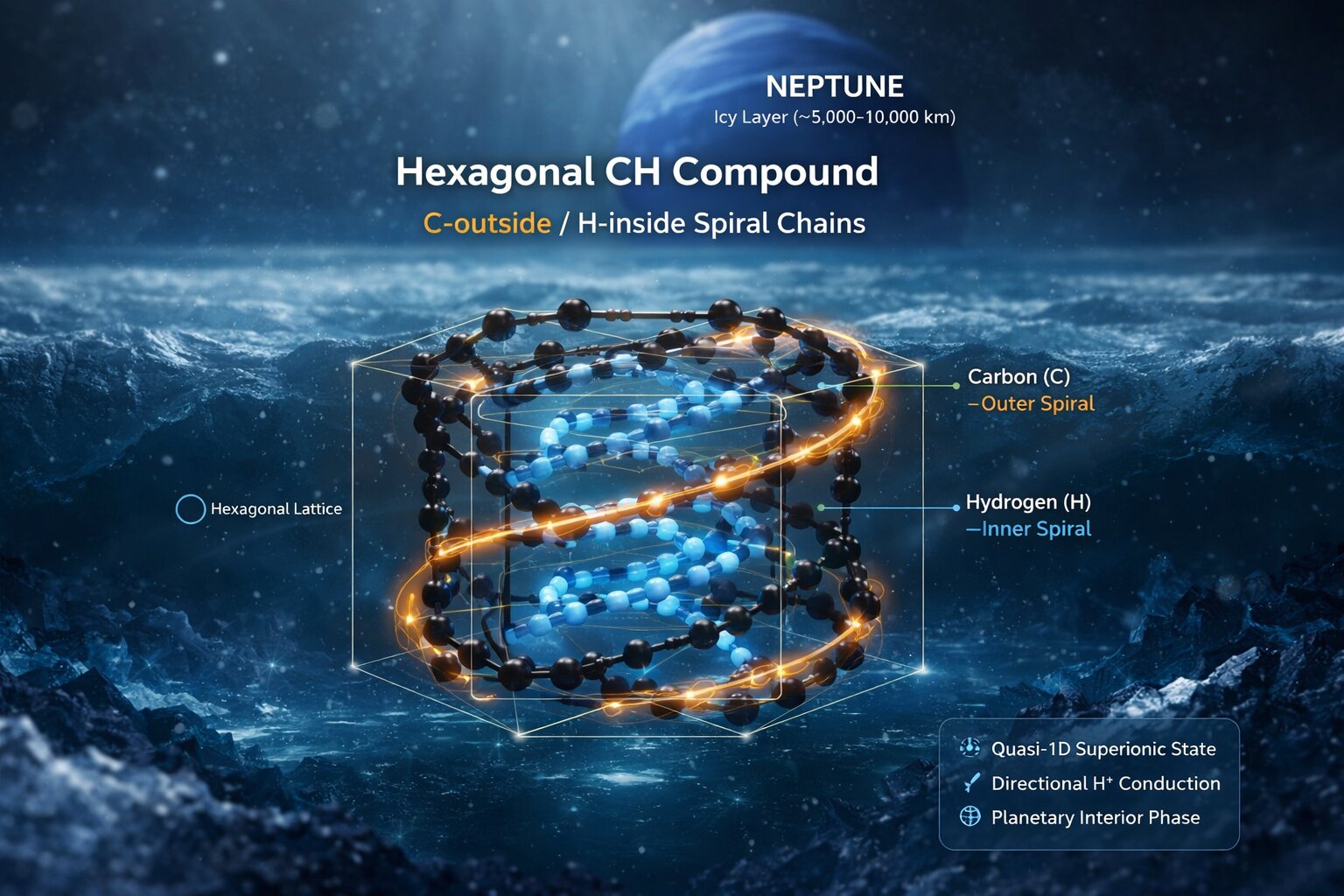 What’s happening deep inside Neptune. Source: phys.org
Interest in the interiors of planets
To date, more than 6,000 exoplanets have been discovered. As this number grows, astronomers, planetary scientists, and geophysicists are breaking down the barriers between disciplines, combining observations, experiments, and theory to identify and investigate the factors that help us understand the dynamic processes shaping these objects—in particular, the formation of magnetic fields.
Consequently, there is growing interest in understanding the processes taking place deep beneath the surfaces of the planets and moons in our Solar System, which could help us better understand planetary dynamics and even their potential for supporting life in more distant corners of the Universe.
Exotic ice inside Uranus and Neptune
Measurements of the densities of Uranus and Neptune suggest that these giant planets contain intermediate layers of unusual “hot ice” located beneath their hydrogen and helium atmospheres and above their rocky cores. It is believed that these layers consist of water (H₂O), methane (CH₄), and ammonia (NH₄), but due to the extreme conditions, it is thought that exotic phases may form.
Physical processes in these regions of high pressure and high temperature can lead to the emergence of unconventional states of matter, which is why theorists and experimentalists are attempting to predict and reproduce what might be discovered there.
A new state of matter: carbon hydride
Using high-performance computing and machine learning, Liu and Cohen conducted fundamental quantum-physical simulations of carbon hydride (CH) under pressures ranging from nearly 5 to nearly 30 million times higher than atmospheric pressure (from 500 to 3,000 gigapascals) and at temperatures ranging from 6,740 to 6,000 kelvins. Their methods suggested the emergence of an ordered hexagonal structure in which hydrogen atoms move along spiral trajectories, creating a quasi-one-dimensional superionic state.
Superionic materials occupy an unusual intermediate position between solids and liquids—one type of atom remains in the crystal structure, while the other becomes mobile.
“This newly discovered phase of carbon and hydrogen is particularly impressive because the movement of the atoms is not entirely three-dimensional,” Cohen explained. “Instead, hydrogen moves primarily along well-defined spiral trajectories embedded within the ordered carbon structure.”
Significance of the discovery for the advancement of planetary science and materials science
The direction of this movement has important implications for understanding how heat and electricity are distributed within the planet. Such behavior may influence energy redistribution in the inner layers, electrical conductivity, and possibly the interpretation of magnetic field formation processes in ice giants.
Their findings also expand our understanding of how simple compounds behave under extreme conditions, suggesting that even simple systems can transition into unexpectedly complex phases.
In addition to studying the internal structure of planets, the ability to observe phenomena with a pronounced directionality in condensed matter may be of significant importance for materials science and engineering.
According to phys.org