
Back to Article List
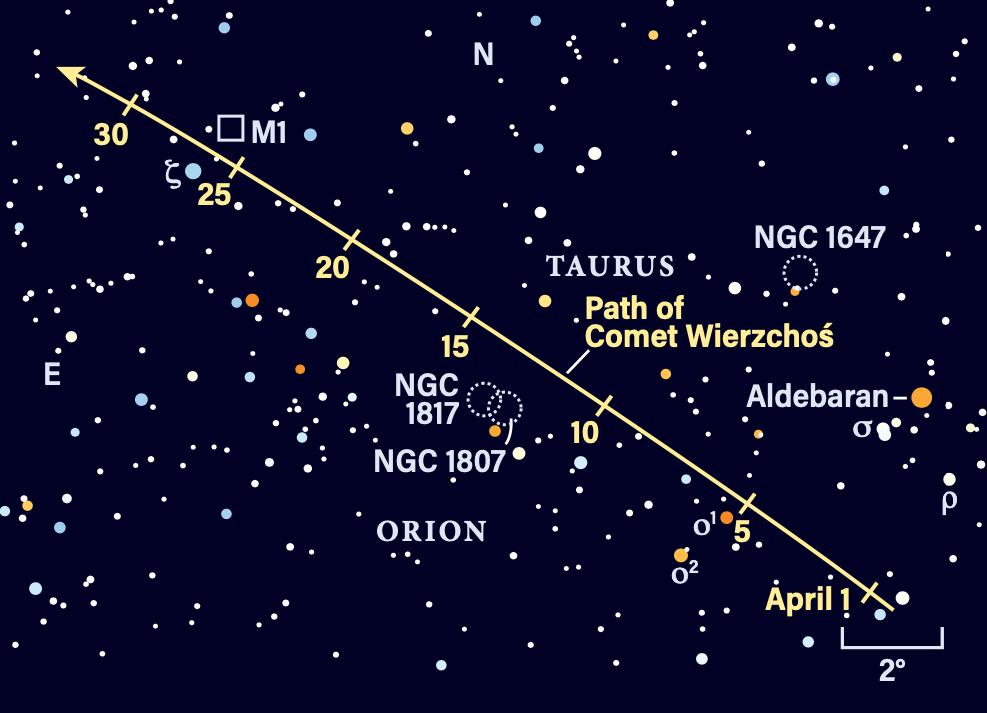
Now fading quickly following a possible nuclear disruption, Comet Wierzchoś is traveling through Taurus, near Orion’s bow.
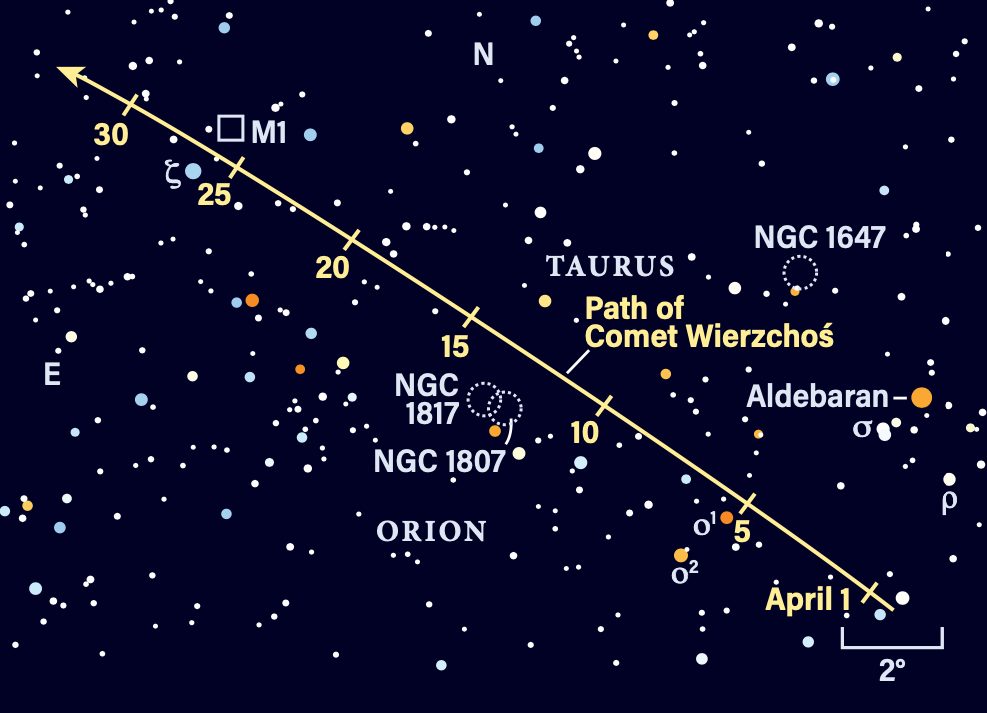
Comet Wierzchoś is fading on its way through Taurus, though it still offers a nice photo op with M1 late in the month. Credit: Astronomy: Roen Kelly
Looking for a sky event this week? Check out our full Sky This Week column.
April 4: Europa disappears
After rounding the Sun in January, Comet C/2024 E1 (Wierzchoś) is now headed back out to the depths of the solar system. This may be your last chance to see it, too, especially as it’s fading fast following a possible disruption of the nucleus in early March. Observers with dark skies and big scopes can try to catch it, now sinking in the west after sunset in the far northwestern corner of Orion, near the Hunter’s border with Taurus.
You can use bright Aldebaran, the Bull’s eye and alpha star, to guide you to the comet tonight. From Aldebaran, Wierzchoś is just a 4.1° slide to the southeast. It also lies just 1.2° northwest of 4th-magnitude Omicron2 (ο2) Orionis in the curve of Orion’s bow.
Last reported around 13th magnitude and fading, Wierzchoś will be a difficult target. However, there’s another comet on the scene that is brighter than expected: C/2025 R3 (PanSTARRS). Visible in the early-morning sky, we’ll try for this one later in the week, so don’t be discouraged if Wierzchoś has fallen out of your range.
Sunrise: 6:37 A.M.
Sunset: 7:29 P.M.
Moonrise: 11:36 P.M.
Moonset: 8:01 A.M.
Moon Phase: Waning gibbous (85%)
*Times for sunrise, sunset, moonrise, and moonset are given in local time from 40° N 90° W. The Moon’s illumination is given at 10 P.M. local time from the same location.
The Moon passes 0.6° south of Antares at 4 P.M. EDT on April 6, with the two visible together in the early-morning sky prior to the passage.
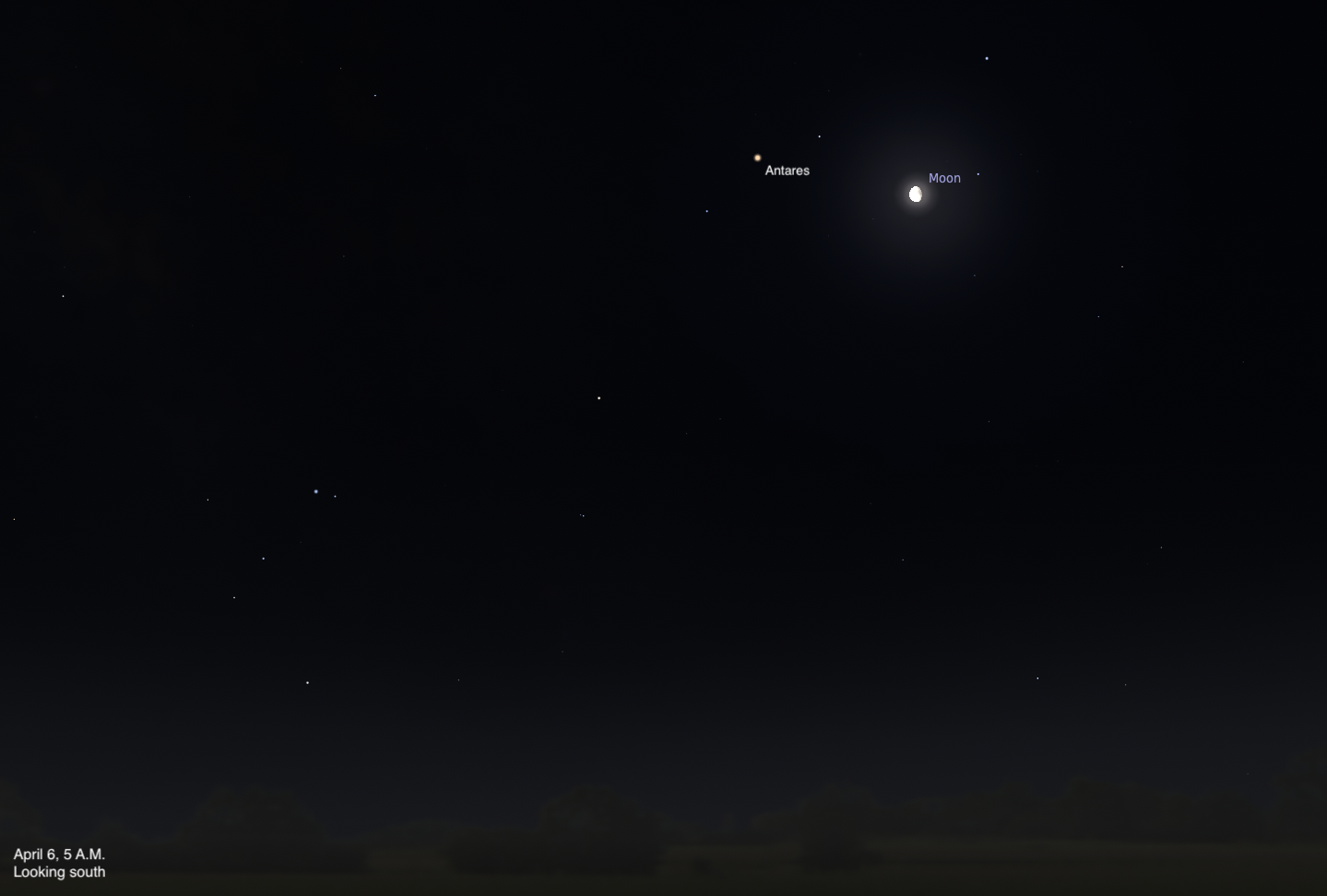
The bright Moon is visible near the deep orange-red star Antares early this morning. Credit: Stellarium/USGS/Celestia/Clementine
Look south around 5 A.M. local daylight time to find the waning Moon already embedded within Scorpius the Scorpion’s front claws. It lies just to the lower right (west) of Antares, also cataloged as Alpha Scorpii and a lovely red giant star whose color you can admire through binoculars or a telescope. That color is what has gained it its name — it is often called the Rival of Mars because it looks to so many observers like the Red Planet.
Shining at magnitude 1.1, Antares is an M-class star that is much more massive than the Sun, weighing in at some 15 to 18 times more, according to the late stellar expert Jim Kaler. Although it’s now much cooler than the Sun, Antares shines about 10,000 times brighter than our star, albeit from some 550 light-years away.
Antares is also a known double star, with a magnitude 5.5 companion visible just 3” away. Although this companion is a hot, blue-white star, it is one of a few stars that sometimes appears green to observers, thanks to the way human eyes see it in contrast with nearby ruddy Antares.