
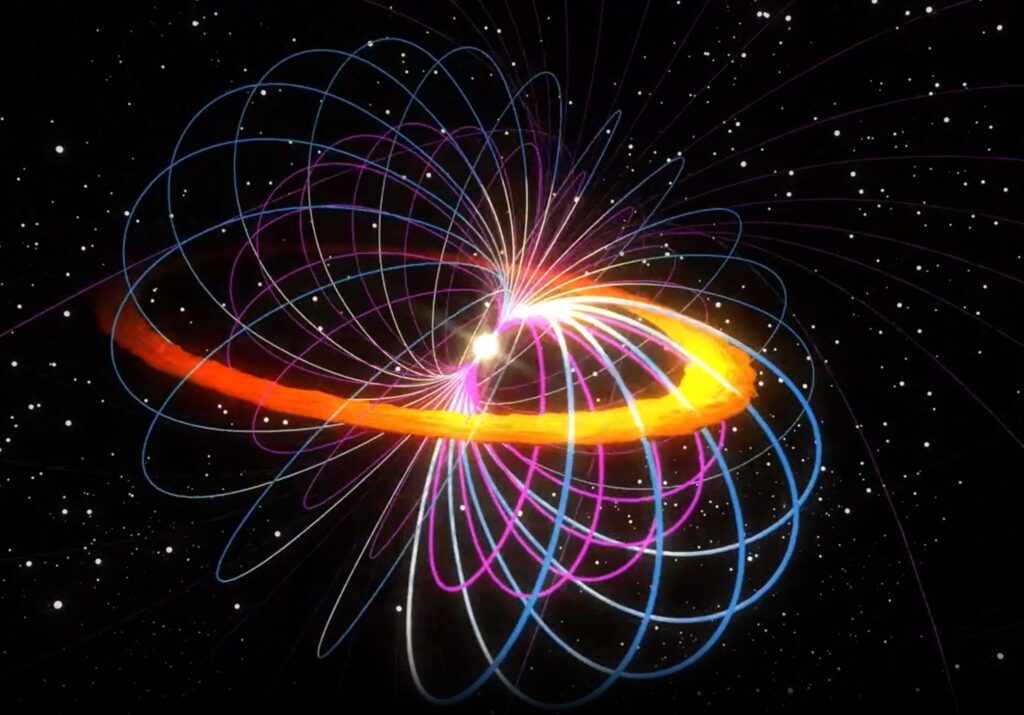
Scientists have discovered a new class of supernova remnants consisting of two objects. One half of its first known representative was named after Gandalf, the wizard from The Lord of the Rings.
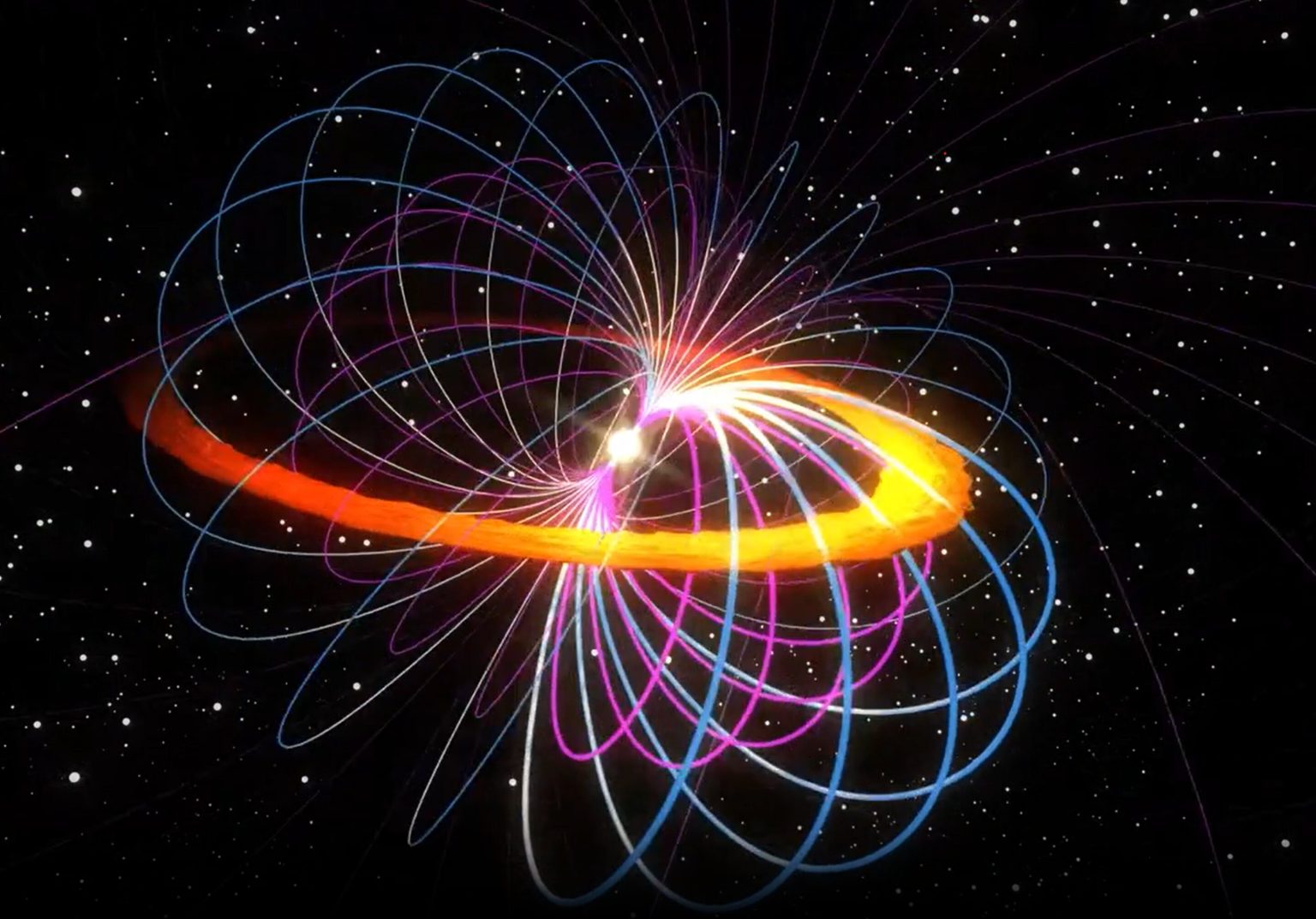 A new type of stellar remnant. Source: phys.org
A new class of binary objects
In about 5 to 8 billion years, our Sun is expected to become a white dwarf—an extremely dense, Earth-sized remnant of a star that has exhausted its fuel and shed its outer layers. But although our Sun is a single star, research over the past 15 years has shown that binary or multiple-star systems are far more common than astronomers previously believed.
When a dense, compact remnant, such as a white dwarf, forms part of a binary system, it often strips material from its companion star. This process, known as accretion, is typically accompanied by X-ray emission, which is considered a “signature” signal.
Now, scientists from the group led by Ilaria Caiazzo, an associate professor at the Austrian Institute of Science and Technology (ISTA), have confirmed the detection of an X-ray signal not in one, but in two isolated objects, named “Gandalf” and “Moon-sized.” These two objects, which exhibit high magnetic activity and rotate rapidly, are called “merger remnants” because each was formed as a result of a violent cosmic collision. Since they emit X-rays without a companion, they now constitute a new, distinct class.
“Gandalf” — The Lord of the Half-Ring?
Gandalf isn’t exactly a new discovery. Caiazzo first spotted it during her postdoctoral research and classified it as an interesting object because of signals indicating the presence of matter around it. At first, scientists thought it was a binary system, but the object’s rapid orbital period pointed to its mysterious characteristics.
“If Gandalf were involved in a binary system, it would have been highly unsynchronized, which might have made it even more puzzling than it already is. But we never found a companion. So, where does the circumstellar material come from?” says Andrei Cristea, a graduate student in the Caiazzo group.
To find the answer to this question, the team used a clue derived from the optical spectra of the radiation—a widely used observational method in astronomy.
“We saw hydrogen emission spectra that exhibited a double-peaked signature, similar to cat ears,” says Cristea. “Usually, this signature indicates the presence of a disk of material surrounding a merger remnant. However, by examining the signal more closely, we realized that it was alternating between the two peaks over the remnant’s six-minute spin period.”
This intriguing observation confirmed the presence of a semicircular ring of material surrounding the star. “We have never seen anything like that before in any white dwarf,” he adds. The team went on to demonstrate that, in order for the material surrounding the merger remnant to be asymmetrically confined in a semicircular shape, the object must possess a strong and asymmetric magnetic field.
Thus, astronomers have demonstrated that “Gandalf” is one of only two known white dwarf merger remnants with asymmetric magnetization. All these mysterious circumstances prompted Cristea to name this celestial object after the famous hero of J. R. R. Tolkien’s novels, who loved to speak in riddles.
“Moon-Sized”—is this a more advanced version of “Gandalf”?
Although the team didn’t find a companion for Gandalf, it’s possible it has a twin in a completely different part of the Universe.
When Caiazzo published her discovery of a white dwarf in 2021—which she described as “Moon-Sized”—this stellar object possessed a number of unique properties. In addition to having a very strong magnetic field and spinning rapidly, it also had a mass equivalent to that of the Sun, while being about the size of the Moon—or slightly larger, as shown by new data in a study led by Aayush Desai, another graduate student in the Caiazzo group.
Astronomers at ISTA have discovered that “Moon-sized” and “Gandalf” share five common characteristics. In addition to being extremely massive, having high magnetic fields, and spinning rapidly, these remnants also have no companions and both emit X-rays. These five common properties led ISTA scientists to propose “Gendalf” and “Moon-Sized” as two representatives of a new class of remnants.
However, these two objects also have significant differences: unlike “Gandalf,” “Moon-sized” shows no signs of surrounding material. Furthermore, if “Gandalf” is the result of a collision that occurred 60–70 million years ago, “Moon-sized” is seven to eight times older, since its formation took place approximately 500 million years ago.
Three scenarios regarding the source of X-ray radiation
The team of scientists proposes several scenarios to explain their findings, particularly regarding the source of the X-ray radiation.
According to the first scenario, a highly magnetized star could have been spinning fast enough to generate a powerful force that pulls matter away from it. “This is my favorite scenario because it only accounts for the white dwarf itself rather than material originating from outside the star remnant,” says Desai. According to the team, this so-called outflow scenario is known to occur in highly magnetized neutron stars, known as pulsars, although it has never been modeled for the remnant of a white dwarf star.
In their second scenario—this time involving an “influx” of material—they hypothesize that the remnant trail of material formed as a result of the merger may not have fully accreted onto the star’s remnant after the explosion. By orbiting the merger remnant with a high eccentricity—that is, moving away along a wide orbit, far from the star, before returning closer—this trail could have “circled back” to the remnant over hundreds of millions of years.
In their third scenario, the team explores yet another source of “incoming” external material. “We know that a third of white dwarfs are ‘polluted,’” says Desai. “They are so dense that we would expect external material, such as asteroids or even disrupted planetary bodies, to collapse onto them.” Although “Gandalf” shows some signs of contamination, possibly due to materials rich in carbon or silicon, the team did not detect such signals from the much older “Moon-sized” object. “This scenario seems less likely, as it does not fully explain why we see the X-rays in both objects right now,” Desai explains.
According to phys.org