
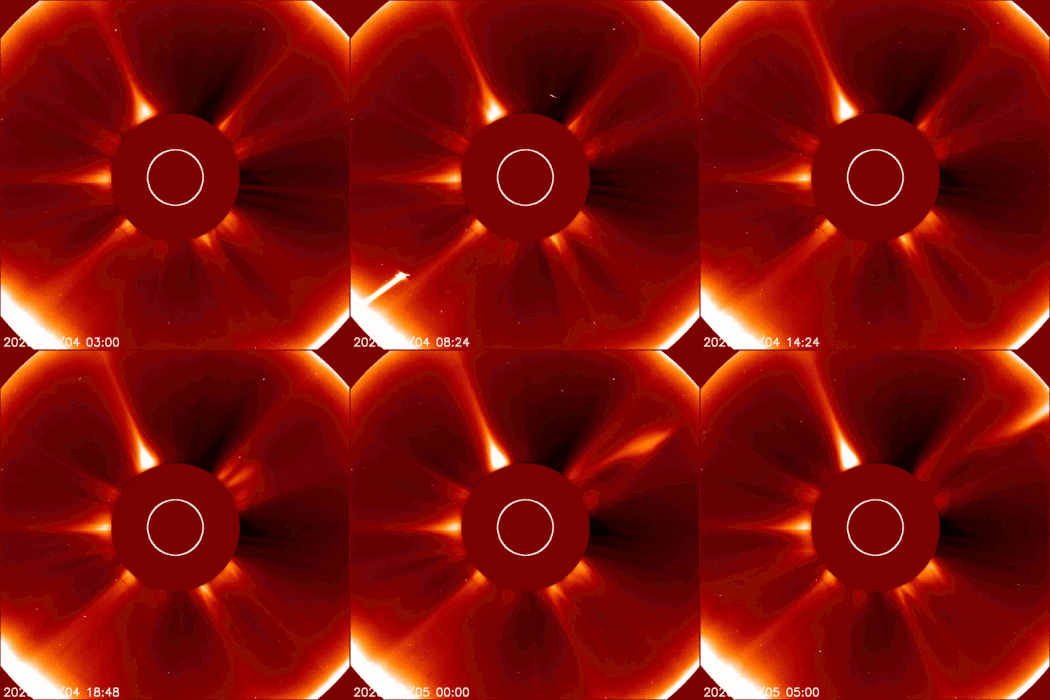
Comet MAPS disintegrates on April 4, 2026, as seen by NASA’s Solar and Heliospheric Observatory.
NASA Solar and Heliospheric Observatory
A comet once forecast as a potential showstopper has instead met a fiery end at the sun just as NASA’s Artemis II astronauts prepared to see a total solar eclipse from beyond the moon.
Comet MAPS (C/2026 A1), which some astronomers thought could be a possible “Great Comet,” was obliterated during an extreme close pass of the sun on April 4. Skywatchers’ focus now shifts to comet C/2025 R3 (PanSTARRS) that looks set to be visible in late April.
High-Risk Comet Gets No Reward
In late March, astronomers highlighted comet MAPS as a classic high-risk sungrazer. As part of the Kreutz sungrazer family, it belonged to a lineage known for both spectacular brightness and frequent disintegration.
Early estimates suggested the comet might pass roughly 487,000 miles (784,000 kilometers) from the sun’s surface and emerge with an enormous tail shining brightly in twilight during mid-April. However, observations by the James Webb Space Telescope revealed it to be much smaller than initially thought — and on an even closer pass of the sun. As it passed just 100,700 miles (162,000 kilometers) from the solar surface, it went behind the sun from the point of view of NASA’s Solar and Heliospheric Observatory — and never emerged.
Comet MAPS disintegrates on April 4, 2026, as seen by NASA’s Solar and Heliospheric Observatory.
NASA Solar and Heliospheric ObservatoryComet’s Final Moments
SOHO’s coronagraph, which monitors the sun’s immediate surroundings, captured the destruction of comet MAPS. As its nucleus disintegrated out of sight behind the sun, a stream of dust emerged from the other side.
Hopes that MAPS might produce a visible twilight display — or even a rare daylight comet — have now been dashed, an outcome that underscores the unpredictable nature of comets.
While some comets like MAP survive and brighten dramatically, many are destroyed before they can be seen with the naked eye.
PanSTARRS R3 Approaches
With MAPS gone, attention now turns to Comet C/2025 R3 (PanSTARRS), a more stable long-period comet expected to peak in late April.
PanSTARRS R3 will reach perihelion on April 20 at a distance of about 46 million miles (76 million kilometers) from the sun — far safer than MAPS’ very close trajectory took it. PanSTARRS R3 will make its closest approach to Earth on April 27, when it is likely to be at its brightest — though comet-hunters will be out with binoculars an hour before sunrise from around April 15.
Predictions for its brightness vary widely. It could remain a binocular object at magnitude 8, or brighten to magnitude 2.5, making it visible to the naked eye under dark skies.
MORE FROM FORBESSee A ‘Pink Moon,’ Meteors, A Comet And Venus: April’s Night SkyBy Jamie Carter
 When And Where To Look
Observers in the Northern Hemisphere should look to the predawn sky in late April, particularly around April 25, when the comet’s brightness may peak. It will pass through the constellation Pisces, near the Great Square of Pegasus.
Viewing conditions will be good, with a new moon on April 17, meaning relatively darker skies. The better news is that forward scattering — where sunlight reflects off the comet’s tail toward Earth — could enhance its brightness from our point of view, according to Sky & Telescope.
Will PanSTARRS R3 become a standout celestial event or be merely a faint visitor seen through binoculars? That remains to be seen. Either way, April 2026 will remain an intriguing month for skywatchers.
Wishing you clear skies and wide eyes.
This article was originally published on Forbes.com