
Andy Weir discusses the pleasures of world-building, the promise of AI, and the coolness of humanity.
Project Hail Mary by Andy Weir. Ballantine Books, 2021. 496 pages.Buy on Bookshop.org
Did you know LARB is a reader-supported nonprofit?
LARB publishes daily without a paywall as part of our mission to make rigorous, incisive, and engaging writing on every aspect of literature, culture, and the arts freely accessible to the public. Help us continue this work with your tax-deductible donation today!
This interview is part of The Rules We Live By, a series devoted to asking what it means to be a human living by an ever-evolving set of rules. The series is made up of conversations with those who dictate, think deeply about, and seek to bend or break the rules we live by.
¤
“BIT BY BIT, the requirements of the life-form came into focus,” Andy Weir tells me, describing how he created the alien Rocky in his 2021 novel Project Hail Mary. He launches through a series of scientific puzzles, asking “how do I make a water-based life-form on a planet that is closer to its sun than Mercury is to ours?” and “how do they tell what’s going on in their environment [when there is no light]?” Bit by bit, Rocky comes to life, a spiderlike being with no face from the distant planet Erid.
Weir’s writing process is driven by these types of questions. He describes the genesis of Project Hail Mary as the intrigue of a hypothetical scenario: “What if humanity had a mass conversion–based spacecraft fuel? Like right now.” Such a technology could solve Earth’s energy problems and ease space travel, Weir muses. From this prompt, he created “astrophage,” a mold-like alien microbe that lives on stars while consuming their energy, and the crisis at the center of the story: by consuming and dimming stars, including our sun, astrophage are threatening another ice age on Earth—and throughout the universe.
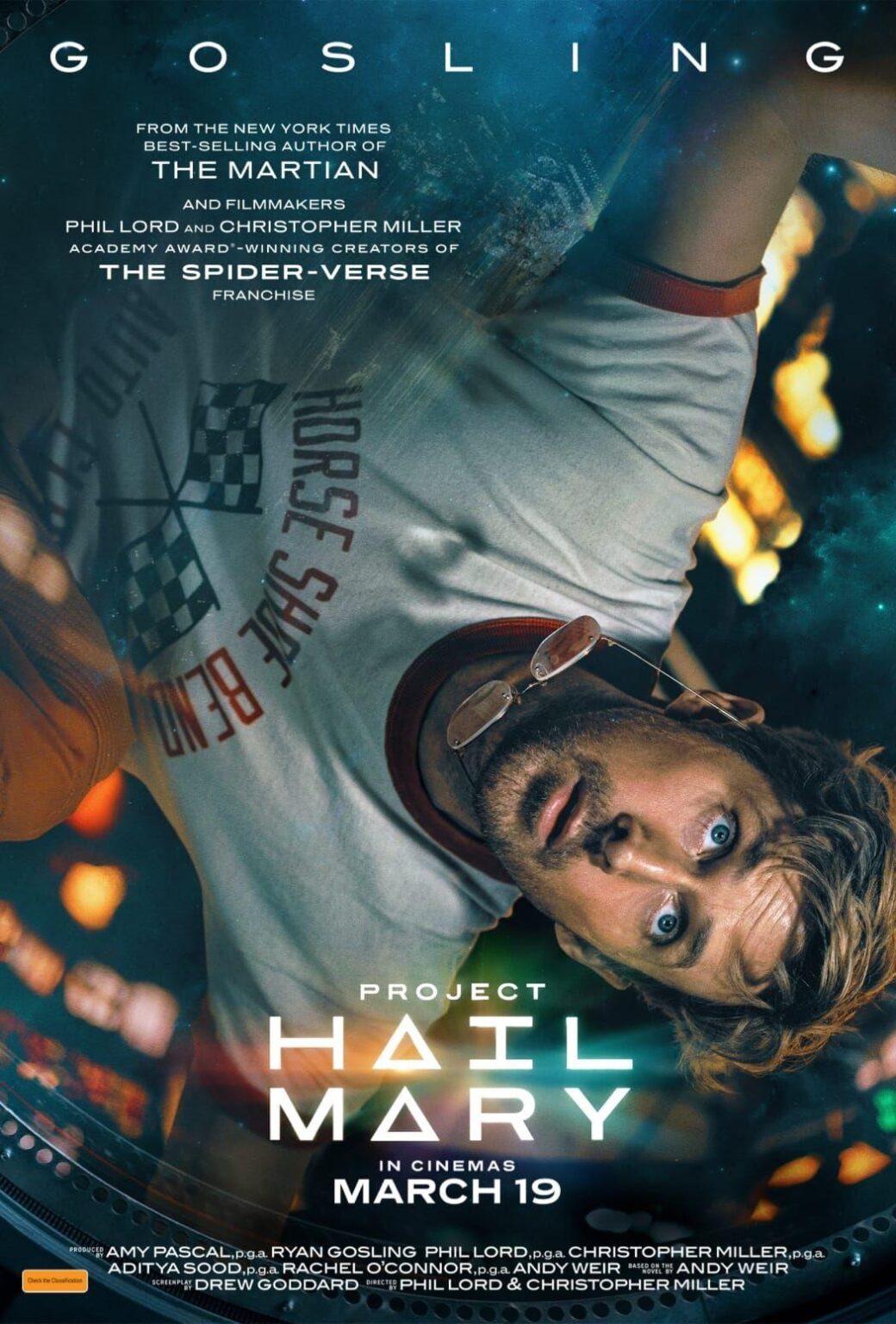
But at the heart of Project Hail Mary is the relationship between the main character, Ryland Grace, a scientist turned schoolteacher sent on a suicide mission to the star Tau Ceti to discover what makes it astrophage-resistant, and Rocky, his Eridian counterpart. In the recently released film adaption of Project Hail Mary, Ryland is played by Ryan Gosling, and Rocky by a team of puppeteers. “You’re lucky,” Weir tells me, “if you get five percent of the book’s events into the screenplay.”
After watching Project Hail Mary at a premiere in Los Angeles, I met with Weir to discuss the book and its film adaptation. In our conversation, we covered the publishing industry, book-to-screen adaptions, how Weir imagines aliens, whether they exist, and why he is optimistic about humanity’s future.
¤
JULIEN CROCKETT: The main character in Project Hail Mary is Ryland Grace, a middle school teacher with a doctorate in molecular biology. In his words, academia “didn’t work well for” him, and on his way out, he wrote a “‘kiss-my-butt’ goodbye” paper titled “An Analysis of Water-Based Assumptions and Recalibration of Expectations for Evolutionary Models,” in which he argues that water is not necessary for life. Where did this theory come from?
ANDY WEIR: I present the idea as fringe, but it’s actually not that uncommon among those who speculate on how life could form. That whole sequence was really there to service two things. First, Ryland’s wrong. In the book, all of the life he encounters is water-based. I don’t like infallible main characters who are right about everything. Sometimes, when the rest of the world is telling you one thing and you believe something else, it’s the world that’s right. And the other thing is, I wanted it to be a demonstration of his personality. He’s so conflict-averse and, frankly, cowardly that as soon as he ran into problems, he just fled to the safety of being a popular middle school teacher. The kids aren’t going to challenge him or his beliefs, and that’s a much safer place for him.
Ryland’s theory doesn’t necessarily reflect any personal beliefs of mine, although I personally subscribe to the idea that water is not necessary for life. Life is just a molecule that somehow can cause a copy of itself to be made. That’s it. I don’t believe that water is critical for that.
Do you think we can recreate biology mechanically, or in software?
Like virtually? Yes. That’s an exciting idea that I’ve thought about for a long time. Once we get computers that are powerful enough, we’re going to be able to simulate an entire living cell at the atomic level without making any assumptions. We’ll just put all the atoms in the correct place to be a simple, single-celled organism, and step it forward in time, and see what happens.
What I’m even more excited about now is using generative AI to figure out protein folding. It’s already getting good at figuring out what shape a protein will fold into given the sequences. The way we taught AI to make images was taking an image and then putting a few ugly pixels in there, deliberately messing it up, and developing an AI that could correct it. We would then mess it up more and develop an AI that could correct that. Eventually, we could say “Give me an image of a garden gnome,” and starting with static, the AI would go “Okay, I’ve got to correct this until it’s a garden gnome.”
Now what we’re doing is saying “I want a protein that makes this shape. So what sequence of amino acids do I need to make that happen?” And AI is able to do that. Pretty soon, we’re going to be able to say “Computer, I need something that’s exactly this shape,” because “this shape” is something that will attack the cancer cells in this patient but won’t harm the healthy cells. We can then add it into E. coli, breed it up, filter it out, inject it into the patient, and cure their cancer. That is the sort of stuff I’m really excited about for the near future.
But that’s me as a science fiction author, probably hand-waving past thousands of extraordinarily difficult hurdles we need to overcome.
What do you think is AI’s potential in your field as an author?
I messed around with AI when it was just starting out and it was really bad at writing. Not that I was planning on having AI write my books. I was curious. But I think it will be good later on. I might be among the last generation of human authors. It’s only a matter of time before AI is able to write more entertaining, compelling, and exciting stories than any human. Train an AI on all the great works of literature, all the great books that people have loved, and it’ll figure out the commonalities and put together stories that are really awesome, in the same way that it can make art that’s really pretty when properly prompted.
Given this, I think the industry is going to shift away from collective entertainment to a personal form. You’ll have an AI that knows you. It knows your interests, just like Google knows you. And you’ll be able to say to the AI “Make a book that I will enjoy,” and it’ll make a book specifically tailored to you. Your best friend may think it’s really lame. But that doesn’t matter because it’s good for you.
So, I think the whole face of entertainment is going to change, probably within our lifespans. I’m going to be out of my job eventually, but I got in under the wire.
But isn’t a lot of what people enjoy about art the community experience and the person behind it? The human creator? It’s hard to see faceless AI creators replacing that aspect of art.
Take a tool like Photoshop. It can do all sorts of really cool things, but nobody wants to talk to the program. Nobody wants to talk to Google SketchUp about its process in rendering 3D models. People accept that there are tools that do this.
But just like the original art forms, human authors will never completely go away. They’ll become niche. Television and movies pretty much replaced live entertainment, but not entirely. There are still plays and people still like to go to them. Photography replaced portrait painting, but not entirely. There are still people who like to get their portraits painted by a human. What was once routine becomes niche.
These are all just my predictions. You can play this back in 50 years and see how hilariously wrong I was.
I want to turn to the aliens in your book, but first, do you believe there is life beyond Earth?
There is absolutely life beyond Earth, and even intelligent life. If you pick whatever numbers you want to figure out the odds against that happening on any given planet, and then multiply that by the number of planets in the universe, you’re going to get some, right? There are so many opportunities for it to happen, and with the fact that it happened at least once, it seems likely that it’s happened elsewhere.
However, I also believe that the speed of light is absolutely inviolate. I believe that a million years from now, we will still not have the ability to travel faster than light or send information faster than light. It’s just not a thing we will ever be able to do. So there may be other intelligent species, maybe even in our own galaxy, but our galaxy is 100,000 light-years across. So if the nearest intelligent aliens are 10,000 light-years away, it would take 10,000 years to say “hello” and then 10,000 years to get a response. So I believe that, presuming we don’t have an extinction event, humans will eventually spread out into the stars and go further and further out, but it will be literally millions of years until we run into an intelligent species out there.
What do you see as the biggest hurdles to our becoming a spacefaring civilization?
Well, we are a spacefaring civilization: it’s been 30 years or so since the last time there were no humans in space. But I know what you mean. I think the answer is the cost. The expense of putting people into space. But the competition between companies like SpaceX, Blue Origin, and Boeing—some international companies as well—will drive down the cost. And the first company that is able to put people into space for a reasonable length of time, maybe like a nice space hotel, and then bring them back to Earth for a price that a middle-class person can afford as a once-in-a-lifetime opportunity—that company is going to be wildly profitable, and that will drive technological development.
If you look, for example, at the aviation industry, in 1903, the Wright brothers managed to make a plane travel a couple hundred feet. Fifty years later, you had transatlantic flights as the norm. So as soon as there is a profit incentive, as soon as companies can take money from customers to give them that service and then turn that money into research to be able to do it better, you’re going to have runaway technological advancement. So we’re not there yet …
When do you think we will be?
In our lifetime. If a company can make dying in spaceflight as rare as dying in air travel and turn a profit, you’re set. I bet you people would like to go to the moon.
Okay, back to the aliens. You have two main types of aliens in your book: the first is astrophage, which becomes a source of fuel, and the other is Rocky from the planet Erid, who becomes a partner to Ryland. How did you come up with them?
I started this story with the question “What if humanity had a mass conversion–based spacecraft fuel?” Like right now. Not 1,000 years from now when we might invent it, but right now. And what could we do with it? Well, if we had that, we could colonize the solar system. It would be trivial. It would solve all of the world’s energy problems because most of our energy problems are about energy storage and transport, not about collection. But it’s a bit much for me to say “Oh, some random mad scientist invents this, and now that problem is solved.” That didn’t ring true. So, I thought, what if it was like a crashed alien spaceship? That’s fine, but then how do we make more? Well, maybe you can use some of it to make more of it—like, maybe it absorbs energy and gains mass. Well, something that absorbs energy and makes more of itself sounds like life, right? So, what if it was a life-form that did this? Well, why would a life-form do mass energy conversion? And why would we encounter it? Well, maybe it’s a mold that lives on stars, and it spores out, and it needs to do mass energy conversion to be able to travel light-years to get to nearby stars and keep sporing out. Like mold.
So, if we got a hold of that, then we could breed it, and everything would be great. But we would have to be pretty careful to make sure it didn’t get on our sun, because that would fuck us up. And that was when I realized: that’s the story. That’s how we first encounter it. It’s on our sun.
And Rocky?
I also wanted to do a first contact story. Ryland and Rocky both meet in the Tau Ceti system because both species have the same problem and have figured out that this one star is not affected.
You describe Rocky as spiderlike. How did you come up with Rocky’s biology?
I started with the real star 40 Eridani A, which has an exoplanet, 40 Eridani A b, or Erid, which I decided would be Rocky’s homeworld. Erid is eight times Earth’s mass. It orbits the star once every 46 days. I also decided that there was one genesis of life. I didn’t like the idea of an individual life genesis on three stars that are all so close together. That’s why I picked the star Tau Ceti, because it is much older than Sol. It had a head start. So, I decided life evolved on the planet Adrian, which orbits Tau Ceti. That’s the only place it evolved. And a panspermia event happened with what we could call primordial astrophage. Like a distant ancestor of astrophage that was able to do interstellar travel and ended up seeding life on, among other things, Earth and Erid. That’s why we’re actually all related and why Rocky’s and astrophage’s and our cells all have ribosomes, mitochondria, and the same cellular mechanisms that evolved on Adrian.
But that means that Rocky’s species has to be water-based, right? So, how do I make a water-based life-form on a planet that is closer to its sun than Mercury is to ours? Well, if you want to have liquid water on a planet that’s really hot, you can do that if it has a really high atmospheric pressure, because the higher the pressure, the higher the boiling point of water. So, the water is over 200 degrees Celsius on the surface of Erid, but it doesn’t boil because the atmospheric pressure is 29 times ours. So, thick atmosphere and oceans and all that. But how do you keep a thick atmosphere when you’re that close to the star? Stars sandblast atmospheres off of planets. There are two things you can do. One, you can have really heavy molecules in your atmosphere. That is what Venus has with carbon dioxide. It’s hard to knock carbon dioxide off with solar wind, so it just tends to stay there on Venus. Second, you can have a strong magnetic field to ensure that life isn’t getting bombarded with radiation, which means the planet needs to rotate really fast.
So, I know they have a short day. I know the length of the year. I know they have a thick atmosphere. I know it’s really hot on the surface. Now I need to design a biosphere. I decided that their atmosphere is made of ammonia, a nice heavy molecule that’s really hard to knock around. How do I make life that is water-based and works off of our same principles in this environment? We know the atmosphere is thick, so sunlight wouldn’t reach the bottom. It’s more like an ocean, which has beings like algae that absorb light in the upper atmosphere. Then there’s stuff that eats that all the way down to fish deep in the ocean where sunlight has never been.
Now what is the apex predator that developed intelligence on this planet? That’s where I got to take creative liberties. I wanted it to be really alien. Not like a Star Trek alien. We know there is a lot of gravity, so you’re squat or sure-footed, and we’re going to give you five limbs. You also have a rocky carapace, because there’s no free oxygen in the atmosphere. There’s obviously no reason to have eyes because there’s no light, so no need to evolve that. So, how do they tell what’s going on in their environment? Well, echolocation would work great, especially in a nice, thick atmosphere.
Bit by bit, the requirements of the life-form came into focus, and then everything else was just creative liberties.
You sound like you enjoy the research aspect of your work.
The research is by far the most fun part for me. Writing is not as fun. I mean, you know, you’re a writer.
The fun of the blank page, yeah.
Writing is like gardening. When people garden, they don’t enjoy digging roots out of the ground. They don’t enjoy being bitten by bugs. They don’t enjoy the hot sun on their skin. They don’t enjoy getting sweaty and dirty. They enjoy finishing the task and then being able to have a nice cup of coffee on their back patio and look at the beautiful garden they’ve made. So I don’t like writing. I like having written.
This is the second movie based on one of your books. What was the process of translating the book to film like? Did the medium impact the story?
In both cases, it translated very well, and I owe that to Drew Goddard, who wrote the screenplays for both The Martian (2015) and Project Hail Mary. He did such an amazing job on The Martian that we held up the production and waited for Drew’s availability to write the screenplay for Project Hail Mary.
When you’re doing a book-to-screen adaptation, you’re lucky if you get five percent of the book’s events into the screenplay, which makes sense. If you read Project Hail Mary, it might take you 20 hours over several sessions. The movie is about two-and-a-half hours. You have a very limited amount of time and space to tell the story. The first thing Drew does is look at the book and ask, “What is the core of the story? What are the most important aspects?” That’s what needs to be highlighted. Everything else will either have to be dropped, condensed, or merged into other similar plotlines to stay true to the core element of the story. In the case of Project Hail Mary, it’s all about the relationship between Rocky and Ryland. Everything was subordinate to that. The second most important thing was the relationship between Ryland and Eva Stratt [leader of the international task force handling the global astrophage crisis, played by Sandra Hüller in the film]. Every scene in the movie services one of those two plots.
That really came through in the film. The other aspect that translated well was the humor.
Ryan Gosling is an amazing actor. I know it’s normal for someone involved in a film to gush about the lead, but it really is true. He has such incredible range. I think people are only now beginning to get that, because he’s a good-looking guy and he’s usually cast in these roles where he is stoic with flat affect like in Drive (2011) or Blade Runner 2049 (2017). But he’s got this tremendous personality. And he’s part of the creative process. He riffed a lot in the film. A lot of what you see in the movie was ad-libbed. I like to say that Ryan considers the screenplay to be sort of a suggestion. But, I mean, he just nailed the role. I can’t imagine anybody else having done that.
I want to end with how the world responded to the astrophage crisis in Project Hail Mary. You portray the global community as banding together to overcome one obstacle after another. Do you think that type of collective action would be possible today?
I might be the wrong guy to ask because I’m a bit of a Pollyanna. I have a very positive view of humanity, and I’m an optimistic guy. I think humanity is way cooler than we give ourselves credit for. I would point to COVID-19 as an example. Now, obviously there was a lot of disorganization, there was a lot of disinformation, and it was messy. But I want you to look at the big picture. As a species, we got together and did things that would have been thought impossible before the pandemic. For instance, pharmaceutical companies are usually in vitriolic competition with one other, guarding their secrets better than governments do. But when it was time to research vaccines for COVID, they freely shared information. That doesn’t happen. And then mRNA vaccines were only a concept when the pandemic began. If it were not for the pandemic, it would probably be 20 or 30 years of slow, methodical research before they were being used. But within one year, we got it working.
A lot of us have very negative feelings about the COVID era, but I think it is a good example of the world working together. I’m not going to get into my own political beliefs, but the United States has never been a nationalized healthcare country, right? I mean, we have Medicare and Medicaid, but that’s it. But we had free COVID shots. Tents in every city. So, in cases of dire emergency, we humans will throw away all of the rules we’ve been following to confront the crisis.
¤
Andy Weir built a two-decade career as a software engineer until the success of his first published novel, The Martian (2011), allowed him to live out his dream of writing full-time. He is a lifelong space nerd and a devoted hobbyist of such subjects as relativistic physics, orbital mechanics, and the history of manned spaceflight. He also mixes a mean cocktail. He lives in Illinois.
LARB Contributor
Julien Crockett is an intellectual property attorney and the science and law editor at the Los Angeles Review of Books. He runs the LARB column The Rules We Live By, exploring what it means to be a human living by an ever-evolving set of rules.
Share
Copy link to articleLARB Staff Recommendations
Andy Weir returns to space with his examination of the dark side of life on the Moon in “Artemis.”
Julien Crockett speaks with Ted Chiang about the search for a perfect language, the state of AI, and the future direction of technology.