
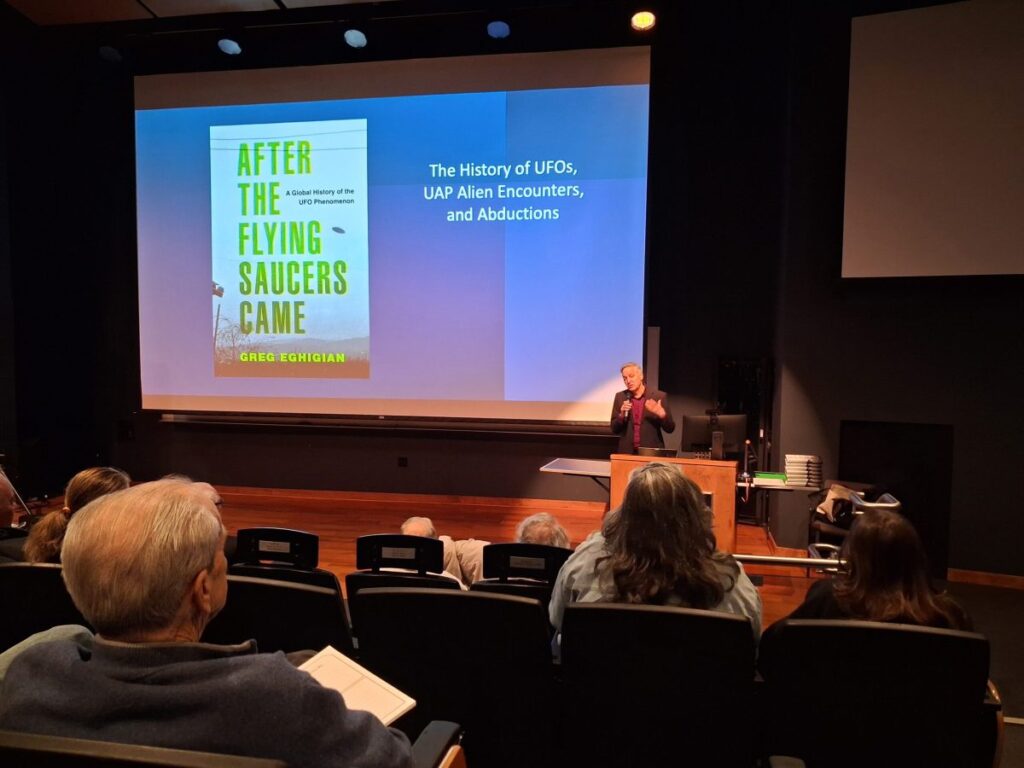
With seating for 300, Gibble Auditorium was filled to near capacity on March 27 to hear a lecture from Dr. Greg Eghigian on the history of unidentified anomalous phenomena or UAPs. They may be more commonly known as UFOs.
Eghigian is a professor of history and bioethics at Penn State University, specializing in the history of human sciences, but more recently, Eghigian has dived into an area of study that had limited existing scholarship—UFOs and UAPs.
Years of research has culminated in his new book, “After the Flying Saucers Came: A Global History of the UFO Phenomenon.” Eghigian stresses that neither his book nor his lecture is intended to defend or debunk claims of UFO sightings or other extraterrestrial encounters. Rather, they delve into why and how UFOs became a cultural curiosity in post-World War II America and the wider world.
“The turnout was fabulous. I don’t know that we knew what kind of turnout it would be,” Eghigian said. “We had people of all ages. That to me tells us that this is a fun, interesting, exciting topic.”
Eghigian’s lecture, which was open to the public, was sponsored by the Society for UAP Studies, an organization he has been involved in since its inception in 2022. For the past year, Eghigian has served on the advisory council that leads the direction and operations of the Society.
The Society for UAP Studies has deep ties to Elizabethtown College. Its cofounders are Dr. Michael Cifone, an Adjunct Professor of Philosophy at St. John’s University who earned his undergraduate degree from Etown in 2000, and Dr. Michael Silberstein, Professor of Philosophy and Professor of Science, Society and Technology in the School of Engineering and Computer Science at Etown.
“We became very interested, as many Americans have at this point, in this UFO/UAP topic,” Silberstein said. “We think there’s plenty of evidence that there’s some there. What we’re devoted to is exploring that as scientifically as possible.”
The Society is made up of dozens of researchers and academics from varying humanities and STEM fields across the globe devoted to analyzing and studying UAPs in a scholarly environment. They also publish a peer-reviewed journal, Limina. The group believes that there has been a lack of serious scholarship regarding UAPs.
“We want to increase this as a subject in higher education,” Silberstein said. “We also want to be a vehicle for education, so we have classes and speakers, and then also to create an environment where we get research dollars to people who are going to do stuff like build new sensors.”
In the years leading up to and succeeding the Society’s founding, there has been increased public curiosity surrounding UAPs, especially following recent congressional committee hearings and the declassification of UAP footage taken by military aircraft.
At Eghigian’s lecture, Silberstein took the opportunity to announce a partnership between Elizabethtown College and the Society for UAP Studies to offer an introductory class on UAP studies to a wider selection of interested people via the Internet. Silberstein himself began teaching the Introduction to UFO/UAP Studies class this semester and has around twenty Etown students enrolled in it. It counts as a humanities core course and will be offered again on campus in Spring 2027.
“In terms of a straight up introductory UAP course for college credit, I think it’s probably the first in the United States,” Silberstein said.
Eghigian’s lecture is not the first UAP lecture held at Etown. In March of last year, the college hosted Dr. Tim Gallaudet, a retired U.S. Navy rear admiral, for a lecture about seaborne UAPs. The Society for UAP Studies was not involved with that lecture but has had interactions with Gallaudet.
For Silberstein and others within the Society for UAP Studies, the organization represents an opportunity to destigmatize discussion of UAPs and build legitimate scholarship around the subject. He likened it to the recent study of potential medicinal benefits sourced from psychedelics.
“Until that stigma was broken lots of research and good work could never go forward,” Silberstein said. “The same thing is true about UAPs. We want the best minds in all the relevant disciplines to be working on this.”