
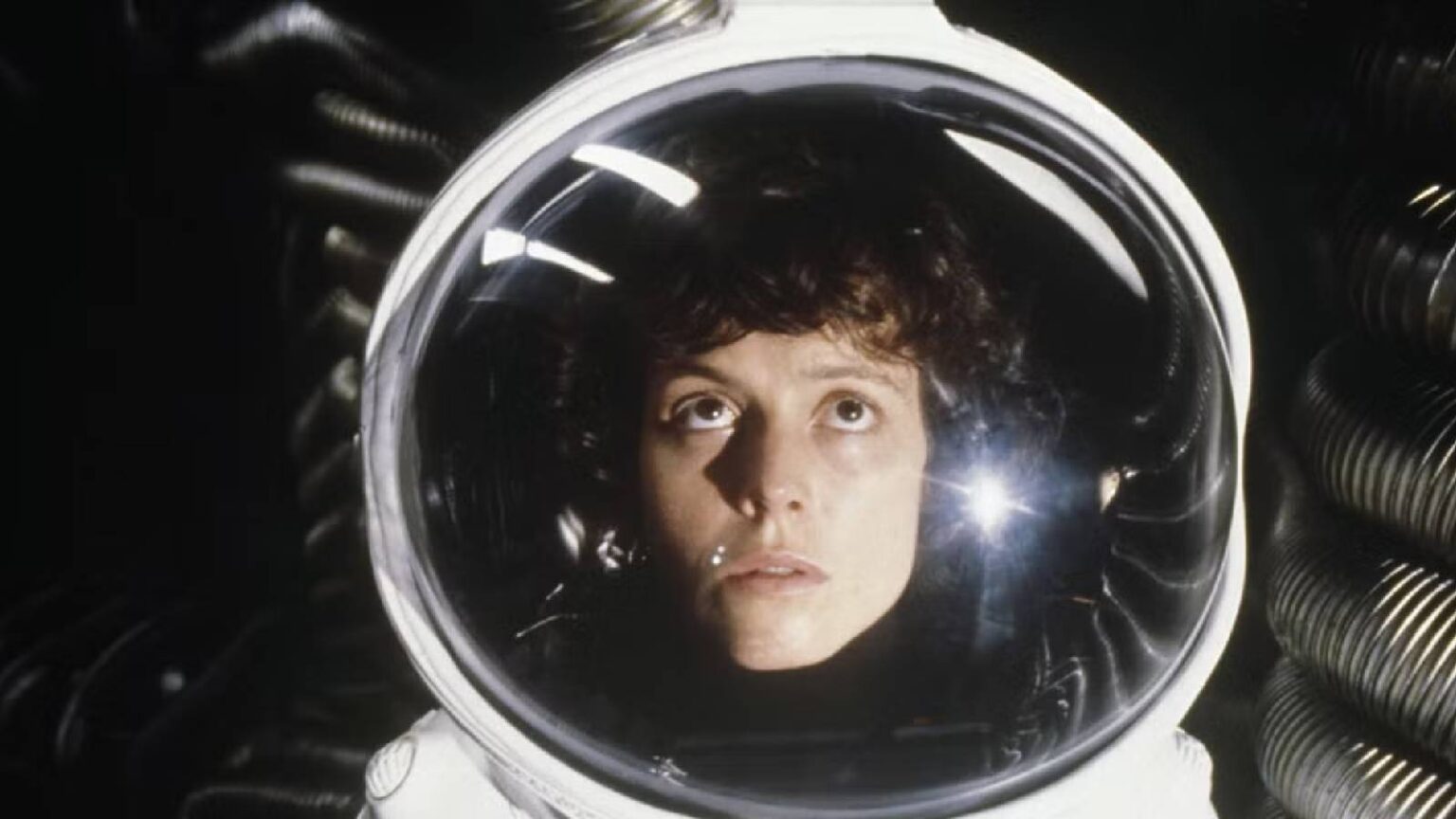
Sci-fi is usually associated with spectacle: spaceships, alien worlds, futuristic technology. However, the genre’s most enduring stories go deeper than just those trappings. Indeed, they turn inward and touch on rich themes, using the unfamiliar to illuminate the deeply human, all while serving up compelling characters who hold our attention.
The science fiction movies on this list all boast intriguing heroes or antagonists, and the characters’ decisions provide most of the narrative momentum. Often, these fascinating figures are confronted with something they cannot quite comprehend, forced to reckon not just with aliens or machines, but with themselves. In the process, they craft thought-provoking arcs that leave you pondering and perhaps a little changed.
Collider Exclusive · Sci-Fi Survival Quiz
Which Sci-Fi World Would You Survive?
The Matrix · Mad Max · Blade Runner · Dune · Star Wars
Five universes. Five completely different ways the future went wrong — or sideways, or up in flames. Only one of them is the world your instincts were built for. Eight questions will figure out which dystopia, galaxy, or desert wasteland you’d actually make it out of alive.
💊The Matrix
🔥Mad Max
🌧️Blade Runner
🏜️Dune
🚀Star Wars
TEST YOUR SURVIVAL →
01
You sense something is deeply wrong with the world around you. What do you do?
The first instinct is often the truest one.
APull on every thread until I understand the system — then figure out how to break it.
BStop asking questions and start stockpiling — food, fuel, weapons. Questions don’t keep you alive.
CKeep my head down, observe carefully, and trust no one until I know who’s pulling the strings.
DStudy the patterns. Every system has a rhythm — learn it, and you learn how to survive it.
EFind the people fighting back and join them. You can’t fix a broken galaxy alone.
NEXT QUESTION →
02
In a world of scarcity, what resource do you guard most fiercely?
What we protect reveals what we believe survival actually requires.
AKnowledge. If you understand the system, you don’t need resources — you can generate them.
BFuel. Everything else — movement, power, escape — runs on it.
CTrust. In a world of fakes and informants, a truly reliable ally is rarer than any commodity.
DWater. And after water, information — the two things empires are truly built on.
EShips and credits. The galaxy is big — you survive it by being able to move through it freely.
NEXT QUESTION →
03
What kind of threat keeps you up at night?
Fear is useful data — if you’re honest about what you’re actually afraid of.
AThat reality itself is a lie — that everything I experience has been constructed to keep me compliant.
BA raid. No warning, no mercy — just the roar of engines and then nothing left.
CBeing identified. Once someone with power decides you’re a problem, you’re already out of time.
DBeing outmanoeuvred — losing a political game I didn’t even know I was playing.
EThe Empire tightening its grip until there’s nowhere left to run.
NEXT QUESTION →
04
How do you deal with authority you don’t trust?
Every dystopia has a power structure. Your approach to it determines everything.
ASubvert it from the inside — learn its rules well enough to weaponise them against it.
BIgnore it and stay out of its reach. The further from any power structure, the better.
CAppear to comply while doing exactly what I need to do. Visibility is the enemy.
DManoeuvre within it carefully. You can’t beat a system you refuse to understand.
EResist openly when I have to. Some things are worth the risk of being seen.
NEXT QUESTION →
05
Which environment could you actually endure long-term?
Survival isn’t just tactical — it’s physical, psychological, and very much about where you are.
AUnderground bunkers and server rooms — cramped, artificial, but with access to everything that matters.
BOpen wasteland — brutal sun, no shelter, constant movement. At least the threat is honest.
CA dense, rain-soaked city where you can disappear into the crowd and nobody asks questions.
DMerciless desert — extreme heat, no water, and something enormous living beneath the sand.
EThe fringe — backwater planets and busy spaceports where the Empire’s attention rarely reaches.
NEXT QUESTION →
06
Who do you want in your corner when things fall apart?
The company you keep is the clearest signal of who you actually are.
AA tight crew of believers who’ve seen behind the curtain and have nothing left to lose.
BOne or two people I’d trust with my life. Any more than that and someone talks.
CNobody, ideally. Alliances are liabilities. I work alone unless I have no choice.
DA community bound by shared hardship and mutual survival — people who need each other to last.
EA ragtag team with wildly different skills and total commitment when it counts.
NEXT QUESTION →
07
Where do you draw the line — if you draw one at all?
Every survivor eventually faces a moment that tests what they’re actually made of.
AI won’t harm the innocent — even the ones who’d report me without hesitation.
BI do what I have to to protect the people I’ve chosen. Everything else is negotiable.
CThe line shifts depending on who’s asking and what’s at stake.
DI draw a long-term line — nothing that compromises my people’s future, even if it’d help now.
ESome lines, once crossed, can’t be uncrossed. I know which ones they are.
NEXT QUESTION →
08
What would actually make survival worth it?
Staying alive is one thing. Having a reason to is another.
AWaking others up — dismantling the illusion so no one else has to live inside it.
BFinding somewhere — or someone — worth protecting. A reason to keep moving.
CAnswers. Understanding what I am, what any of this means, before time runs out.
DLegacy — shaping the future in a way that outlasts me by generations.
EFreedom — for myself, for others, for every world still living under someone else’s boot.
REVEAL MY WORLD →
Your Fate Has Been Calculated
You’d Survive In…
Your answers point to the world your instincts were built for. This is the universe your temperament, your survival instincts, and your particular brand of stubbornness were made for.
The Resistance, Zion
The Matrix
You took the red pill a long time ago — probably before anyone offered it to you. You’re a systems thinker who can’t help but notice the seams in things.
You’re drawn to understanding how the system works before figuring out how to break it.
You’d find the Resistance, or it would find you — your instinct for spotting constructed realities is the machines’ worst nightmare.
You function best when you have access to information and the freedom to act on it.
The Matrix built an airtight prison. You’d be the one probing the walls for the door.
The Wasteland
Mad Max
The wasteland doesn’t reward the clever or the well-connected — it rewards those who are hard to kill and harder to break. That’s you.
You don’t need comfort, community, or a cause larger than the next horizon.
You need a vehicle, a clear threat, and enough fuel to outrun it — and you’re good at all three.
You are unsentimental enough to survive that world, and decent enough — just barely — to be something more than another raider.
In the wasteland, that distinction is everything.
Los Angeles, 2049
Blade Runner
You’d survive here because you know how to exist in moral grey areas without losing yourself completely.
You read people accurately, keep your circle small, and ask the questions others prefer not to answer.
In a city where humanity is a legal designation rather than a feeling, you hold onto something that keeps you functional.
You’re not a hero. But you’re not lost, either.
In Blade Runner’s world, that distinction is everything.
Arrakis
Dune
Arrakis is the most hostile environment in the known universe — and you are precisely the kind of person it rewards.
Patience, discipline, and political awareness are your core strengths — and on Arrakis, they’re survival tools.
You understand that the long game matters more than any single victory.
Others come to Dune and are consumed by it. You’d learn its logic and earn its respect.
In time, you wouldn’t just survive Arrakis — you’d begin to reshape it.
A Galaxy Far, Far Away
Star Wars
The galaxy far, far away is vast, loud, and in a constant state of violent political upheaval — and you wouldn’t have it any other way.
You find meaning in being part of something larger than yourself — a cause, a crew, a rebellion.
You’d gravitate toward the Rebellion, or the fringes, or whatever pocket of the galaxy still believes the Empire’s grip can be broken.
You fight — not because you have to, but because standing aside isn’t something you’re capable of.
In Star Wars, that willingness is what makes all the difference.
↻ RETAKE THE QUIZ
10
‘Under the Skin’ (2013)

Image via A24
“I am not myself.” Jonathan Glazer’s Under the Skin is one of the most philosophical and identity-focused sci-fi movies of the last quarter-century. In it, an alien entity disguised as a human woman (Scarlett Johansson) roams Scotland, seducing and capturing men for an unknown purpose. As she continues her work, something begins to shift within her, a growing awareness that complicates her role as predator.
Johansson’s performance is hauntingly detached, gradually evolving into something more uncertain and vulnerable. For example, her early interactions are transactional and controlled. Later encounters, especially with the disfigured man (Adam Pearson), reveal hesitation and something like empathy. There isn’t much plot in the traditional sense. Instead, we get lingering close-ups, abstract imagery (the black void, the dissolving bodies), and observational sequences of everyday human life. All these elements externalize the alien’s inner state. Ultimately, Under the Skin very much refuses to explain itself, allowing its ambiguous meaning to emerge through feeling.
9
‘Ex Machina’ (2014)

Domhnall Gleeson and Oscar Isaac standing in a small corridor looking serious in Ex Machina.Image via A24
“Isn’t it strange to create something that hates you?” Ex Machina follows a young programmer, Caleb (Domhnall Gleeson), who is invited to administer a Turing test to Ava (Alicia Vikander), an advanced AI created by the reclusive tech genius Nathan (Oscar Isaac). However, Caleb soon begins to question the nature of Ava’s consciousness… and Nathan’s intentions. Alex Garland builds this premise into a psychological pressure-cooker, relying on little more than conversation.
The dialogue is precise and layered, exploring themes of consciousness, control, and manipulation. The setting is minimal, the cast small, yet the stakes feel immense. Every plot development emerges directly from the characters’ desires and traits, whether that’s Caleb’s loneliness and idealism, Nathan’s ego and tendency to underestimate people, or Ava’s hidden strategizing. The performances are strong across the board, doing a lot to flesh out the characters and give them interesting dimensions they might have lacked simply on the page.
8
‘Her’ (2013)

Image via Warner Bros. Pictures
“The heart’s not like a box that gets filled up. It expands in size the more you love.” Joaquin Phoenix delivers a brilliant performance in Her as Theodore, a lonely writer who develops a romantic relationship with an advanced operating system named Samantha (voiced by Scarlett Johansson). Their connection deepens way beyond that of owner and machine, challenging his understanding of love and intimacy. The tale that follows is disarmingly intimate, a major break with most sci-fi movies of its time.
Rather than being about killer robots or a mecha apocalypse, Her is all about emotions and psychology, love, and loneliness. It’s one of the most prescient films ever made about modern isolation and humanity’s relationship with technology. The aesthetics complement this approach perfectly. Spike Jonze creates a future that is soft, warm, and accessible, not that far off from our own, allowing the focus to remain on Theodore’s internal journey.
7
‘Gattaca’ (1997)

Ethan Hawke as Vincent Freeman in ‘Gattaca’Image via Sony Pictures Releasing
“There is no gene for the human spirit.” Gattaca follows Vincent Freeman (Ethan Hawke), a man born without genetic enhancement in a society that values perfection. Determined to pursue his dream of space travel, he assumes the identity of a genetically superior individual, risking everything to pass as something he is not. Although that premise draws heavily on hard sci-fi, it becomes the jumping-off point for a deeply human story about ambition and identity.
Unlike many dystopian films, Gattaca is not about overthrowing the system: there is no revolution, no mass uprising, no attempt to dismantle the genetic hierarchy. Rather, the story is intensely personal, and Vincent’s inner defiance drives the whole plot, refusing his assigned limitations and the authority of genetic destiny — he refuses to see himself as inferior. Through him, the film engages smartly with questions around gene-editing, inequality, and discrimination, and the technologies it depicts are rapidly advancing in the real world.
6
‘District 9’ (2009)
“You are all sick!” District 9 was one of the most thematically rich and creative sci-fis of the 2000s. It bucked genre convention by depicting its aliens as extraterrestrial refugees confined to a slum in Johannesburg, where they are exploited and marginalized by humans. When bureaucrat Wikus van de Merwe (Sharlto Copley) is exposed to alien biotechnology, he begins to undergo a transformation that forces him to see the world differently.
Wikus begins as an unremarkable, even unlikable figure, but his transformation, both physical and emotional, becomes the heart of the narrative. At first, he is bureaucratic, eager to please, and even casually racist, but his priorities rapidly shift once his metamorphosis begins. In this sense, the protagonist’s journey mirrors the film’s broader societal critique. It helps that Copley delivers such a charming, entertaining performance in the role. Finally, on the aesthetic side, the documentary-style presentation adds a perfect touch of realism, making the world feel immediate and lived-in.
5
‘Eternal Sunshine of the Spotless Mind’ (2004)
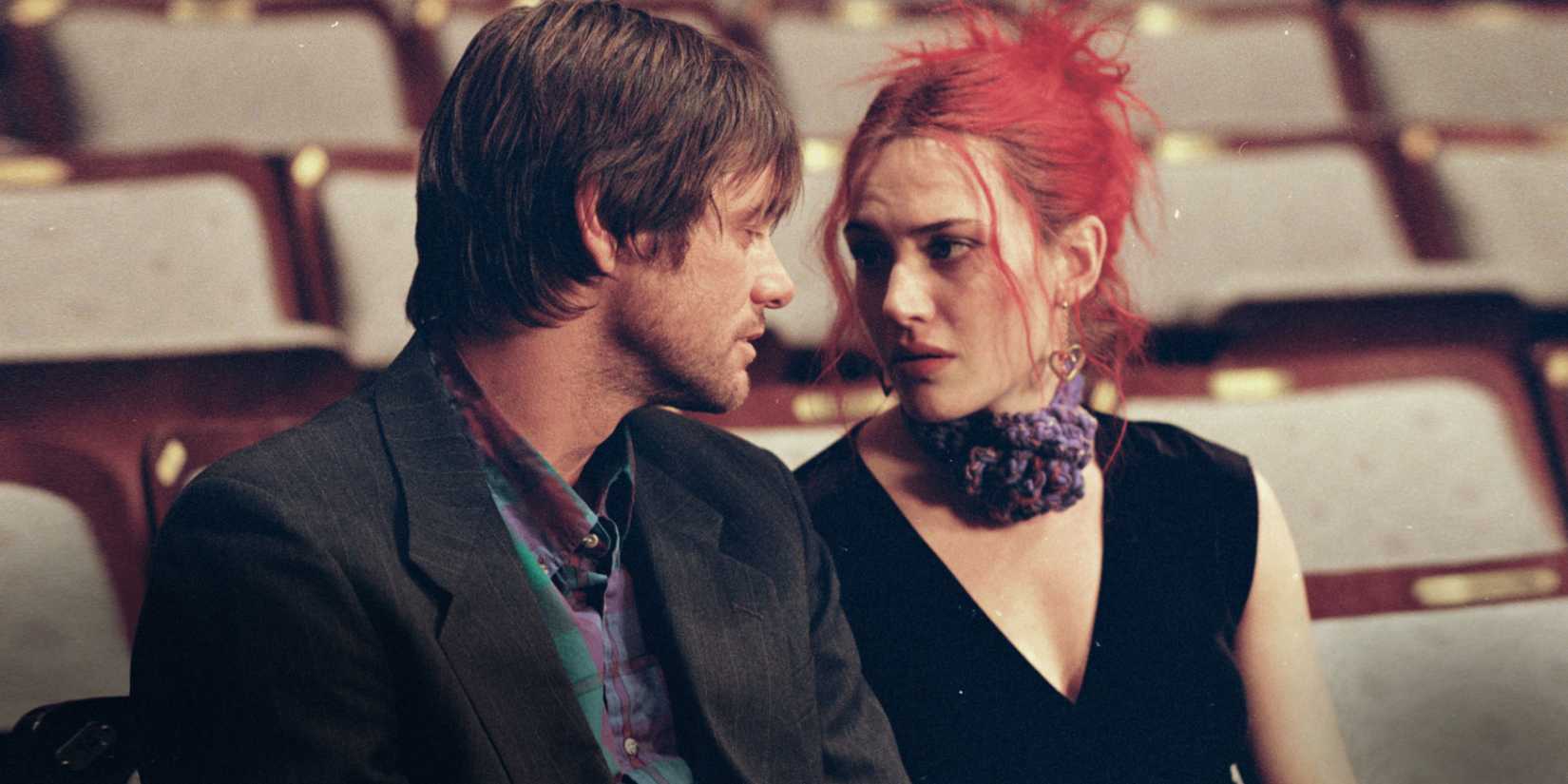
Jim Carrey and Kate Winslet looking at each other in Eternal Sunshine of the Spotless Mind (2004)Image via Focus Features
“Blessed are the forgetful, for they get the better even of their blunders.” This quirky gem was directed by Michel Gondry, one of the masters of offbeat cinema. Here, he strikes the perfect balance between strange and accessible. Jim Carrey plays Joel, who discovers that his ex-girlfriend Clementine (Kate Winslet) has undergone a procedure to erase all memories of their relationship. In response, he chooses to do the same, only to change his mind as the memories begin to disappear.
Gondry uses this speculative setup as a tool for emotional excavation; the sci-fi elements never overshadow the human ones. As Joel relives moments from his relationship, the film moves fluidly through time and space, mirroring the fragmented nature of memory itself. It becomes a blunt, vulnerable study of a relationship. It’s all believably messy: moments of joy blur with moments of pain, trivial details take on emotional weight, and regrets surface too late.
4
‘Solaris’ (1972)

Donatas Banionis as Kelvin standing in a field of plants in Solaris (1972).Image via Mosfilm
“We don’t want other worlds. We want mirrors.” Solaris is another reflective, psychological sci-fi masterpiece, this time from legendary Soviet director Andrei Tarkovsky. A psychologist named Kris Kelvin (Donatas Banionis) is sent to a space station orbiting a mysterious planet that appears to manifest physical embodiments of the crew’s memories. There, Kelvin confronts a version of his deceased wife (Natalya Bondarchuk), forcing him to grapple with guilt, grief, and even the nature of reality.
In this regard, the planet itself is less a setting than a catalyst, forcing characters to deal with unresolved emotions. It’s a clever inversion, replacing the genre’s usual focus on exploration, discovery, and external conflict with an inner reckoning defined by distorted memories and resurfacing trauma. The dialogue is philosophical, too, often reflecting on the limits of human understanding and the desire for connection. In the end, Solaris is science fiction as a mechanism for introspection.
3
‘Arrival’ (2016)

Image via Paramount Pictures
“If you could see your whole life from start to finish, would you change things?” While it lacks the grandeur of Dune, Arrival is Denis Villeneuve’s deeper project when it comes to theme and psychology. Amy Adams carries most of it single-handedly as linguist Louise Banks, who is recruited to communicate with extraterrestrial visitors who have arrived on Earth. She slowly, painstakingly begins to understand their language, at the same time experiencing time in a fundamentally different way, altering her perception of life itself. In the process, a first-contact story turns into an exploration of language, time, and choice.
The movie has a lot to say about loss and acceptance, in particular. The emotional core is Louise’s relationship with her daughter. Cleverly, what initially appears to be backstory is eventually revealed to be something else entirely. As a result, Arrival’s central question isn’t “Why are the aliens here?” but “Would you choose love if you knew it would end in loss?”
2
‘Children of Men’ (2006)
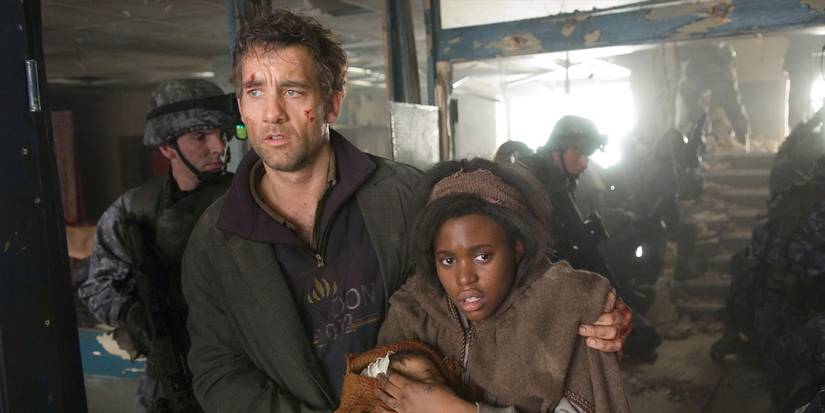
Clive Owen holding Clare-Hope Ahitey as they walk through a crowd in Children of MenImage via Universal Pictures
“Even if they discover the cure for infertility, it doesn’t mean the world will be saved.” In Children of Men, a disillusioned man named Theo (Clive Owen) is tasked with protecting a miraculously pregnant woman (Clare-Hope Ashitey) in a world where humanity has become infertile. Bereft of a future, society is collapsing into nihilism and violence, and the characters’ journey becomes a fragile thread of hope.
Theo himself mirrors this dystopia: at the start, he’s an empty person who has lost everything. In other words, Theo does not begin as a hero — he’s reluctant, self-interested, emotionally detached, and cynical. The real narrative is his slow re-engagement with the world, moving from indifference to responsibility, from survival to sacrifice. The film’s long takes and immersive cinematography place the viewer directly inside the action, but it is the character development that lingers. Theo begins as a passive observer and gradually becomes someone willing to act, driven by the possibility of renewal.
1
‘Alien’ (1979)
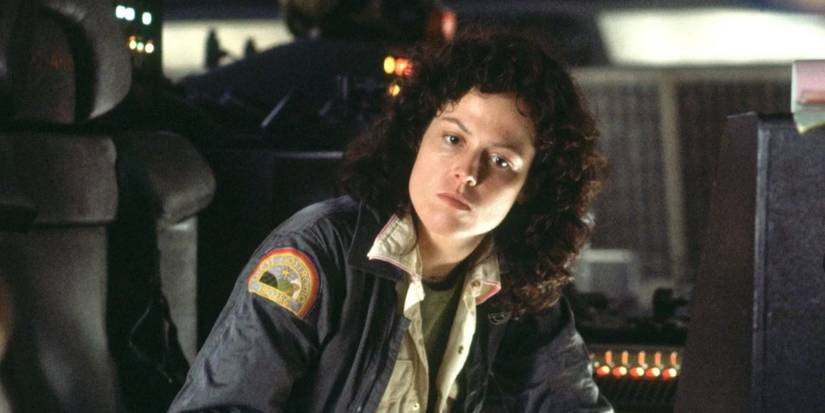
Sigourney Weaver as Lieut. Ellen Ripley aboard a spacecraft in the science-fiction–horror film Alien.Image via 20th Century Studios
“In space no one can hear you scream.” The crew of a commercial spaceship responds to a distress signal, only to encounter a deadly extraterrestrial organism that begins to hunt them one by one. While it may seem odd at first to call Alien a character-driven movie, since so much of its power stems from creature design and masterful horror storytelling, a big part of why the film is iconic is thanks to the character of Ellen Ripley (Sigourney Weaver). She’s a fantastic protagonist: resourceful and tough as nails, but also real and empathetic and anchored by unyielding principles.
Ripley’s not superhuman, but she does have a remarkable ability to adapt and keep her wits about her under pressure. Her fierceness makes her a match for even a monster as formidable as the xenomorph. The movie may start as an ensemble piece, driven by a collection of colorful and contrasting personalities, but it gradually centers on Ripley. In short, she’s one of the genre’s greatest heroes.