
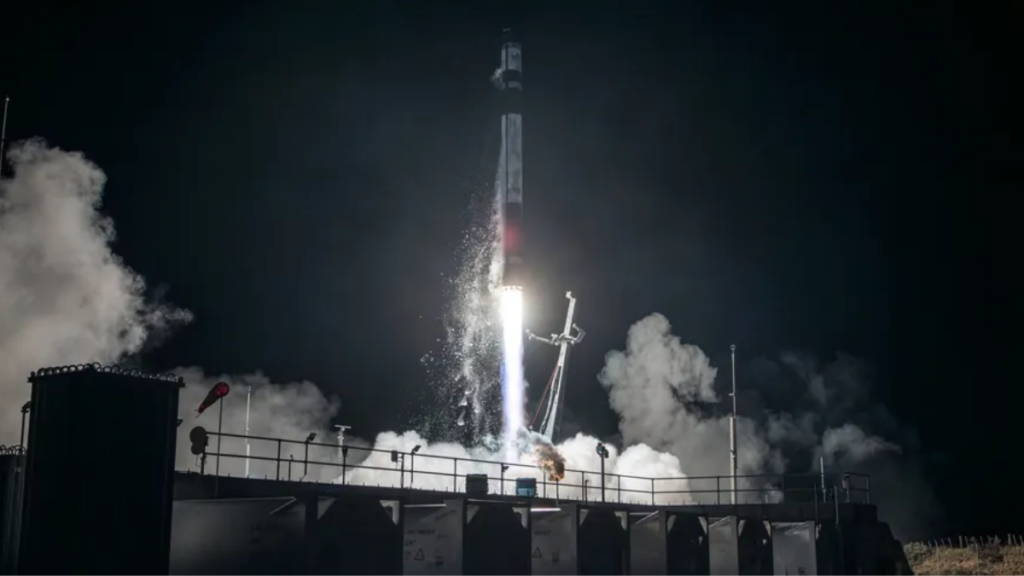
Rocket Lab’s Electron rocket successfully launched two Celeste navigation satellites from New Zealand on March 28, 2026. The launch was the first European low Earth orbit navigation demonstrator. The “Daughter of the Stars” mission put the satellites in a circular Sun-synchronous orbit at an altitude of 510 km over the Earth. The pathfinder satellites carry experimental payloads to test new signals in the L- and S-frequency bands. The Celeste satellites will test the LEO layer of the European navigation system Galileo.
Launch and Payload
According to Space.com, Rocket Lab’s three-stage Electron rocket launched on March 28, 2026, at 10:14 pm NZDT (09:14 UTC) from the Mahia Peninsula in New Zealand. The payload was placed into a circular sun-synchronous orbit at an altitude of 510 km above Earth. The first satellite separated 20 minutes after launch, and the second satellite separated four minutes later. These experimental satellites are IOD-1 and IOD-2, with masses of approximately 20 kg and 30 kg, respectively. This is just the first phase of ESA’s Celeste program, and there are plans for 11 LEO navigation demonstrators.
Mission Objectives and Significance
The Celeste mission is a low-orbit demonstration mission of ESA. Its satellites provide stronger signals to users because they operate at an altitude of about 510 km (compared to 23,200 km for Galileo). According to ESA, the LEO layer will enhance navigation in Europe, making it more robust and allowing new services. Nearer signals assist in bridging urban areas, edifices, and polar areas. To serve the upcoming services, such as autonomous transport, IoT, and indoor navigation, Celeste will test new multi-frequency signals. Eventually, ESA has proposed 11 Celeste satellites by 2027 to finish the demonstration.