
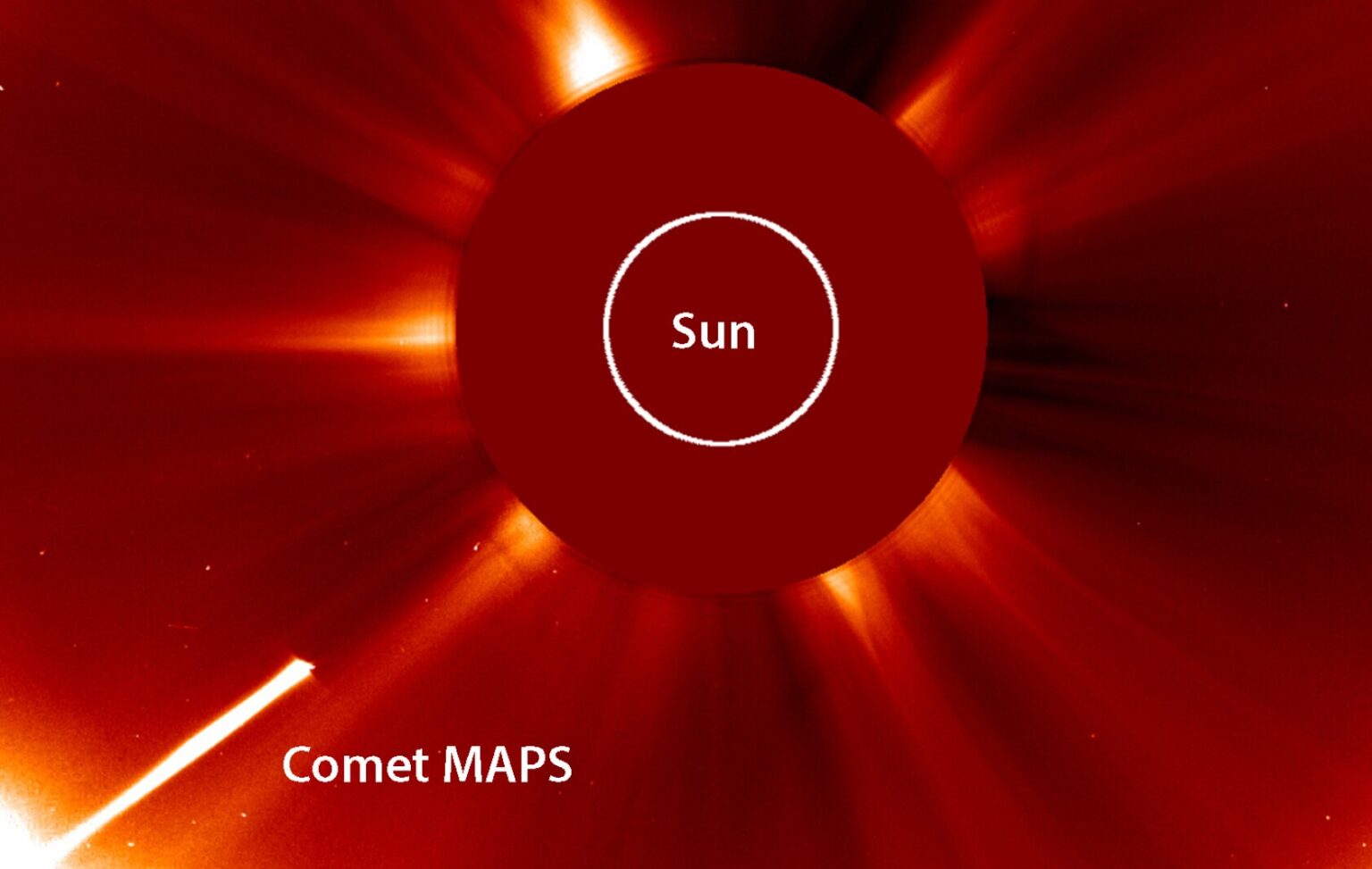
In case you’re not familiar, a comet belonging to the Kreutz sungrazer family was discovered on Jan. 13 by a group of astronomers in Chile. Named C/2026 A1 (MAPS) or just Comet MAPS, the comet has been closing in on the sun since discovery. On Saturday, it skimmed just 100,000 miles from the blazing solar surface. As I write this, I don’t know whether this small, icy body — only about 1,300 feet across — has survived the intense heat and gravitational stress from its close passage to our star — or not.
The latest photo analysis appears to show that the comet has disintegrated, though we may not know for certain until Sunday. If the fragile dusty ice ball broke apart and vaporized under those dual stressors, then there will be little left to see for skywatchers.
But if it rounds the sun and remains intact, solar heating will vaporize gobs of dust-rich ice from the comet. And that dust will create a long, narrow, bright tail visible several days later when the comet emerges during evening twilight.
Even then it won’t be particularly easy to spot. Comet MAPS will have to battle the orangey glow of dusk, and it will be low in the western sky, especially for observers in the northern hemisphere. Circumstances will be better for southern hemisphere skywatchers.
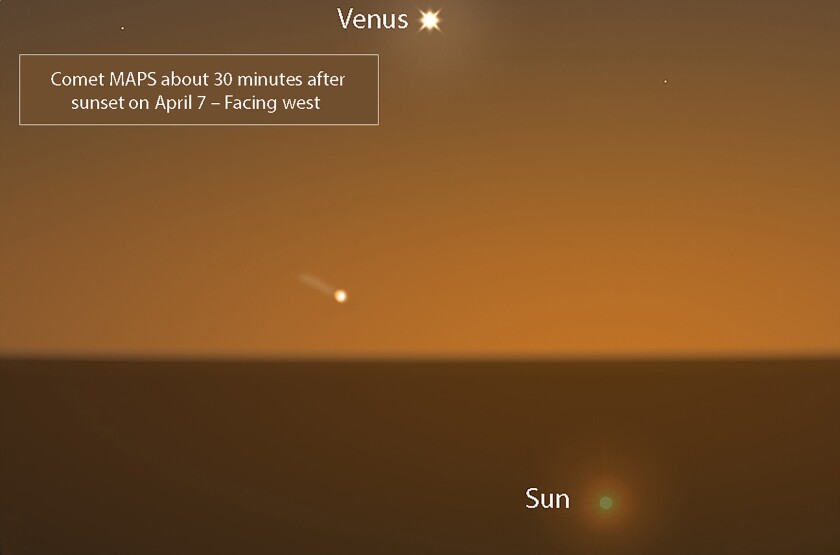
Should the comet survive you can hunt for it in the evening sky very low in the west during twilight. Be sure to bring binoculars. Venus will shine about a fist above and to the right of the comet.
Contributed / Stellarium with additions by Bob King
Make sure you observe from a site with an unobstructed view to the west. The comet never gets very high above the western horizon as seen from the northern U.S. so you’ll need an unobstructed view in that direction. Also, be sure to bring binoculars to the hunt in case it’s fainter than expected. If it survived, the fuzzy visitor will be in view for several evenings starting about Tuesday. You can begin the hunt 30 minutes after sunset not far above the western horizon.
Let Venus be your guide. After you identify the planet, take a moment to carefully focus the binoculars on it. That way you’ll know you’re in focus when you’re ready to seek the comet. Then drop about 10 degrees (two binocular fields of view) below and to the left of Venus and look for the comet’s slanted tail. If you don’t see it right away, wait till the western sky gets a bit darker and try again.
Of course, it’s also possible that by the time you look, the comet will have fallen apart or faded faster than expected. So many unknowns! That’s the nature of sungrazers. Thousands of years ago, the parent of Comet MAPS fragmented into countless pieces when it passed close to the sun. The broken bits created an entire family of comets called Kreutz sungrazers.
Among other shared characteristics, the most notable is that they all approach the sun closely. And if they’re large enough, they survive and go on to become spectacular sights.
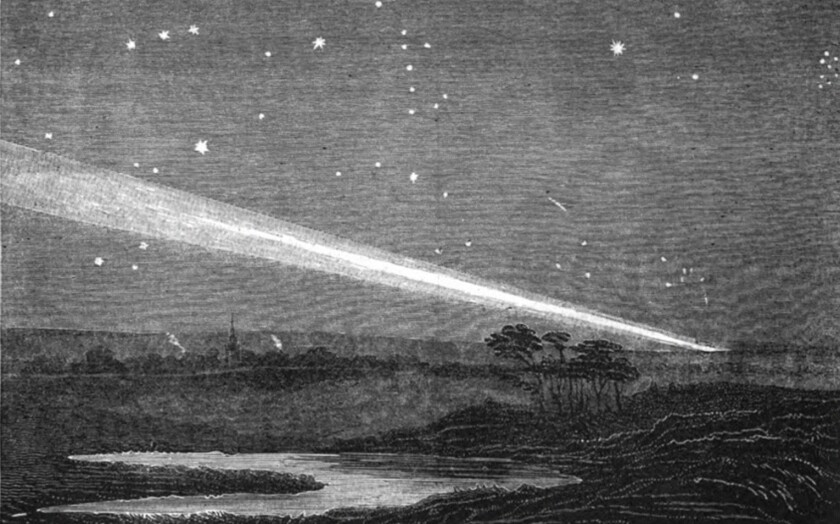
This depiction of the Great Comet of 1843 from March of that year shows its incredibly luminous tail more than 45 degrees long fanning out below the constellation Orion (three Belt stars at upper left). Both this comet, MAPS and thousands of others like it all trace their origin to a large comet that fragmented in the distant past.
Contributed / The Illustrated London News (1843: 211)
In recent decades, sungrazers Comet Ikeya-Seki (1965) and Comet Lovejoy (2011) put on fantastic shows. One of the best of the bunch was the Great Comet of 1843, which was many times brighter than Venus and visible in broad daylight.
Let’s hope Comet MAPS makes it over the line. If so, it could blossom into something wonderful.

“Astro” Bob King is a freelance writer and retired photographer for the Duluth News Tribune. You can reach him at nightsky55@gmail.com.