
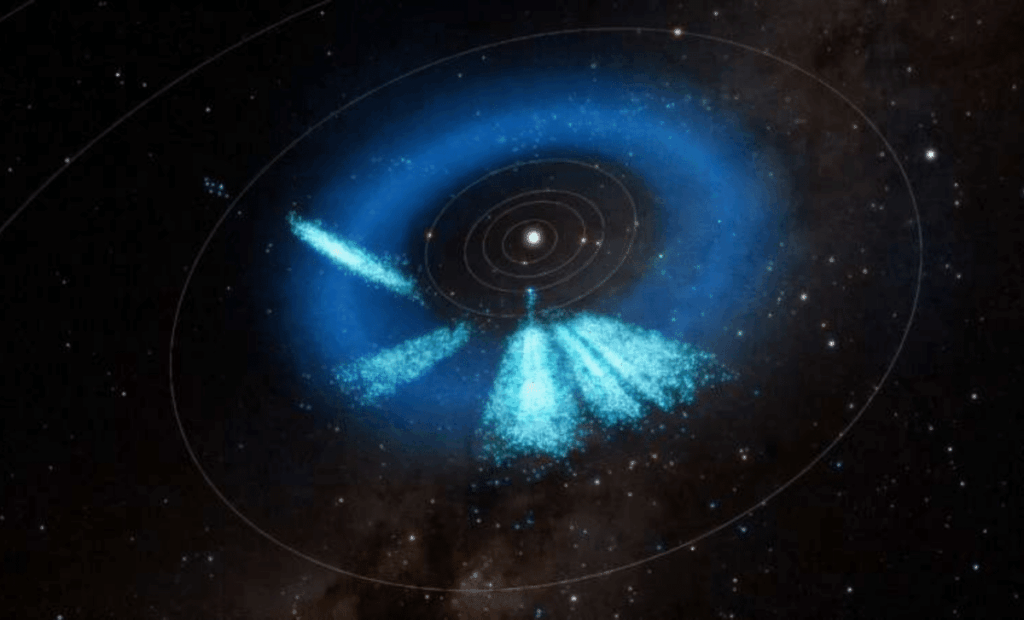
A single early dataset from the Vera C. Rubin Observatory has revealed more than 11,000 new asteroids, marking one of the most significant leaps in solar system discovery in decades, as reported in findings published in collaboration with the International Astronomical Union’s Minor Planet Center.
A Discovery Rate That Redefines Astronomy
The scale and speed of this discovery are unlike anything astronomers have seen before. In just six weeks of early observational data, the Rubin Observatory generated nearly one million measurements, capturing not only thousands of unknown asteroids but also refining the orbits of more than 80,000 previously cataloged objects. Some of these had effectively vanished from tracking systems due to uncertain trajectories, and are now recovered with far greater precision.
What makes this moment remarkable is not only the number of discoveries, but the pace at which they were achieved. Traditionally, identifying and confirming asteroid populations required years of observation, cross-checking, and computational effort. Rubin compresses that timeline dramatically, offering a near real-time mapping capability of the solar system.
“This first large submission after Rubin First Look is just the tip of the iceberg and shows that the observatory is ready,” says Mario Juric, faculty at the University of Washington and Rubin Solar System Lead Scientist. “What used to take years or decades to discover, Rubin will unearth in months. We are beginning to deliver on Rubin’s promise to fundamentally reshape our inventory of the solar system and open the door to discoveries we haven’t yet imagined.”
The implications extend far beyond cataloging. This rapid detection capability signals a structural change in planetary science, where dynamic tracking replaces static observation, and where the solar system becomes a continuously monitored environment rather than a partially mapped frontier.
Inside The Technology Powering Rubin’s Breakthrough
At the core of this achievement lies a powerful combination of hardware and software engineered to operate at unprecedented sensitivity. The Rubin Observatory pairs a massive mirror with the most advanced digital camera ever deployed in astronomy, enabling it to scan the southern sky with exceptional depth and frequency.
This observing cadence produces enormous volumes of data, requiring entirely new computational methods to identify faint, fast-moving objects hidden among billions of light sources. Detecting asteroids is no longer just about imaging, it is about pattern recognition at scale.
“Rubin’s unique observing cadence required a whole new software architecture for asteroid discovery,” says Ari Heinze of the University of Washington. “We built it, and it works. Even with just early, engineering-quality data, Rubin discovered 11,000 asteroids and measured more precise orbits for tens of thousands more. It seems pretty clear this observatory will revolutionize our knowledge of the asteroid belt.”
According to NOIRLab, these systems do more than detect motion, they predict it, refine it, and connect fragmented observations into coherent orbital paths. This allows scientists to transform fleeting points of light into fully characterized celestial objects in record time, dramatically increasing both accuracy and efficiency.
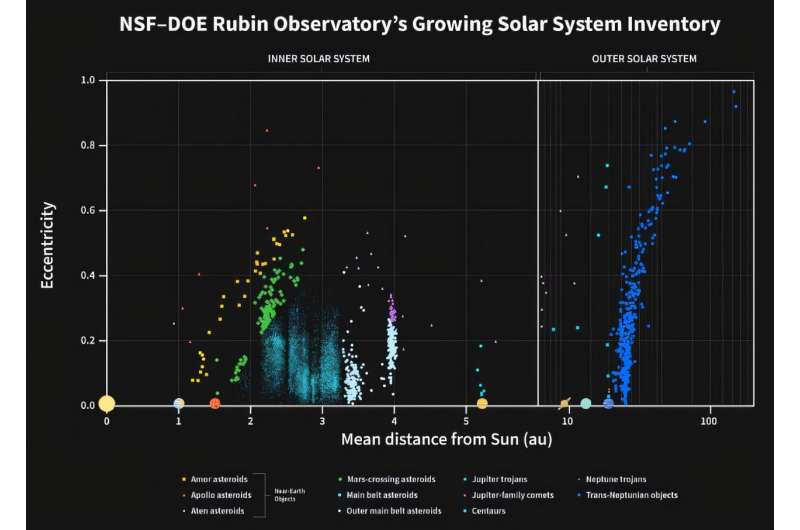 Distribution of new asteroids discovered by NSF–DOE Rubin Observatory. Credit: NSF–DOE Vera C. Rubin Observatory / NOIRLab / SLAC / AURA. Acknowledgement: PI: Mario Juric (University of Washington)
Near-Earth Objects And Planetary Defense
Among the thousands of newly identified bodies are 33 near-Earth objects (NEOs), a category of particular interest due to their proximity to Earth’s orbit. None of these newly detected objects pose any threat, and the largest measures roughly 500 meters across. Still, their detection highlights a critical gap in our current knowledge.
Scientists estimate that only about 40% of mid-sized NEOs, those larger than 140 meters, have been identified so far. Objects in this size range are capable of causing regional damage if they were to impact Earth, making early detection a central goal of planetary defense strategies.
Rubin is expected to dramatically improve this situation. Once fully operational, it could discover up to 90,000 additional NEOs, potentially doubling the known population of hazardous-sized objects. This would transform early warning systems and provide humanity with far greater lead time to respond to potential threats.
The observatory’s continuous monitoring approach also ensures that newly discovered objects are tracked over time, reducing uncertainty and preventing them from becoming “lost” again. This shift toward persistent surveillance represents a new paradigm in safeguarding Earth from cosmic hazards.
Probing The Edge Of The Solar System
Beyond the asteroid belt and near-Earth space, Rubin’s early data has also uncovered around 380 trans-Neptunian objects (TNOs), icy bodies orbiting far beyond Neptune. Two of these, 2025 LS2 and 2025 MX348, follow highly elongated orbits that carry them as far as 1,000 times the Earth-Sun distance, placing them among the most distant known objects in the solar system.
Detecting such distant bodies presents a formidable challenge. Their motion is slow, their brightness faint, and their signals easily lost among countless background stars.
“Searching for a TNO is like searching for a needle in a field of haystacks—out of millions of flickering sources in the sky, teaching a computer to sift through billions of combinations and identify those that are likely to be distant worlds in our solar system required novel algorithmic approaches,” explains Matthew Holman of the Center for Astrophysics | Harvard & Smithsonian.
These discoveries are not just statistical additions, they carry deep scientific value.
“Objects like these offer a tantalizing probe of the solar system’s outermost reaches, from telling us how the planets moved early on in the solar system’s history, to whether a hitherto undiscovered ninth large planet may still be out there,” says Kevin Napier, also of the Harvard-Smithsonian Center for Astrophysics.
Each newly detected TNO adds a data point to a larger puzzle about planetary migration, gravitational influences, and the possible existence of unseen massive bodies in the far reaches of the solar system.
A Glimpse Of What Comes Next
This initial dataset is only an early demonstration of Rubin’s capabilities. When the Legacy Survey of Space and Time (LSST) begins full operations, the observatory is expected to discover tens of thousands of asteroids every few nights. Over the course of a decade, this will likely triple the known asteroid population and increase the number of identified trans-Neptunian objects by nearly an order of magnitude.
Such growth will not only expand catalogs but reshape scientific understanding. With richer datasets, astronomers will be able to reconstruct the solar system’s formation history with greater precision, identify previously unseen patterns in orbital dynamics, and test long-standing hypotheses about distant planetary influences.
The transformation is already underway. What was once a slow accumulation of discoveries is becoming a continuous stream of insight, turning the solar system into a dynamic, data-rich environment where new worlds are revealed at an accelerating pace.