
Astronomers have uncovered the most pristine star ever found in the universe, revealing a breathtaking window into the formation of the earliest stars and galaxies. Using data from the Sloan Digital Sky Survey-V (SDSS-V) and cutting-edge observations with the Magellan telescopes at Carnegie Science’s Las Campanas Observatory in Chile, researchers have identified SDSS J0715-7334 as the purest star yet discovered. Published in Nature Astronomy, this discovery holds the potential to reshape our understanding of cosmic evolution and the origins of elements in the universe.
Unveiling the Star of the Century: SDSS J0715-7334
SDSS J0715-7334 is not just any star, it’s a relic from the early universe, formed just a few billion years after the Big Bang. The star’s significance lies in its pristine nature, containing an exceptionally low amount of “metals,” elements heavier than hydrogen and helium. In fact, it has less than 0.005% of the metal content of our Sun, making it twice as metal-poor as the previous record holder for the most pristine star.
The discovery, published in Nature Astronomy, was made possible by a collaborative effort led by Alexander Ji from the University of Chicago, along with Juna Kollmeier from Carnegie Observatories. Their team, which included a group of undergraduate students from UChicago, was able to identify SDSS J0715-7334 as part of the ongoing SDSS-V survey. The team’s detailed observations at Las Campanas were pivotal in confirming the star’s rare composition, offering astronomers a rare glimpse into the birth of stars.
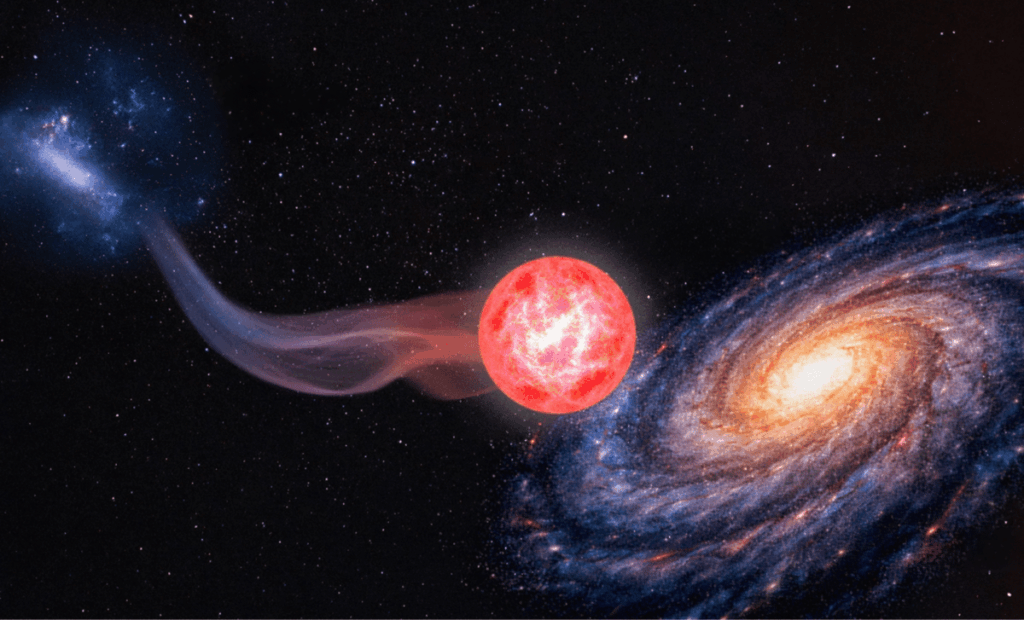
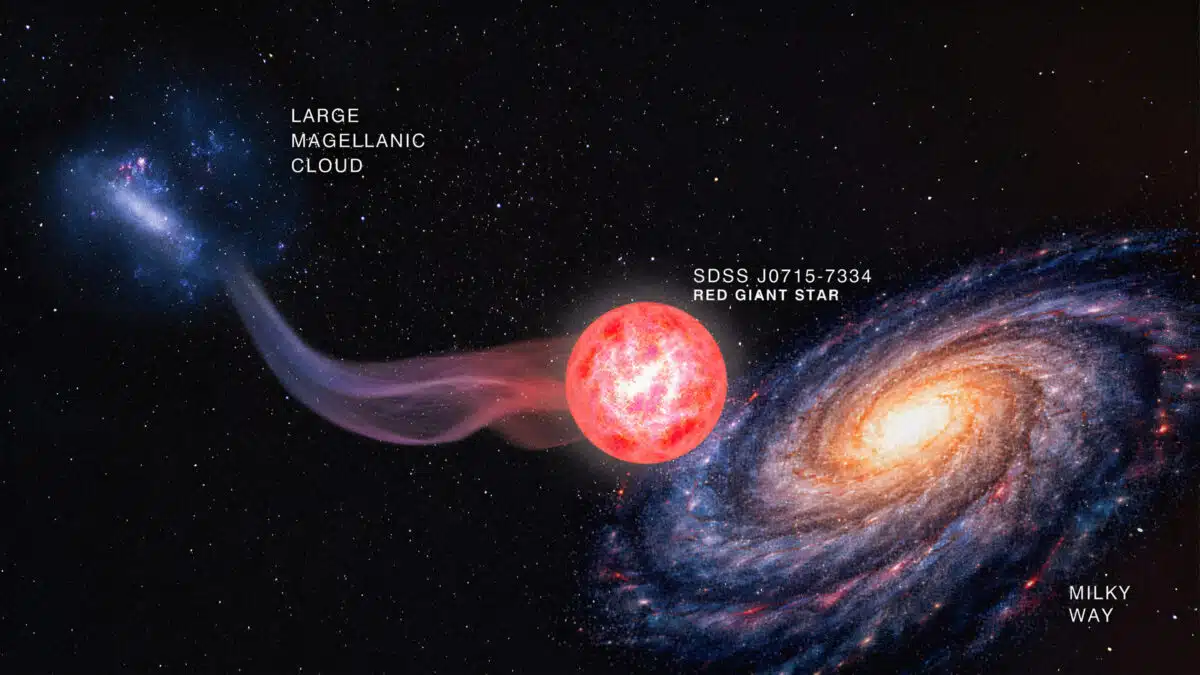 An ancient immigrant: an artist’s conception (not to scale) of the red giant SDSS J0915-7334, which was born near the Large Magellanic Cloud and has now journeyed to reside in the Milky Way.
Credit: Navid Marvi/Carnegie Science
A Time Capsule From the Dawn of the Cosmos
“What makes SDSS J0715-7334 so remarkable is that it is a star born from the primordial elements of hydrogen and helium, just like the first stars that lit up the universe,” Ji explained. “These pristine stars are windows into the dawn of stars and galaxies in the universe.” This discovery provides invaluable insights into the processes that shaped the first generations of stars, which in turn influenced the formation of galaxies and all the elements that make up our world today.
The team’s efforts to analyze SDSS J0715-7334 were not just about measuring the star’s purity but also about understanding the broader picture of star formation. Stars like SDSS J0715-7334 are rare, and spotting one offers a chance to test theories of how the very first stars ignited and how they evolved into the more complex celestial objects we see today.
The Role of SDSS-V and Las Campanas in the Discovery
The SDSS-V survey, which collects millions of optical and infrared spectra across the entire sky, proved instrumental in identifying SDSS J0715-7334.
“We have to look in our cosmic backyard to find these objects, because we can’t yet observe individual stars at the dawn of star formation,” said Kollmeier. “Since these stars are rare, surveys like SDSS-V are designed to have the statistical power to find these needles in the stellar haystack and test our theories of star formation and explosion.”
The success of the project was also driven by the powerful instruments at the Las Campanas Observatory. The collaboration between the SDSS-V data and the high-resolution capabilities of the Magellan telescopes enabled the team to confirm that SDSS J0715-7334 was not just another star, but a cosmic treasure. Michael Blanton, Director of the Carnegie Science Observatories, emphasized the critical role the Las Campanas ecosystem of telescopes played in making the breakthrough possible: “The ecosystem of telescopes at Las Campanas was critical to nearly every aspect of this breakthrough work.”
The Science Behind Metal-poor Stars
Stars like SDSS J0715-7334 hold immense scientific value because they can teach us about the earliest stages of stellar evolution. The first stars in the universe were formed from hydrogen and helium alone, with no heavier elements. As these stars lived and died, they enriched the surrounding space with heavier elements such as carbon, iron, and oxygen. These elements are the building blocks for the next generation of stars, planets, and even life itself.
Ji explained the importance of finding stars with very little metal content:
“All of the heavier elements in the universe, which astronomers call metals, were produced by stellar processes—from fusion reactions occurring within stars to supernovae explosions to collisions between very dense stars.”
By studying these rare, metal-poor stars, scientists gain insight into the conditions that existed in the early universe and how stars played a pivotal role in shaping the cosmos.