
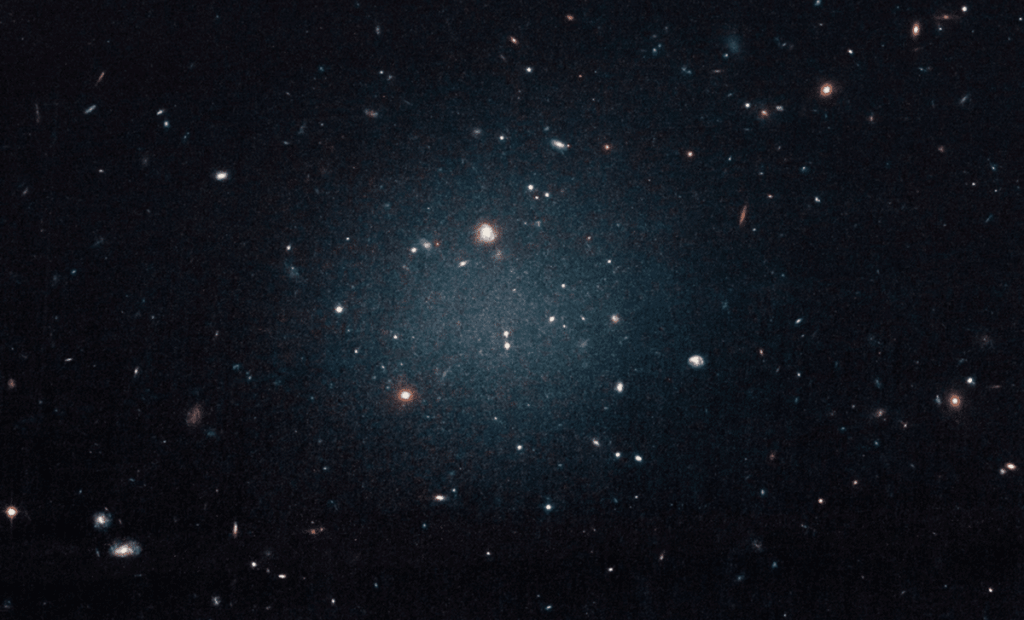
astronomers has uncovered a third galaxy devoid of dark matter, challenging conventional wisdom about the invisible substance that is believed to hold galaxies together. Published in a new study available in pre-print on arXiv, this discovery of NGC 1052-DF9 adds significant weight to the radical “Bullet Dwarf” collision theory, which proposes that galaxies can lose their dark matter entirely after violent cosmic collisions.
The Mystery of Dark Matter and Galaxy Formation
For decades, scientists have believed that dark matter serves as an invisible scaffolding, exerting a gravitational pull strong enough to keep galaxies intact. Without dark matter, the forces exerted by a galaxy’s stars would be too weak to prevent the galaxy from falling apart. However, the discovery of NGC 1052-DF9, along with its predecessors, NGC 1052-DF2 and NGC 1052-DF4, is forcing astronomers to rethink the very nature of galaxy formation and the role dark matter plays in the universe.
As explained by Universe Today, these ultra-diffuse galaxies, so far lacking dark matter, contradict the standard model of how galaxies form and evolve. The significance of this finding cannot be overstated, as it shows that galaxies might not always follow the expected patterns of gravitational behavior seen in other galaxies.
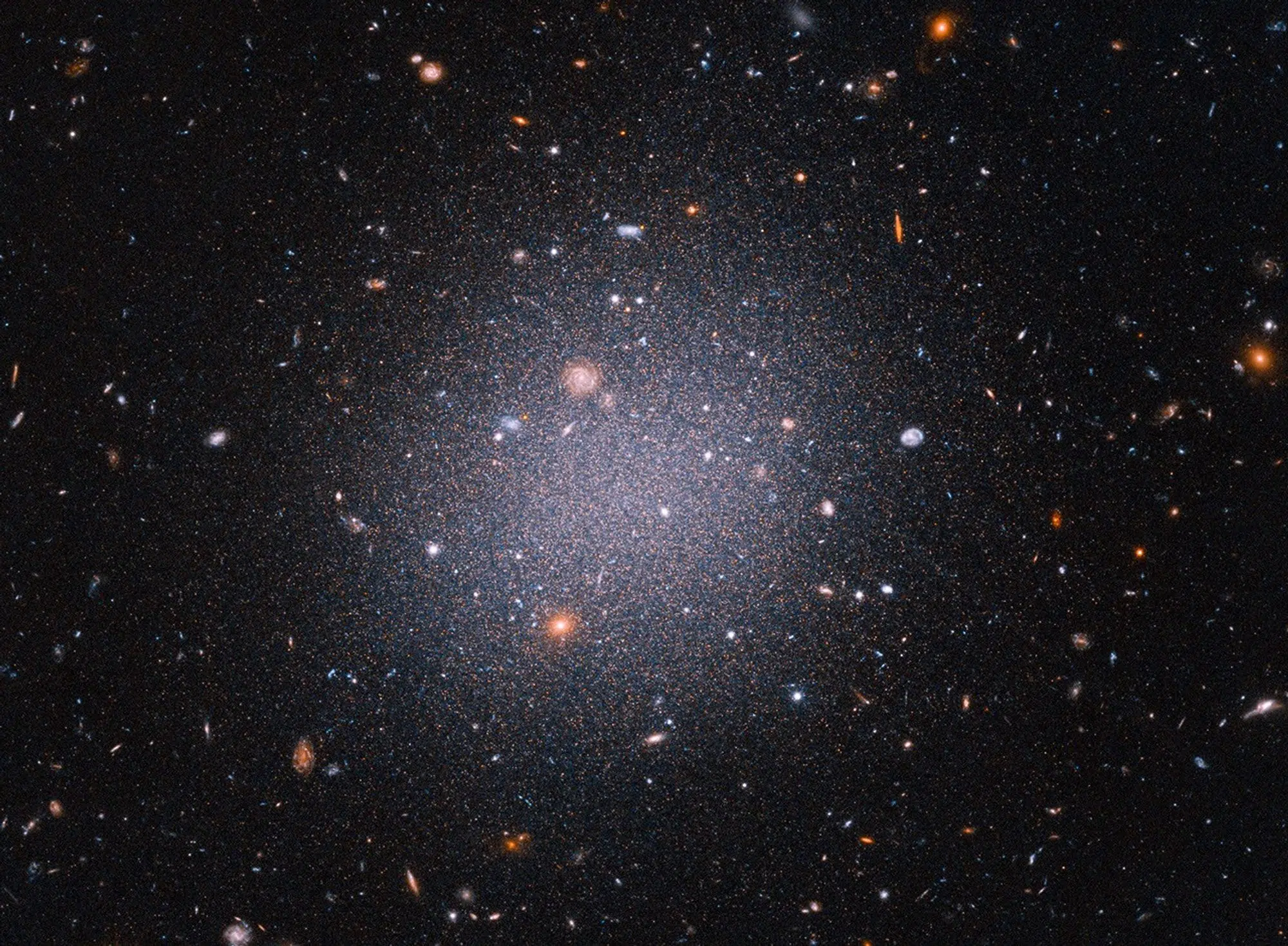 NASA, ESA, STScI, Zili Shen (Yale), Pieter van Dokkum (Yale), Shany Danieli (IAS); Image Processing: Alyssa Pagan (STScI)
The Bullet Dwarf Collision Theory
The key to understanding this cosmic puzzle lies in the “Bullet Dwarf” collision theory, a concept that has been gaining traction with each new discovery. Proposed as an explanation for these dark-matter-free galaxies, the theory suggests that when two gas-rich dwarf galaxies collide at tremendous speeds, their dark matter halos pass through each other without interacting, while the normal matter, primarily in the form of gas clouds, crashes into one another. This collision could strip away the dark matter, leaving behind a galaxy that is seemingly missing its invisible, gravitational glue.
The recent discovery of NGC 1052-DF9, which fits perfectly into the line of galaxies stretching from DF2 to DF4, strengthens the case for the Bullet Dwarf collision scenario. It’s now clear that this string of galaxies may have been formed during a single, cataclysmic event, one that caused a massive, high-speed collision that stripped away dark matter from these galaxies. This theory, once controversial, is rapidly gaining credibility among astronomers.
The Discovery of NGC 1052-DF9
NGC 1052-DF9 represents a new milestone in the study of dark matter. Like its predecessors DF2 and DF4, DF9 shows no signs of the dark matter that is usually found in galaxies of similar size. The implications of this discovery are immense. It raises the possibility that not all galaxies are bound by dark matter, and that our understanding of gravity and galaxy dynamics may need to be reconsidered.
What makes NGC 1052-DF9 particularly important is its role in proving the Bullet Dwarf collision theory. The galaxy is part of a clear trail of dark-matter-free galaxies, leading researchers to believe that they were all born from the same catastrophic collision. This discovery, further detailed in a new study available in pre-print on arXiv, provides a rare and invaluable opportunity to explore galaxy formation through a new lens, one that challenges the dominant theories about the relationship between matter and gravity in the universe.
Testing New Theories of Gravity
The discovery of these galaxies provides an exciting testing ground for alternative theories of gravity, such as Modified Newtonian Dynamics (MOND). MOND, which posits that gravity behaves differently in low-acceleration environments, has long been used to explain the phenomena observed in galaxies with unusual rotational speeds. However, the behavior of DF2 and DF9 challenges MOND’s predictions. In these galaxies, stars are moving more slowly than MOND would expect, suggesting that standard Newtonian dynamics, rather than any modifications to gravity, might be the correct explanation.
As new data emerges from these galaxies, scientists may be forced to rethink MOND and other alternative gravity theories. This discovery is not only a win for the Bullet Dwarf collision theory but also a step forward in testing the foundations of physics as we know it.