
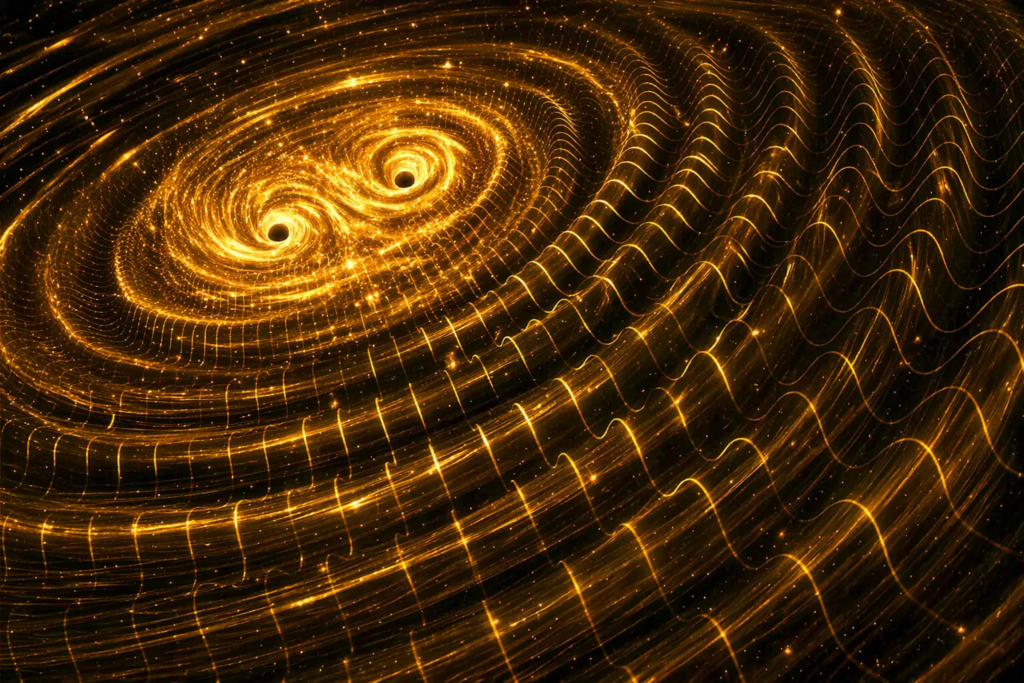
Dark matter is thought to exist everywhere, wrapping around galaxies and helping to shape the largest things in the universe. But nobody knows what it is made of. Now, a new theoretical study presents a surprisingly unique situation that could provide some of the missing puzzle pieces. Some of the dark matter may have originated from ancient gravitational waves. These waves travelled through the early universe before stars or galaxies had formed.
This hypothesis is the product of collaboration between Professor Joachim Kopp from Johannes Gutenberg University Mainz and the PRISMA++ Cluster of Excellence. The work was also in collaboration with Dr. Azadeh Maleknejad from Swansea University. Furthermore, this work was published in Physical Review Letters.
Visible matter makes up approximately 4% of our universe. It contains all the planets, stars, and living organisms which we can actually observe. Dark matter is estimated to represent around 23% of the universe. Although astronomers are aware of its existence due to its influence on the formation of galaxies and the structure of the universe as a whole, the identity of the particle or particles which comprise dark matter remains one of the major unsolved mysteries of physics.
Illustration that visualizes the stages of evolution of our universe and the stages at which stochastic gravitational waves are formed. (CREDIT: Azadeh Maleknejad, Swansea University) Ripples From the Early Universe
Gravitational waves are ripples created by disturbances in spacetime. Most frequently, they are associated with cataclysmic phenomena like the union of two black holes or neutron stars. However, this most recent study examines a completely different kind of gravitational wave known as stochastic gravitational waves. These are a collection of multiple less energetic signals from the early days of the universe.
In addition to these observable gravitational waves, many other types of gravitational waves exist. Many of these other types of waves were created during earlier stages of the universe when matter was still in a gaseous state. These earlier waves combined to create an overall background signal that is now spread over enormous stretches of space. Kopp and Maleknejad conducted an inquiry into the possibility that the presence of gravitational waves in the early universe could have played a role in creating new types of particles.
“We explored whether a background of gravitational waves may have converted into Weyl fermion particles, which could potentially serve as dark matter. The proposed mechanism for producing dark matter via gravitational waves has not previously been explored by other researchers,” said Kopp.
Based on the results of the research, it appears that the answer is yes.
Particle Creation and Dark Matter Origins
According to the current study, stochastic gravitational waves could have given rise to a massless or nearly massless particle known as a Weyl fermion. This particle would subsequently acquire mass and exist as dark matter. This would happen after the early universe underwent changes in temperature and density.
The graviton-fermion cubic and quartic vertices. (CREDIT: Physical Review Letters)
This is significant because previous models of dark matter based on gravity have usually required extremely massive fields, approximately 10^14 GeV. They also required extremely high reheating temperatures above 10^13 GeV. The findings from this study provide an alternative means for producing dark matter.
Studies on the role of gravitational waves in the early universe suggest that gravitational waves can create new types of particles.
The main focus of this research is examining how a gravitational wave background would change the symmetry of Weyl fermions formed in an expanding universe.
Symmetry Breaking
Typically, massless Weyl fermions exhibit a symmetry called conformal symmetry as a result of their energy density decreasing due to expansion of space. Therefore, expansion alone cannot produce massless Weyl fermion particles.
However, this study presents evidence that the presence of a background of gravitational waves would alter the existing picture of Weyl fermions in an expanding universe. It suggests new ways to create Weyl fermions and provides alternative avenues for producing dark matter. By generating a newly formed physical scale in the system, these waves create an imbalance in the usual process that keeps fermions from being observed.
Breaking that balance is the most critical component.
Using an in-in style one-loop calculation, the team estimated how producing fermions with a stochastic gravitational wave background is possible. The researchers utilized a broken power law shape to model the gravitational wave’s energy signature. This is a simplification based on the shape expected in many of the earliest models of the universe. It includes phase transitions and primordial magnetic fields that arose during those times.
GW-induced freeze-in of dark matter for a GW background with a broken power-law spectrum. (CREDIT: Physical Review Letters)
As a result, the group found that the produced fermions act like radiation shortly after being formed. However, if and when they gain mass, they could represent all or part of the dark matter we observe today.
Conditions and Limitations
This mechanism can work across a variety of early universe temperatures and dark matter masses. Most cases favor producing them at temperatures far higher than the electroweak mass scale. But the temperatures are still significantly below the Planck mass scale and below that required by conventional cosmological production models.
That said, not every instance will yield equal amounts of dark matter. The final amount of dark matter generated depends on the gravitational wave spectrum’s shape, especially at high frequencies. It also depends on whether the source producing those waves is coherent or incoherent over time.
In their analysis, the researchers also identified some potential limitations. They used analytical approximations for estimating the gravitational wave backgrounds instead of full numerical calculations. They also neglected the backreaction from fermion production on the gravitational waves. However, they assert that this neglect is justified because the energy density of fermions is much smaller than that of the gravitational wave energy density.
The study hints at one reason this work may be of interest beyond providing a new avenue for obtaining dark matter.
Testing the Hypothesis
The authors say the same process might also facilitate the production of other extraordinarily weakly interacting particles, such as right-handed neutrinos.
The frequencies associated with this scenario would likely occur in the kilohertz to gigahertz range today. The lower end of that frequency range may be accessible in the future through technologies such as the Einstein Telescope and the Cosmic Explorer. However, higher frequency ranges will likely remain unavailable until newly developed detection methods improve further.
The next step, according to Kopp, is to go beyond analytical estimates and run numerical calculations to refine and improve the predictions from this study. He is also examining additional implications of gravitational waves interacting with early universe processes. He is considering their effects on the difference between particles and antiparticles.
Practical Applications of This Research
This research study may help shift thinking about how dark matter is created. It links dark matter with primordial gravitational waves and provides a path for future experiments to analyze.
If validated, signals from gravitational waves may offer an indirect way to uncover the origins of the non-visible matter that makes up most of the known universe.
Related Stories