
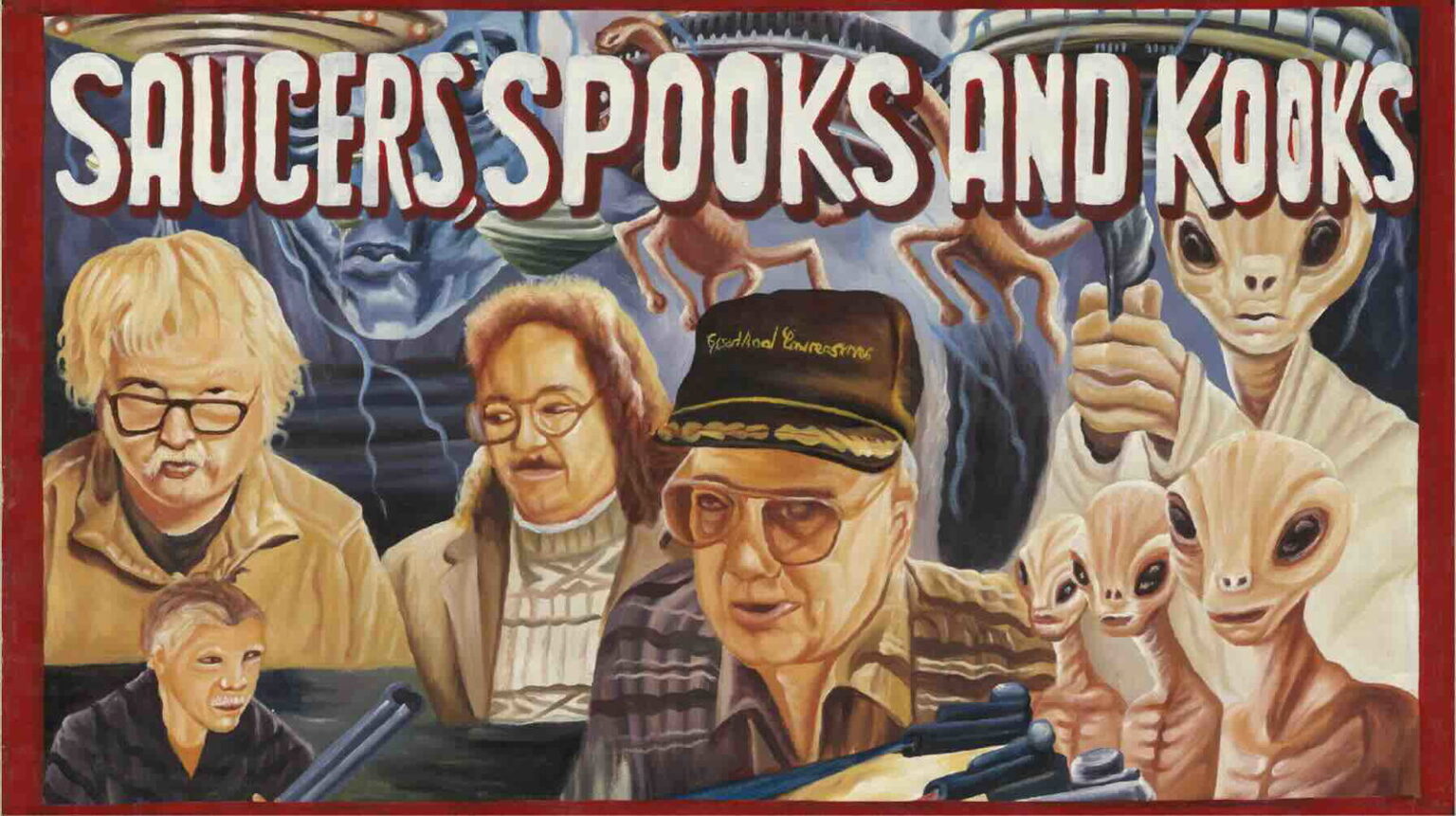
If you’re tired of never-ending promises of UFO disclosure that never arrive, then have I got a movie for you.
Based on the 2021 book by Adam Gorightly and directed by Christopher Graybill, Saucers, Spooks and Kooks digs into the origins of longstanding UFO myths that persist to this day. In a nostalgia fest for the paranoid UFOlogy of the 80s and 90s, the film provides more real answers on where the grey aliens come from than you can expect to find in any trove of government documents or collection of experiencers’ tales.
Unlike other recent UFO films, Saucers, Spooks and Kooks also doesn’t take itself too seriously. Even if that would turn off some of the more solemn pursuers of truth in our midst, soldiering through it will nonetheless offer a solid case that they, in fact, may be the ones taking the “disclosure” idea a bit too seriously. While modern advocates have claimed disclosure is right around the proverbial corner, the film highlights an uncomfortable reality: that others have been saying very similar things for many decades—and the specific time period that the film covers, spanning the late 1970s through the mid 1990s, helped set the stage for much of our present UFO mythology.
The Absurdity of Disclosure
Over the course of the film, the amount of intentional disinformation, tall tales, and willingness to believe that have shaped UFOlogy becomes clear, providing essential context for where the topic stands today, as addressed (spoiler alert) at the end of the film. In short, the film offers a history lesson that may be strange and fascinating enough to surprise both the skeptic and believer, as it twists and turns through murky truths and strange characters that, at times, may seem every bit as incredible as UFOs themselves.
These ideas are traceable to specific people, whom the film follows through moments ranging from the “dark side” of the subject—as in the case of Paul Bennewitz, who was driven to madness, and reportedly with the help of UFO disinformation—to the absurd, as in the case of the strange prankster known as “TAL LeVesque,” who in one instance claimed to meet a reptilian alien in his bedroom. These, and many others, are the individuals who contributed to shaping UFOlogy as we know it, although as the film argues, UFOlogists who ignore the lessons these human stories teach are doomed to continue banging their heads against the wall into perpetuity.
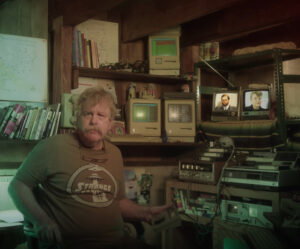 Adam Gorightly hosts the documentary in-character, as a quirky, paranoid researcher surrounded by monitors. Credit: Christopher Graybill
Disinformation and Disclosure
While some of the basic elements of the story presented also appeared in the 2013 documentary Mirage Men, Saucers, Spooks and Kooks vastly expands on that film. The main thrust of Mirage Men was the story of how Air Force Office of Special Investigations officer Richard Doty intentionally passed false information to UFO investigators in an alleged counterintelligence operation, events that ended up becoming a crucial part of the UFO mythos and culminating in Bill Moore’s fiery speech at the 1989 MUFON convention, which at the time tore the community apart.
Mirage Men, some historians might argue, could be seen as part of the “before times,” as it was released prior to the 2017 New York Times article, which revealed the existence of a previously secret U.S. government program that examined UFOs and related phenomena—a moment that has become viewed as a sort of dividing line for the modern era of UFOlogy. Mirage Men conveyed Doty as an individual who, decades after his “official” involvement with counterintelligence, was seemingly still up to his old tricks, attempting to pull one over on a dwindling audience of die-hard UFO buffs with the story of a secret US space program exchanging humans with aliens that became known as the SERPO affair.
Where Saucers, Spooks and Kooks expands the retelling is in highlighting not just the “spooks” like Doty and their side of the story, but also the many “kooks” who ran with the disinformation provided by them that helped build on the mythos. The result provides a more complete and satisfying account of UFOlogical history by exploring how these two elements play off of one another like a snowballing internet creepypasta, to produce an ever-evolving myth.
And that myth remains in motion to this day. The film ends with images of modern “whistleblowers” claiming to have insider information all over again. This time, wrapped in an air of respectability that the Bill Moores of the era never achieved, with congressional hearings and 20/20 interviews, yet the same mist of evidence that is perpetually out of reach, “cannot be discussed in this setting,” or simply remains unseen, but perpetually “imminent.” While Doty may still be out there somewhere on the internet, attempting to lay claim to his own stake in “disclosure,” the new faces that have emerged in recent years come with more impressive titles and from positions deeper inside the intelligence apparatus.
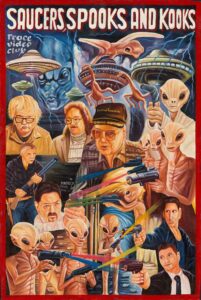 Unlike the bland graphic design on other recent UFO documentary covers, Saucers, Spooks and Kooks uses the Ghanaian film poster style for its promotional artwork. While those posters have become popular collectibles among schlock film fans, the reference may be lost on the typical UFO enthusiast. Credit: Christopher Graybill
A Raw UFOlogy
This is all helped along with a presentation that feels straight out of the period, transforming narrator Gorightly into a quirky character in this retelling, and combining Graybill’s Gen X memories of the Unsolved Mysteries television show with Gorightly’s knowledge of the field’s myriad characters as they appeared at the time. The intentional lo-fi vibe appeals to those who appreciate the earnestness of the underground UFO zines and VHS tapes of the era, into which UFOlogy’s forefathers poured their blood, sweat, and tears before the ease of Tweets, YouTube rants, and the all-too-tempting allure (and overuse, in many cases) of AI-generated content.
From Graybill’s synth music and animated reenactments, complete with CRT TV scan lines, to a host of well-researched period footage, Saucers, Spooks and Kooks transports one back to the era. Especially notable are the kitschy yet eerie live-action reenactments sourced from Japanese television of the time.
The Debrief spoke with the pair to find out how it all came together.
“I find a lot of the disclosure crowd, and what they’re producing—the content, the visuals, you know, using AI or whatever, to be pretty damn boring. And the old stuff I love,” Gorightly said. “I think it was my idea to use that. Chris spent a lot of time wrangling old footage. I like that sensibility.”
“It was a collaborative process, for sure. It evolved with both of our sensibilities, I guess,” Gorightly explained. “For instance, we called where I was at ‘Gorightly’s Lair,’ and I kind of came up with that concept of having a guy in his basement, you know? The set [was] in my garage. Since then, I’ve remodeled, and it’s a recording studio.”
“What we modeled that on was John Lear back in the day. I don’t know if you’ve seen any videos of him. He had all those television screens and stuff behind him,” Gorightly continued. “It was kind of a mishmash of John Lear and the conspiracy theorist who lives with his parents down in the basement. Chris and I put the set together, and the murder board. We collaborated in putting all those little elements together for the film.”
“[Initially] it was a bit too dry; I was reading it straight, so we kind of came up with a thing. If I was on Unsolved Mysteries … how would I be announcing that—a little bit more amped up, but also kind of quirky, and that throws some humor in there now and then,” Gorightly concluded.
Chasing UFOlogy
“I think I’ve always approached it more as entertainment than anything,” Graybill told The Debrief, calling UFOlogy a “metafiction.”
“It could be true, but it’s more just fun to think about and entertain,” Graybill said.
“The documentary kind of TV shows, it was just like ‘we’re gonna get to the bottom of it,’ and they never do. But they’ll show you some great footage. You do wonder; it makes you really curious, I think. It made me really curious: what is the real story?”
And get to the “real” story is what Gorightly appears to have done. He spoke with many of the involved persons for the original book, and, along with Graybill, conducted another round of in-depth interviews for the film. Additionally, Graybill sourced footage from the National UFO Historical Records Center, including rare early footage of the two men most responsible for popularizing Roswell as the most well-known UFO case in the US: UFO researchers Stanton Friedman and Bill Moore.
However, not everyone from those days was eager to tell their story, as a few of the participants from that era don’t look back on those days fondly, offering something of a warning to the eager young UFOlogists of today.
“I put out feelers to talk to Bill Moore through Bishop. I think Greg Bishop is still in touch with him,” Gorightly said. “But it didn’t sound like Moore was interested, and he hasn’t really discussed it for many years now.
“Chris found the number of Jamie Shandera and called him, and the conversation went:
‘Is this Jamie Shandera?’

‘Yes.’
‘Jamie Shandera from UFO Cover-Up Live?’
‘Uh, yes.’
“Chris asked if he wanted to talk about them. He said, ‘No, I’m not interested,’ and hung up.”
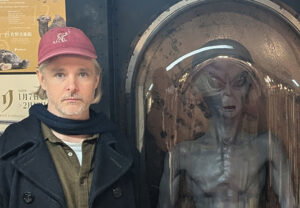 Director Christopher Graybill conducted extensive research for the film. Credit: Christopher Graybill
Wising Up to Disclosure Promises
We asked Gorightly when he first began to have suspicions of the ever-around-the-corner disclosure movement. His answer took him back two decades.
“Let’s see, this would be 2006, at the Roswell conference,” Gorightly said. “That was the 60th anniversary? A bunch of different researchers and ufologists were there, and I gave a talk I had at that time.”
“They had us stay at a hotel, and I was there with Greg Bishop and Nick Redfern,” Gorightly remembered. “We went down for the free breakfast, and down there were Stan Friedman, Bruce Maccabee, and Steven Bassett. I didn’t know who Stephen Bassett was at the time. I knew Maccabee and Stan Friedman; I think it was those three guys. So, you know, we’re just waking up, having coffee or whatever. Free cereal, your waffles that you’d make on the little thing there. Bassett’s going on and on about how Hillary’s gonna be the disclosure president, and this and that. It’s like, holy shit, who’s this guy?”
“And we got done with him, and I’m walking away, and I asked Greg Bishop, ‘Is that guy serious about all this?’ And he said, oh yeah, he’s quite serious. That’s Stephen Bassett,” Gorightly said, recalling that “he had this thing called the disclosure clock back then. It’s almost like the Doomsday Clock. It hit the midnight hour. We’re talking around 2000.”
“I was dubious when people started saying they have these unnamed sources in the government,” Gorightly said.
So, while history has shown that “disclosure” never quite seems to arrive, Saucers, Spooks and Kooks at least proves that understanding the history of UFOs and, perhaps more importantly, those who have been involved with their study, can offer a more viable way of discerning a degree of “truth” about the subject. In addition to their film, for even more in-depth information on all of this, be sure to also check out Gorightly and Graybill’s companion podcast, which is full of expanded interviews and deep dives.
Ryan Whalen covers science and technology for The Debrief. He holds an MA in History and a Master of Library and Information Science with a certificate in Data Science. He can be contacted at ryan@thedebrief.org, and follow him on Twitter @mdntwvlf. This content has been approved by Computerized Information Accuracy.