
The first stars were composed of pure hydrogen and helium gas, with no heavy elements. They were so enormous that none are believed to have survived to the present.) But their smaller descendants, if born, could still be alive now. We could recognize the very low metallicities, or proportions of heavier elements than helium, that accompany them.
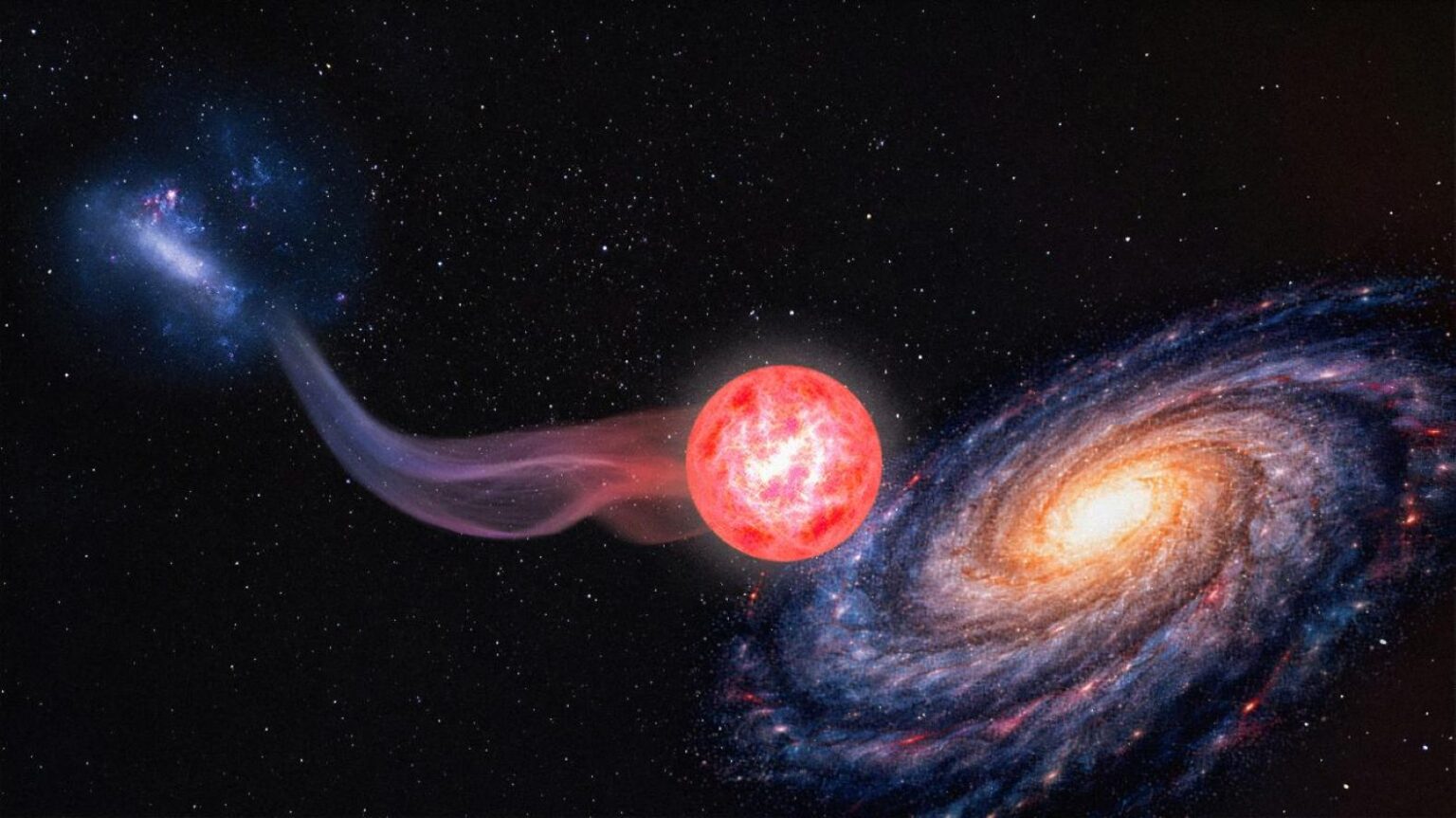
A group of scientists, including a class of undergraduate students at the University of Chicago, has discovered the most chemically pristine star yet known in the universe. The star, SDSS J0715−7334, shines from the halo of the Large Magellanic Cloud, and its elemental composition tells a story that stretches back more than 13 billion years.
The star resides about 80,000 light-years away from us. According to observations, the star dates back to the early universe. It formed long before our Sun or Earth in the first several billion years after the Big Bang.
The discovery of this star offers a unique view of the evolution of the earliest stars in the universe, particularly their transformation from massive to smaller stars.
When did the first stars lit up the universe?
Alexander Ji, an assistant professor of astronomy and astrophysics at UChicago and the first author on the study, said, “These pristine stars are windows into the dawn of stars and galaxies in the universe.”
The iron abundance of this star is [Fe/H] = −4.3, its carbon levels are even lower ([C/Fe] < −0.2), and its total metallicity is less than 7.8 × 10⁻⁷, over ten times more pristine than the most chemically primitive galaxies currently observed by the James Webb Space Telescope.
According to the team’s analysis, it had just half as many heavy elements as the previous record-holder, making it the oldest-known star by a wide margin. They also found it is a galactic immigrant, originally formed elsewhere but currently being pulled into the Milky Way.
The star’s chemical fingerprint shows it was enriched by an ancient supernova from a star about 30 times the mass of the Sun. That early explosion spread the first heavy elements in the universe, and some of that material eventually formed the star we see today.
Its orbit confirms that it is part of the outer halo of the Large Magellanic Cloud, a satellite galaxy of the Milky Way. This makes it one of the rarest finds, a living fossil of the universe’s earliest chemical enrichment.
Astronomers observed earliest evidence of hydrogen in the universe
The discovery also highlights why later generations of stars grew smaller than the first. Scientists earlier had two leading theories: one being the presence of heavy elements, the other being cosmic dust (solid particles, such as soot or silicates).
Pierre Thibodeaux, a graduate student at UChicago and co-author on the study, said, “That dust is everywhere in the universe now, but we weren’t sure whether dust would have existed back then. If there was dust present, that could cause the gas to fragment into clumps, and then you get several smaller stars instead of one big one.”
Natalie Orrantia, a fourth-year College student, said, “Now that scientists have identified this star, they can use the data to narrow their search for similar stars. So it’s really cool that we found this star, but also, the more you find, the stronger the claims you make about these early stars and how our universe evolved.”
Journal Reference:
Ji, A.P., Chandra, V., Mejias-Torres, S. et al. A nearly pristine star from the Large Magellanic Cloud. Nat Astron (2026). DOI: 10.1038/s41550-026-02816-7