
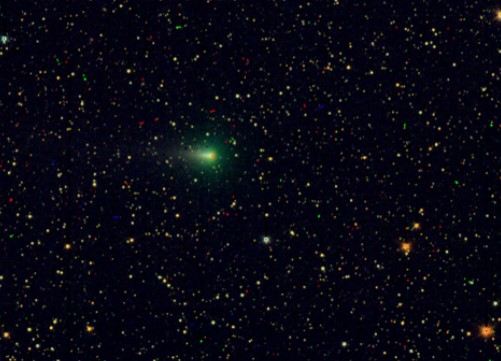
On 4th February 2026, the European Space Agency (ESA) announced preliminary findings from its Jupiter Icy Moons Explorer (Juice) mission concerning interstellar comet 3I/ATLAS. In November 2025, Juice, while en route to Jupiter, was ideallypositioned to observe the comet shortly after its closest solar approach. Five science instruments were activated to gather data.
Here are five things Juice has found out.
ONE: Juice’s Moons And Jupiter Imaging Spectrometer (MAJIS) detected 2000 kilograms of water vapor expelled per second by 3I/ATLAS on 2nd November 2025, which was four days post-perihelion. This volume, equivalent to 70 Olympic swimming pools daily, is high but consistent with active comets.
TWO: The Submillimeter Wave Instrument (SWI) corroborated the expulsion, noting most vapor originated from the Sun-facing side and from icy dust grains in the coma. The SWI team is examining the ratio of ‘light’ water (H2O) to ‘semiheavy’ water (HDO) to validate earlier ALMA and Webb telescope findings of an unusually high ratio for 3I/ATLAS. The H2O/HDO ratio is seen as a cosmic fingerprint which can point to how and where the comet was created.
THREE: Juice’s Ultraviolet Imaging Spectrograph (UVS) observed gas elements—oxygen, hydrogen, and carbon—and dust stretching over 5 million kilometers from 3I/ATLAS’s nucleus. This extensive plume is typical for active comets.
FOUR: The high-resolution science camera, JANUS, further confirmed the comet’s gas and dust emissions. It also showed that despite its interstellar origin, 3I/ATLAS visually resembled a standard comet.
FIVE: Unexpectedly, Juice’s Navigation Camera (NavCam), primarily for Jupiter moon navigation, contributed to planetary defense. It offered a unique, close-range perspective on 3I/ATLAS, supplementing Earth-based trajectory estimates. This enabled ESA’s Planetary Defence team to precisely refine the comet’s orbital path, demonstrating the value of deep-space observations for tracking celestial objects and inferring material outgassing effects.
Instrument teams continue analyzing the comprehensive dataset, with detailed publications anticipated soon. Olivier Witasse, ESA Juice Project Scientist, commented on the opportunity: “3I/ATLAS is a rare and unexpected visitor, its arrival came as a complete surprise,” adding, “Observing the comet was challenging, with no guarantee of success, but in the end, it turned into a great bonus for JUICE during its journey to Jupiter.” Despite the 60-million-kilometer observation distance, JUICE’s instruments proved effective.
The mission’s next milestone is an Earth gravity assist in September 2026, and all instruments will be turned on. Co-Project Scientist Claire Vallat expressed optimism: “The data we are already seeing from Juice’s instruments is really promising. We are getting more excited about how well they work and how much we will reveal about Jupiter and its icy moons in the 2030s.”
 Published by James Hydzik
James Hydzik is a technology geek focused on the junction of engineering, writing, and coffee. He joined Orbital Today in 2020 to help make sense of the Johnson government’s decision to buy OneWeb. Since then, he has taken on interviewing and editor-in-chief roles. James learned the ropes of editing and writing with Financial Times magazines, The World Bank, PwC, and Ericsson. Thus far, interviewing New Space movers has put the biggest smile on his workaday face. The son of an Electrical Engineer, James understands the value of putting complex topics into clear language for those with a lay person’s understanding of the subject. James is a European transplant from the United States, and as ex-KA3LLL, he now holds European amateur radio licenses. His next radio project is a portable 10GHz EME (moonbounce) station, as it combines his childhood interests in antennas and space.