
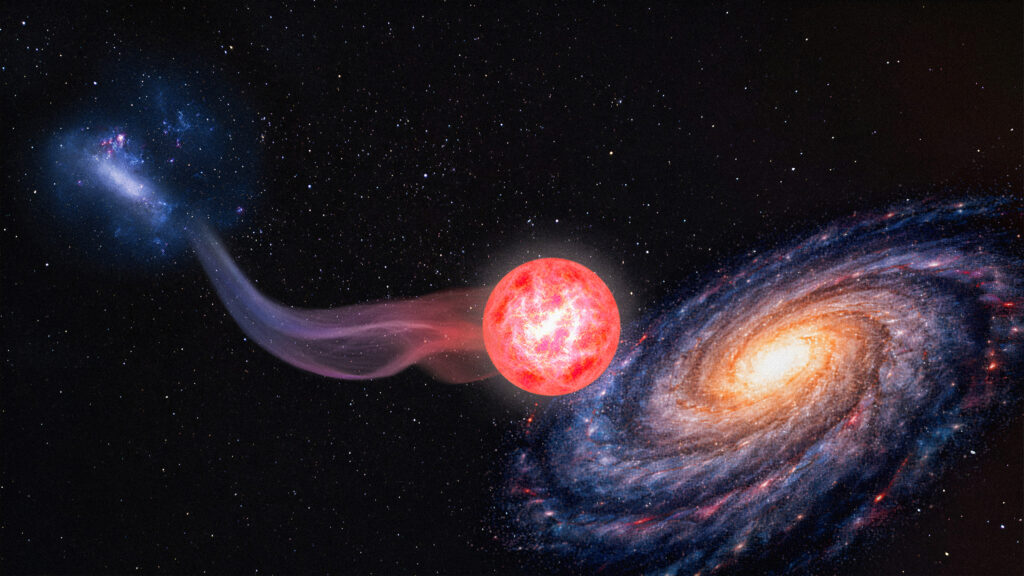
A group of scientists, including a class of undergraduate students at the University of Chicago, has discovered the most chemically pristine star yet known in the universe.
This star dates back to the early ages of the universe, formed long before our sun or Earth in the first several billion years after the Big Bang. The finding gives scientists a rare look into the evolution of the earliest stars in the universe—particularly how they transitioned from the first generation of massive stars into the smaller ones common today.
“These pristine stars are windows into the dawn of stars and galaxies in the universe,” said Alexander Ji, an assistant professor of astronomy and astrophysics at UChicago and the first author on the study, published April 3 in Nature Astronomy. “I expected great things from the students, but this is above and beyond.”
‘You could feel the energy in the room’
In the beginning, just after the Big Bang, stars began to form.
These stars were big—made up of just helium and hydrogen, they burned hot and died early. But inside their cores, atoms had fused into heavier elements. When those huge stars exploded, new stars formed out of the debris. As this happened over and over, we got more heavy elements, until there was enough to make up the iron in our blood and the oxygen we breathe.
Scientists know this much, but are still investigating how the following generation of stars became smaller and longer-lived.
The most direct way to learn more would be to locate some of these ancient stars. This is what Ji’s research focuses on—so when it was his turn to teach an undergraduate astronomy field course focused on making actual scientific observations, he set the students to the problem.
The class combed star catalogs made by the Sloan Digital Sky Survey, looking for stars with hints of anomalous readings. Because it takes time to build up an accumulation of heavy elements, the less of them a star has, the older it must be.
The students identified a handful of candidate stars. Then, over spring break of 2025, the class journeyed down to the Magellan Telescopes at Carnegie Science’s Las Campanas Observatory, located in the remote mountains of Chile. These powerful telescopes can make more detailed measurements of the elements present in stars.
On the first night there, the students began scanning the candidate stars they’d identified. In the early hours of the morning, they got an inkling that something was up.
“I think we still had one or two stars left on the observing run, but meanwhile [teaching assistant Hillary Diane Andales] was doing some preliminary analysis on what we’d collected so far,” said Natalie Orrantia, a fourth-year College student. “She started making these little noises, and then, ‘This is nuts, could it be a mistake?’ But the more we looked at it the more it looked like it was real.”
“You could feel the energy in the room,” added Ha Do, a fourth-year student. “I think Professor Ji was doing mental backflips.”
The team allotted multiple hours the next night to observing the star, gathering all the data they could to get a clear reading. Then, on the flight home, Ji said, “I sat there just scrapping and rewriting the entire curriculum I had planned for the next quarter. Instead, we were going to throw everything into analyzing this star.”
Early star formation
Over the course of the next quarter, the class divided into small groups and set to work analyzing the data and writing the scientific paper, which would eventually be accepted to Nature Astronomy. They also presented their findings to the entire Sloan Digital Sky Survey collaboration.
The star, named SDSS J0715−7334, resides about 80,000 light-years away from us. According to the team’s analysis, it had just half the amount of heavy elements measured in the previous record-holder, making it the oldest-known star by a wide margin. They also found it is a galactic immigrant, originally formed elsewhere but currently being pulled into the Milky Way.
The finding also sheds light on why later generations of stars grew smaller than the first. Previously, scientists had two leading theories—one being the presence of heavy elements, the other being cosmic dust (solid particles, such as soot or silicates).
“That dust is everywhere in the universe now, but we weren’t sure whether dust would have existed back then,” explained Pierre Thibodeaux, a graduate student at UChicago and co-author on the study. “If there was dust present, that could cause the gas to fragment into clumps, and then you get several smaller stars instead of one big one.”
Heavy elements in the gas phase could have also caused the same fragmentation. But when the scientists added up all the elements in this newly discovered star, they found there weren’t sufficient amounts to make this explanation work.
“It seems the transition was much more likely caused by that cosmic dust,” said Thibodeaux.
An ‘incredible’ experience
Orrantia explained that now that scientists have identified this star, they can use the data to narrow their search for similar stars.
“So it’s really cool that we found this star, but also, the more you find, the stronger the claims you make about these early stars and how our universe evolved,” she said.
Asked what they took away from the experience, both students named the trip to the observatory as “incredible.”
“It’s a great experience for the science, but also for having an appreciation for the human aspect of things. We met the engineers who work on the telescopes, and the operators were up at night with us,” said Do. “We really got to understand how many human hands these photons go through before they come to us.”
The other undergraduate students on the study were Selenna Mejias-Torres, Zhongyuan Zhang and Rithika Tudmilla, as well as graduate student Hillary Diane Andales and postdoctoral researcher Guilherme Limberg.
The study used the resources of UChicago’s Research Computing Center.
Citation: “A nearly pristine star from the Large Magellanic Cloud.” Ji et al, Nature Astronomy, April 3, 2026.
Funding: The University of Chicago, the National Science Foundation, Alfred P. Sloan Research Fellowship, Max Planck Society, European Research Council, NASA, Agence Nationale de la Recherche, Gruber Science Fellowship, ANID, Joint Committee ESO-Government of Chile, Hungarian Academy of Sciences, Kavli Institute for Cosmological Physics, UChicago Data Science Institute.