

Listen to this article
Estimated 4 minutes
The audio version of this article is generated by AI-based technology. Mispronunciations can occur. We are working with our partners to continually review and improve the results.
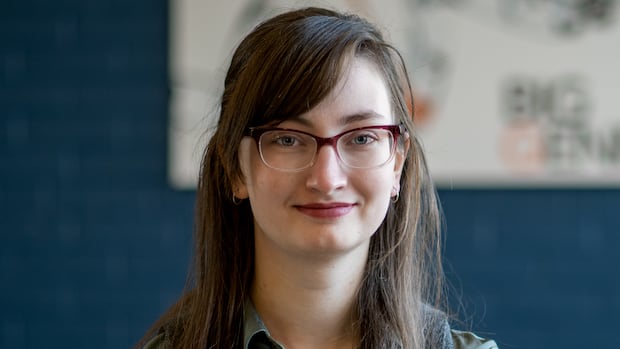
A Newfoundland and Labrador astrophysicist taking her love of space and aiming for the stars.
In March Anna O’Grady, who is originally from the St. John’s community of Kilbride, learned she was one of 24 astrophysicists accepted into the NASA Hubble Fellowship’s most recent cohort, which begins in September.
“I’ve always loved space science. I’ve always loved looking at the stars, learning about them. And for me, there’s just something fundamental about how we are a very small part of the universe,” she told CBC Radio’s The St. John’s Morning Show.
O’Grady is currently a post-doctoral fellow at Carnegie Mellon University’s McWilliams Center for Cosmology and Astrophysics in Pittsburgh.
She said astronomers work toward a better understanding of the universe.
“We’re curious people. Humans are curious. We want to understand things. And for me personally, there’s no greater thing to understand than the universe itself and the parts that make it up.”
She said the fellowship gives astrophysicists early in their career funding to independently carry out their research into the “prime questions” NASA is investigating.
“How did the universe start? You know, where do we all come from? How is the universe evolving? And are we alone in the universe?,” said O’Grady.
It’s a competitive fellowship, she added, with hundreds of people applying every year with 24 chosen from a wide variety of subfields in the discipline, like exoplanet studies to stellar astronomy to cosmology.
“I am an observational stellar astrophysicist. So what that means is that I study stars similar to our sun, although my specific specialty is in massive binary stars, so stars that are much bigger than our own sun and stars that are in pairs together.”
For example, she brought up an iconic scene in Star Wars on the fictional planet Tatooine where there are two suns.
As part of her work, O’Grady uses archival telescope data or takes data from telescopes to try to understand what is happening to stars. She added she works in tandem with theoretical astrophysicists who use equations of the physical world and computer simulations to better understand how stars work.
She said this work is important for a number of reasons other than just being curious. The development of data science techniques have applications in the corporate world as well as in medicine.
“Some technique for understanding clusters of galaxies might have an application in some other part of human life that’s useful in a different way,” said O’Grady.
“The technological advancements that we make while we’re doing our astronomy research benefit lots of other aspects.”
O’Grady said her parents always encouraged her to be curious, but she can recall in Grade 8 shopping with her mother at the Chapters bookstore in St. John’s and spotting a large astronomy book on the bargain table.
Since she was holiday shopping for other people, she put it down but said her mother noticed her interest and the book ended up beneath the Christmas tree.
“I absolutely inhaled the book,” O’Grady said, and it led her to the NASA website, reading what she could, and she became hooked.
Download our free CBC News app to sign up for push alerts for CBC Newfoundland and Labrador. Sign up for our daily headlines newsletter here. Click here to visit our landing page.