
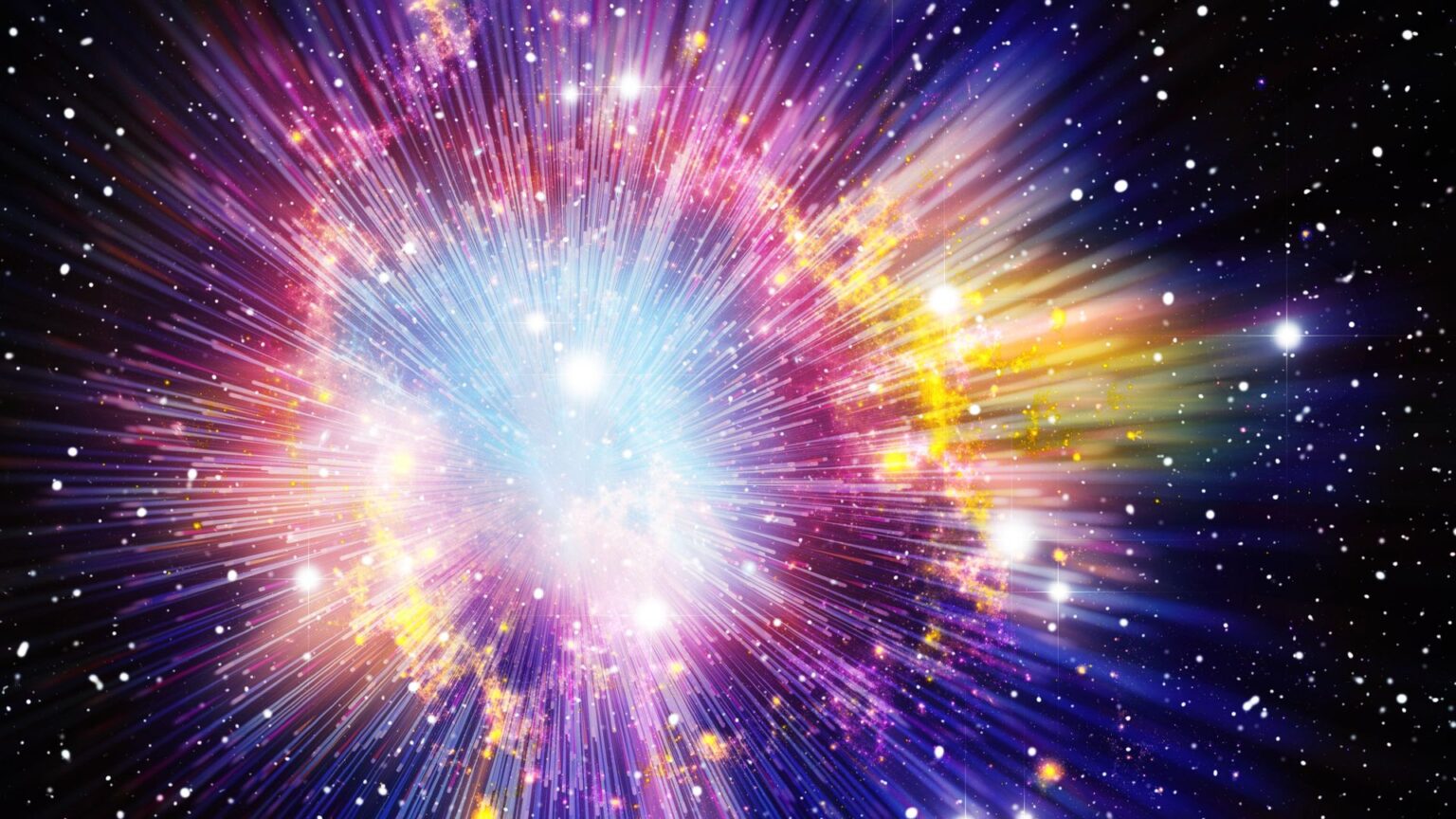
The Big Bang is often described as the moment everything began — a point of infinite density where the laws of physics broke down. But what if that picture is incomplete?
A new study proposes a different account of the universe’s birth: Instead of an abrupt beginning from a singularity, as predicted by Einstein’s theory of general relativity, the early cosmos may have passed through a more controlled high-energy phase governed by a modified theory of gravity known as QQG.
You may like
Why Einstein’s theory may not be enough
Einstein’s theory of general relativity has been extraordinarily successful in describing gravity on large scales. It explains the motion of planets, the behavior of black holes, and the expansion of the universe. However, it struggles to explain the ultra-small world of quantum mechanics and is widely believed to contain some fundamental inconsistencies.
“The main problem is that Einstein’s general relativity predicts its own failure under extreme conditions, most famously at the Big Bang singularity,” Afshordi said.
At that point, densities and space-time curvature become infinite — a clear indication that the theory is incomplete. Physicists have long sought a deeper framework that can describe gravity under such conditions.
“What makes [quadratic quantum gravity] interesting is that it may provide a mathematically consistent way to describe gravity at very short distances and very high energies, where ordinary general relativity is expected to break down,” Afshordi said. “In that sense, it offers a possible conservative route toward a quantum theory of gravity, while still remaining close to Einstein’s theory at ordinary scales.”
A universe without a singularity
In the new study, the researchers explored how QQG would reshape the earliest moments of the cosmos if it is indeed a correct completion of Einstein’s theory. Their results suggest that the universe may not have started from a singular point at all.
“Our main result is that, within quadratic gravity, the very early universe can avoid the usual Big Bang singularity and instead pass through a better-controlled high-energy phase,” Afshordi said.
What to read next
Rather than emerging from an infinitely dense state, the universe would have begun in a smoother, more stable configuration with finite density and finite temperature, with its precise properties depending on the particles and fields present at extremely high energies and temperatures. This avoids one of the most troubling predictions of standard cosmology.
The theory also offers a fresh perspective on cosmic inflation, the brief period of extremely rapid expansion thought to have occurred just after the Big Bang.
“In our analysis, this framework can also generate an inflation-like period without having to introduce an extra hypothetical field by hand,” Afshordi said.
In standard models, inflation is typically driven by a mysterious field known as the inflaton. That field has never been directly observed. In contrast, QQG produces inflation naturally as a consequence of gravity itself.
“In other words, some of the key ingredients we normally add separately to cosmology may arise directly from the gravitational theory itself,” Afshordi added.
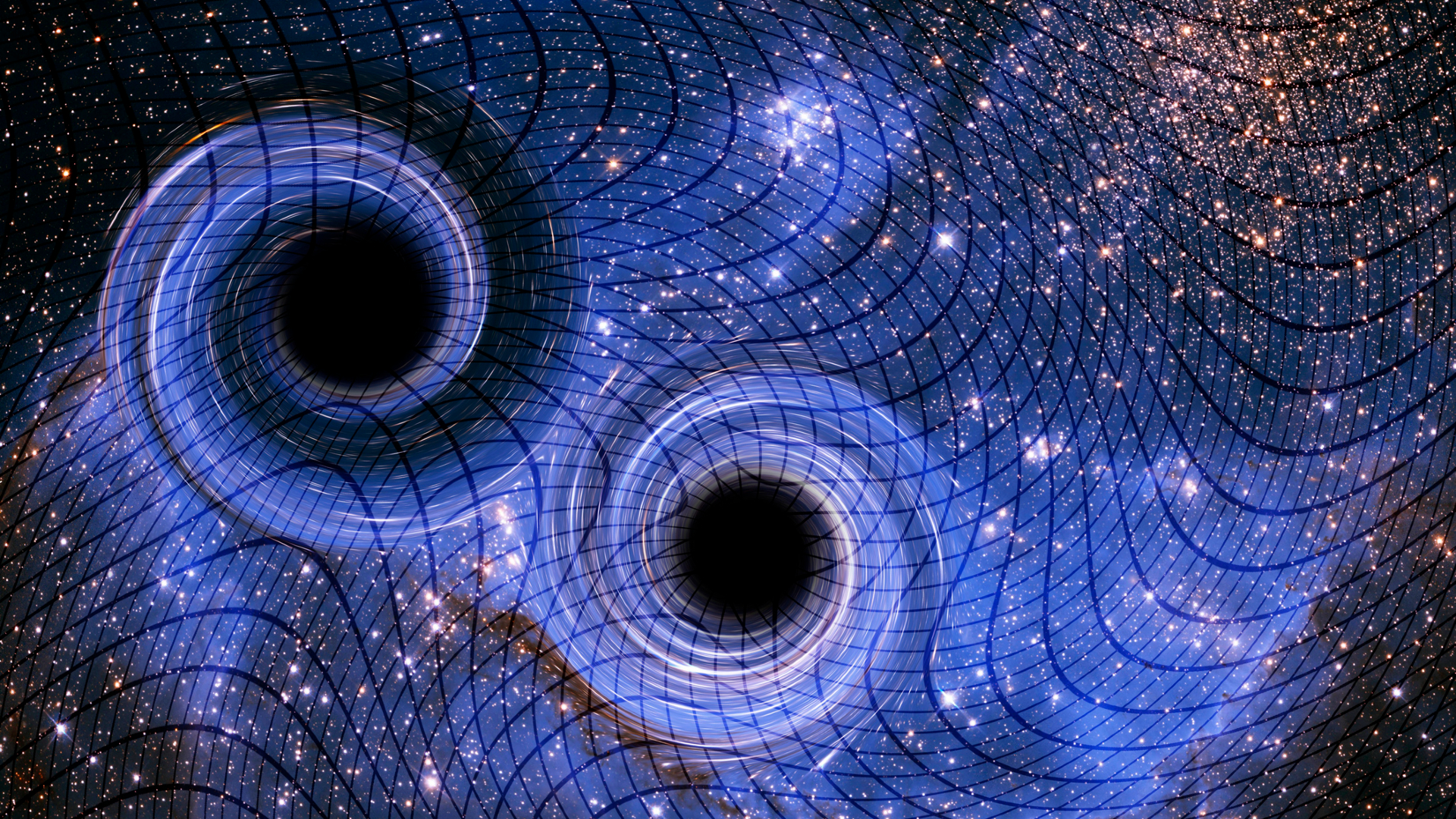
An illustration of black holes merging and releasing gravitational waves. Studying these signals with ever-more-sensitive instruments could help answer our questions about the earliest moments of the universe. (Image credit: VICTOR de SCHWANBERG/SCIENCE PHOTO LIBRARY via Getty Images)From exotic physics to the familiar universe
One striking feature of QQG is that it behaves very differently depending on the energy scale. At extremely high energies, it follows new quantum rules. But as the universe expands and cools, it transitions back to the familiar physics described by Einstein.
The theory suggests that gravity becomes simpler at very high energies — a property known as asymptotic freedom — before evolving into the form we observe today. Eventually, the universe enters the hot, radiation-filled phase described by standard cosmology.
This framework provides a continuous bridge between an exotic early universe and the well-tested physics of later times. The key question, however, is whether this idea can be tested.
“Yes, at least in principle,” Afshordi said. “The most promising tests come from cosmology, especially from the imprint of the early universe on primordial gravitational waves and the cosmic microwave background.”
These ancient signals carry information about the universe’s earliest moments. According to the new theory, these signals should contain subtle differences compared with predictions from standard inflation models.
“One particularly interesting aspect of our scenario is that it can lead to distinctive predictions for the gravitational-wave signal produced in the early universe,” Afshordi noted. “As observational sensitivity improves over the coming years and decades, future measurements of primordial gravitational waves could begin to distinguish this kind of model from more conventional inflationary scenarios.”
Although the idea is still being explored, it offers a compelling possibility: that the Big Bang may not have been a singular beginning but rather part of a deeper, quantum description of gravity. If confirmed, this framework could reshape how scientists understand the origin of the universe — replacing a breakdown of physics with a new, more complete picture of cosmic beginnings.
Liu, R., Quintin, J., & Afshordi, N. (2026). Ultraviolet completion of the Big Bang in quadratic gravity. Physical Review Letters, 136(11). https://doi.org/10.1103/6gtx-j455
Think you know about Einstein’s theories? Test your knowledge with our Albert Einstein quiz!