
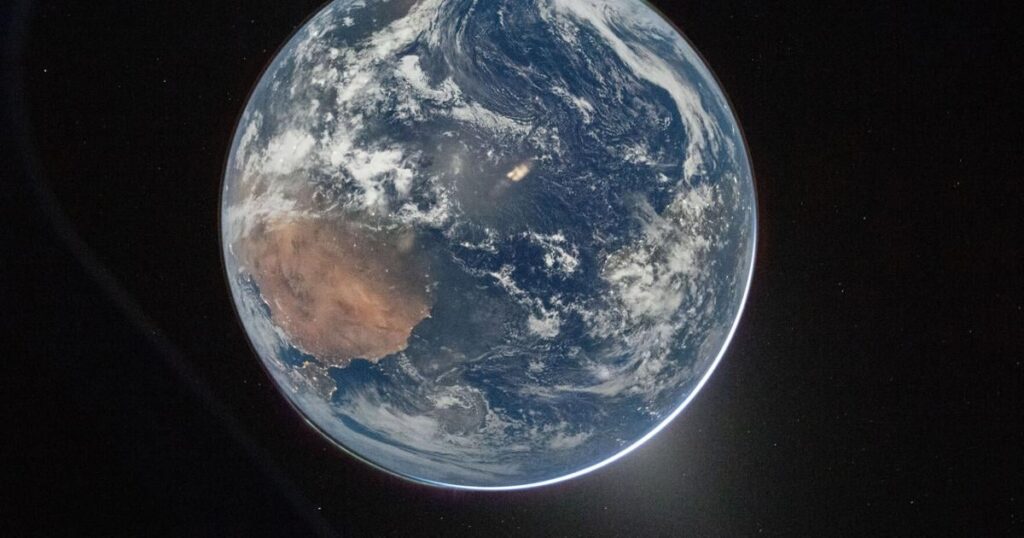
HOUSTON — As the Artemis II astronauts fly farther from Earth, they’re taking the opportunity to look back home.
On Friday morning, NASA shared a partial view of our bright blue planet as captured by Reid Wiseman, the mission’s commander. Earth, swathed in swirling clouds, is shown rising through a window on the Orion capsule in which the crew is to journey around the moon.
Another picture posted by the space agency shows Earth in full, with green streaks of aurora painting parts of its atmosphere.
“You look amazing, you look beautiful,” Victor Glover, the pilot of Artemis II, said in a video call with ABC News on Thursday night.
Glover, the first Black astronaut to travel to deep space, emphasized the unifying power of seeing Earth from such a distance. “No matter where you are from or what you look like, we’re all one people,” he said.
The Artemis II crew also includes mission specialists Christina Koch, the first woman to journey around the moon, and Jeremy Hansen, the first Canadian astronaut to make the trip.
“With the exception of our four friends, all of us are represented in this image,” Lakiesha Hawkins, an acting deputy associate administrator at NASA, said at a news conference at Johnson Space Center on Friday afternoon.
NASA added two more pictures of Earth taken by the crew Friday afternoon. One showed our planet cut in half, with one side lit up by the sun and the other obscured by the black of night. In a second image, our world is bathed in darkness, with a tiny crescent of light illuminating its lower limb.
Howard Hu, the Orion program manager, shared in Friday’s news conference that his favorite image so far was not of Earth, but of the four astronauts smiling during their video call Thursday night.
“I do believe Jeremy is too comfortable,” Hu joked, because the astronaut was lying sideways. (Hansen is notably taller than the rest of the crew.)
On Thursday, after testing out various systems of the Orion spacecraft in Earth orbit, NASA committed the capsule and crew to the trip around the moon with the spacecraft’s final major engine burn.
“With this burn to the moon, we do not leave Earth,” Koch said shortly before the maneuver. “We choose it.”
In Friday’s news conference, Hu said that the performance of the burn was “outstanding,” and that there were no major issues so far with Orion’s life support systems.
The action-packed first two days of the Artemis II mission are over, and the crew has moved on to more routine tasks, including medical check-ins and window inspections.
It is now the third day of the crew’s 10-day mission. The crew awoke during the early afternoon Eastern time to begin the day’s activities, including a test of how loud the toilet is.
They have also finally spoken with their families.
To keep the spacecraft on an optimal path to the moon, a minor engine burn was planned for Day 3. But according to Judd Frieling, a NASA flight director, the navigation and propulsion systems are performing so well that the burn is not needed. Two more correction burns are planned for later in the mission.
The crew’s checklist for the rest of Day 3 includes an in-space CPR demonstration, a test of the emergency communication system and an evaluation of their medical kits. The astronauts are also preparing the cabin for lunar science observations.
On Day 6, the astronauts will loop around the far side of the moon, the first humans to visit — from afar — in more than half a century. On Friday, the crew is to rehearse some of the scientific observations that they will try during that phase of the mission.
Then gravity will swing them back toward home. On the final day of the mission, the astronauts are expected to splash down in the Pacific Ocean.
As NASA and its astronauts worked their way toward the moon, the Trump administration on Friday released its budget request for the agency for the 2027 fiscal year, which begins Oct. 1.
Like last year, it would provide plenty of money for the moon missions, but seeks deep cuts elsewhere, including a 47% reduction in spending on NASA science missions.
Casey Dreier, who leads policy efforts at the Planetary Society, a nonprofit organization that advocates for space science and exploration, said Congress will likely ignore the administration’s requests and continue bipartisan support for all parts of NASA.
But the uncertainty of the money, especially with the midterm elections in November, makes it more difficult for NASA to look ahead and plan. According to Dreier, this past year was the first in 40 years that NASA did not commit to starting work on any new science missions.
“I encourage the workforce to leave the politics for the politicians and remain focused on the mission,” Jared Isaacman, the NASA administrator, wrote in an email about the budget proposal sent to the agency staff. The email was shared by an agency employee not authorized to distribute it.
This article originally appeared in The New York Times.