
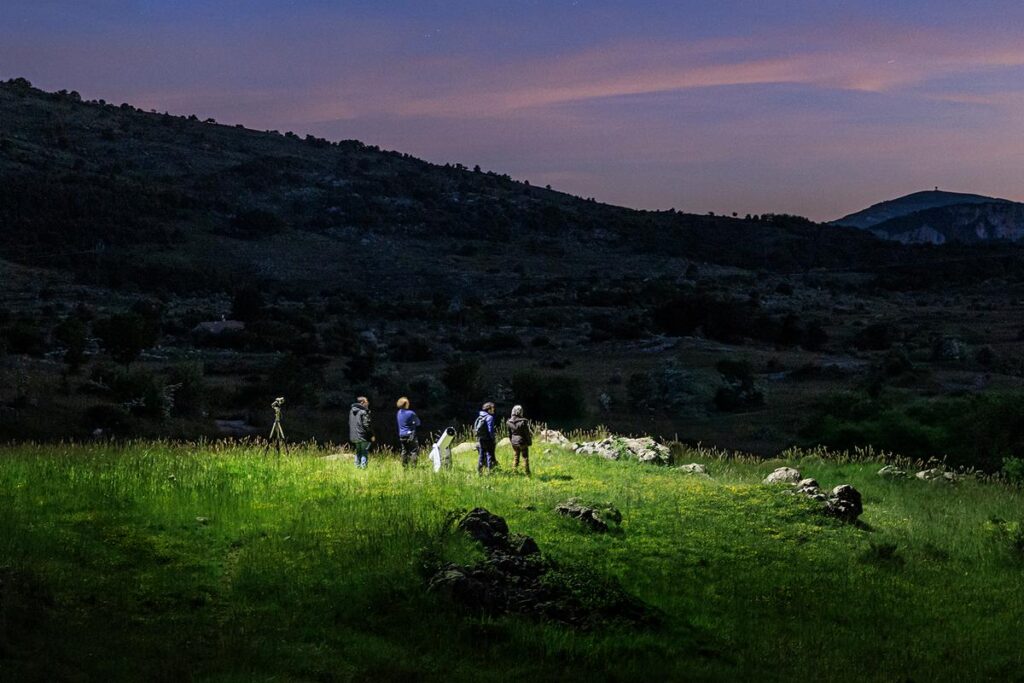
A cosmos too vast for solitude
The night sky hints at a truth larger than any single life. The Milky Way alone holds hundreds of billions of stars, each with the potential for worlds. Across observable space, there are trillions of galaxies, a number that dwarfs our certainty and magnifies our ignorance.
The science of possibility
The Drake Equation is not prophecy but a framework, a way to think about probabilities. With thousands of exoplanets confirmed, we now know that planets are common, not rare ornaments. Many orbit in habitable zones where liquid water might persist, and chemistry could begin its ancient dance.
Life’s resilience on Earth
On Earth, life thrives in extremes that once seemed impossible. Organisms flourish in boiling vents, acidic hot springs, and beneath Antarctic ice, drawing energy from rock and lightless depths. If life can be tenacious here, it hints at possibilities that are far more cosmic than parochial.
The humility of perspective
Our assumptions are often shaped by our brief tenure as a species. We have only just learned to send faint whispers into space, signals that fade into cosmic noise within a handful of light-years. The timeline of civilizations could be staggered by millions of years, missing each other like ships passing in a boundless night.
Why the silence persists
Silence is not proof of absence; it is a measurement of our limits. Signals can be fleeting, directional, or encoded in ways we don’t yet recognize. Vast distances, intervening dust, and the tyranny of light-speed make even a hello feel like a daring leap.
Beyond radio: the search evolves
We are widening our net from radio beacons to subtle technosignatures. Astronomers study exoplanet atmospheres for disequilibria—oxygen with methane, or other anomalies—that might signal life. We look for waste heat, artificial night lights, or spectral fingerprints no geology could forge.
Wonder, skepticism, and balance
True curiosity wears both wonder and doubt like a matched pair. Healthy skepticism protects us from wishful thinking and elaborate hoaxes, while wonder keeps us open to the unexpected pattern in the noise. Each new instrument must be tuned to catch the narrow threads of possibility without inventing what is not there.
“Between the signal we hope for and the silence we endure lies the patient practice of attention—and the courage to keep listening.”
The paradox reframed
The Fermi paradox asks, “Where is everybody?” but the question may be oddly framed. It presumes that visibility is easy and that civilizations want to be found. Perhaps the zoo is ours to escape, not theirs to open, and perhaps the rules of contact are older than our myths.
Practical steps toward discovery
Progress is not a sprint but an accumulation of persistent effort. We can prioritize the most promising targets, share data openly, and build tools designed for longevity rather than novelty. In doing so, we line up our present curiosity with the future that will inherit our results.
Invest in next-generation telescopes capable of high-contrast exoplanet imaging.
Expand multi-wavelength surveys to capture diverse technosignatures.
Standardize open data protocols and cross-disciplinary collaboration.
Fund long-baseline projects that outlast political cycles.
Ethics for a larger universe
If we do find life, even microbial, our first duty is care. Planetary protection is not bureaucratic caution but a moral stance toward ecosystems we don’t yet understand. Discovery should be guided by restraint, reciprocity, and a sense of shared belonging in something grander than our present ambition.
The human part of the equation
We are the universe’s listeners, but also its storytellers. Our narratives shape what we build, where we search, and how we interpret what we see. A culture that prizes open inquiry over quick conclusions will be better prepared for the day a small signal becomes a new beginning.
Listening as a civic virtue
In an age of noise, patient attention is a radical choice. The night sky asks for humility, persistence, and the willingness to be surprised. To assume we are alone in such immensity is not caution—it is a failure of imagination dressed as certainty, a door closed when the hall is full of light.