
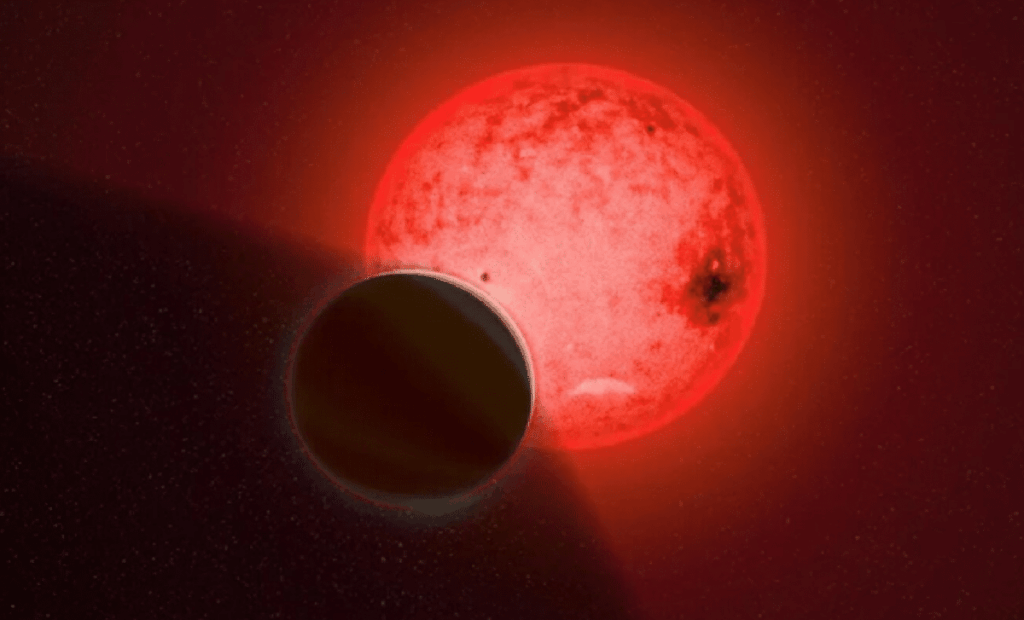
A massive exoplanet orbiting a small red dwarf star has revealed an atmospheric composition that contradicts long-standing theories of planetary formation, according to a new study published in The Astronomical Journal.
A Planet That Should Not Exist… Yet Does
The discovery of TOI-5205 b is already unusual before its atmosphere is even considered. This Jupiter-sized world orbits a cool red dwarf star that is far smaller and less massive than the Sun, roughly 40% of its mass. According to established models, such small stars should not be able to form or retain planets of this size, earning TOI-5205 b the nickname of a “forbidden planet.”
What makes this system even more striking is the planet’s transit behavior. When TOI-5205 b passes in front of its host star, it blocks nearly 6% of the star’s light, a dramatic signal that allowed astronomers to study its atmosphere in rare detail. Using the James Webb Space Telescope, researchers captured multiple transits and split the starlight into spectra, revealing the chemical fingerprints of the planet’s gaseous envelope.
The observations confirmed the presence of methane (CH₄) and hydrogen sulfide (H₂S), compounds that provide critical clues about atmospheric chemistry. Yet the real surprise came from what was missing: heavier elements. Compared to expectations, and even compared to its own star, the planet’s atmosphere appears strikingly deficient in these materials.
This mismatch between theory and observation immediately signals that something unusual happened during the planet’s formation, pushing astronomers to reconsider how such systems evolve.
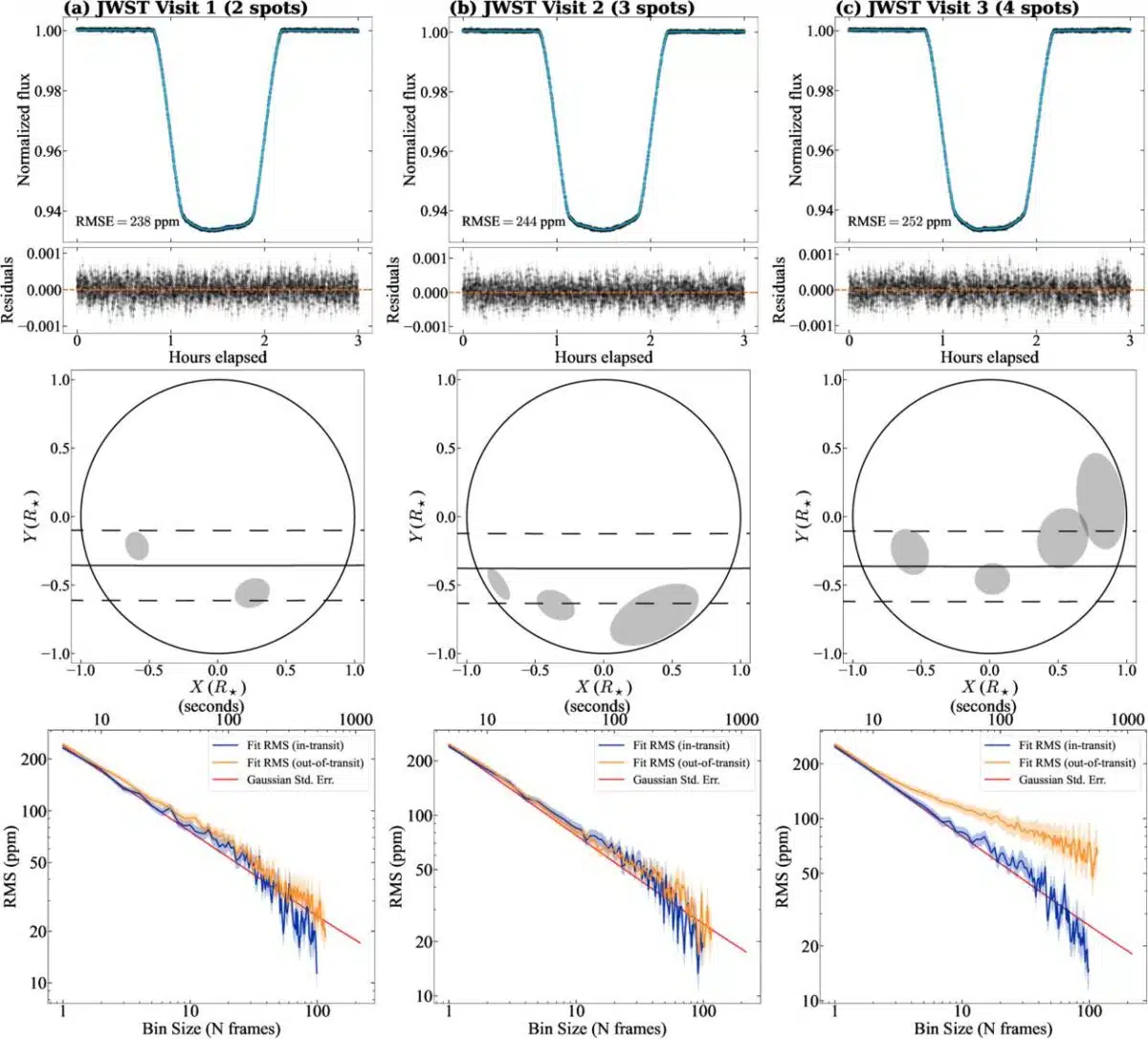 Panels (a)–(c) JWST NIRSpec PRISM white light curves produced using ExoTiC-JEDI after binning to a cadence of 5 s. Top row: the data along with the best-fitting model (solid line) along with the residuals to the fit below. Middle row: the stellar surface and the adopted spot configuration. (The transparency of the spots is arbitrary and does not reflect the spot flux ratio.) The solid line indicates the position of the transit chord (center of the planet), and the dashed lines mark the ± Rp from the center of the transit chord. Bottom row: the rms for each visit for in-transit (blue) and out-of-transit (orange) data. The prediction for Gaussian white noise is shown as a red solid line. The residuals to the model fits demonstrate there is no significant time-correlated noise in transit after modeling the spots.
Credit:The Astronomical Journal.
A Chemical Mystery That Defies Expectations
The research, published in The Astronomical Journal and led by teams from NASA Goddard Space Flight Center and Carnegie Science, reveals a key anomaly: the atmosphere of TOI-5205 b contains far fewer heavy elements than predicted. In planetary science, this property, known as metallicity, is a crucial indicator of how and where a planet formed.
Dr. Anjali Piette from the University of Birmingham emphasized the significance of this finding:
“These findings have implications for our understanding of the giant planet formation process that occurs early in a star’s lifespan. The planet having a lower metallicity than its own host star makes it stand out among all the giant planets that have been studied to date.”
In most known systems, gas giants tend to have atmospheres enriched with heavier elements relative to their stars. Jupiter, for example, shows higher metallicity than the Sun. TOI-5205 b flips that expectation entirely. Its atmosphere is not only metal-poor compared to similar planets, it is also poorer than the star it orbits.
This discrepancy suggests that the processes shaping this planet were fundamentally different. The data indicates that while the atmosphere is depleted, the planet’s interior may still hold a large reservoir of heavy elements, creating a layered and chemically divided world.
Such a structure challenges the assumption that planetary interiors and atmospheres remain well mixed over time, opening new questions about how materials move within giant planets.
Inside The Planet: A Hidden Reservoir Of Heavy Elements
To understand the anomaly, scientists combined observational data with advanced models of planetary interiors. These models suggest that TOI-5205 b could be up to 100 times richer in heavy elements internally than what is observed in its atmosphere.
This leads to a compelling explanation: during the planet’s formation, heavier elements may have migrated inward, becoming trapped deep within its core or lower layers. As a result, the upper atmosphere remained dominated by lighter gases like hydrogen, creating the low-metallicity signature detected by JWST.
Dr. Shubham Kanodia from Carnegie Science explained that this separation hints at a lack of mixing between the planet’s interior and atmosphere. Such a scenario implies that once the planet formed, its internal structure stabilized in a way that prevented heavier elements from resurfacing.
The implications go beyond a single planet. If similar processes occur elsewhere, many giant planets could harbor hidden internal compositions that are not reflected in their atmospheres. This would complicate efforts to infer planetary makeup solely from atmospheric observations.
The chemical profile also suggests a carbon-rich, oxygen-poor environment, which may influence everything from cloud formation to thermal structure, making TOI-5205 b an important laboratory for atmospheric physics.
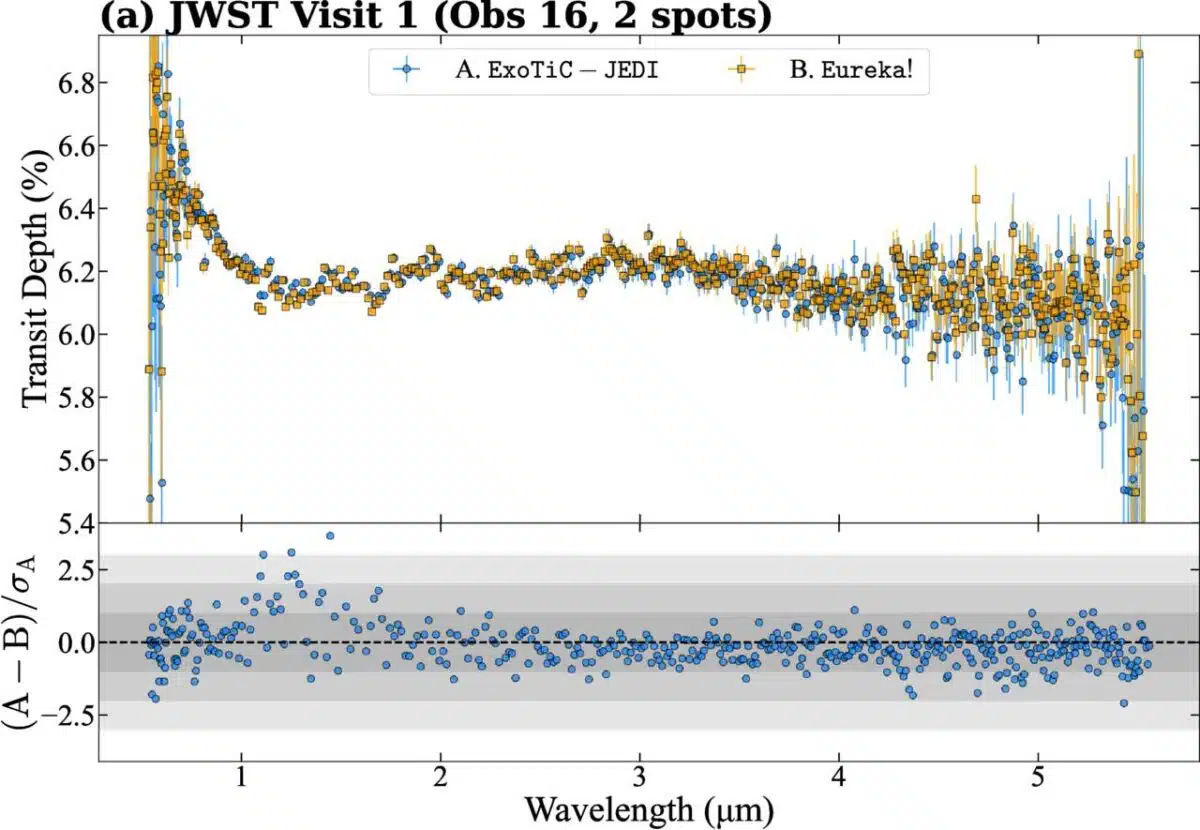 Top: the transmission spectra for the first observation (observation 16) of TOI-5205b on 2023 October 10. The ExoTiC-JEDI
reduction is the blue circles, and the Eureka!
reduction is the orange squares. Bottom: the differences between both reductions, scaled by the errors of the ExoTiC-JEDI
derived data. The 1σ, 2σ, and 3σ regions are shaded for reference. The complete figure set (five images, one for each observation and comparisons of all ExoTiC-JEDI
and Eureka!
reductions) is available in the online journal. All transmission spectra are included as data behind the figure. (The data used to create this figure are available.) (The complete figure set (five images) is available.)
Credit:The Astronomical Journal.
A New Frontier In Studying Active Stars And Their Planets
Another layer of complexity comes from the host star itself. The red dwarf star in this system is heavily covered in starspots, cool, dark regions that can distort observational data. These features can mimic or obscure atmospheric signals, making precise measurements extremely challenging.
To overcome this, the research team developed methods to correct for the star’s activity, ensuring that the atmospheric signals they detected truly originated from the planet. This approach is now being tested in ongoing James Webb Space Telescope programs, marking a step forward in studying planets around active stars.
The work is part of the GEMS Survey, which focuses on giant planets orbiting M-dwarf stars. These stars are the most common in the galaxy, meaning that understanding their planetary systems is key to building a complete picture of planet formation.
As more data is gathered, TOI-5205 b may prove to be just the first example of a broader class of unexpected worlds. Each new observation has the potential to refine, or overturn, existing models.
This planet’s strange chemistry and improbable existence highlight a larger truth: the universe continues to produce systems that stretch the limits of current theory, forcing astronomers to rethink the rules governing how planets are born and evolve.