

Each Voyager Golden Record contains analog-encoded photographs, greetings in dozens of languages, and approximately 90 minutes of music selected by a small committee working under extraordinary time pressure in 1977. The two 12-inch gold-plated copper disks now travel through interstellar space at speeds exceeding 30,000 miles per hour, each one carrying a portrait of Earth assembled by a small team in a matter of weeks. That fact alone should give you pause. A handful of scientists, artists, and engineers decided what humanity sounds like, looks like, and values, then bolted their answer to the side of a spacecraft and launched it toward the stars. The choices they made, and the ones they didn’t, tell us as much about late-twentieth-century America as they do about any universal human condition.
I think about this project differently than most space writers do. I spent years on Capitol Hill and in DC think tanks watching how institutions make decisions under constraints: budget constraints, political constraints, time constraints. The Golden Record was assembled under all three. And what emerged from that pressure says something real about how we represent ourselves when the stakes feel infinite but the resources are very finite.
The Committee and Its Constraints
Carl Sagan chaired the committee that selected the contents of the Golden Record. NASA tasked him with assembling the message contained on what would become the most famous phonograph record never played on Earth. The team included Sagan’s future wife Ann Druyan; science writer Timothy Ferris; astronomer Frank Drake; artist Jon Lomberg; and several other collaborators drawn from Sagan’s professional orbit at Cornell University.
They had a very limited timeframe. Voyager 2 launched on August 20, 1977, and Voyager 1 followed on September 5. The records had to be designed, assembled, tested, and physically attached to both spacecraft before those dates. The committee had to curate the human experience for an audience that might not exist and might not be recognizable as an audience at all.
That timeline shaped every decision. You don’t conduct a global survey of human civilization in such a short period. You call the people you know, rely on the institutions you trust, and make judgment calls that feel right in the moment. This doesn’t invalidate their work. It contextualizes it.
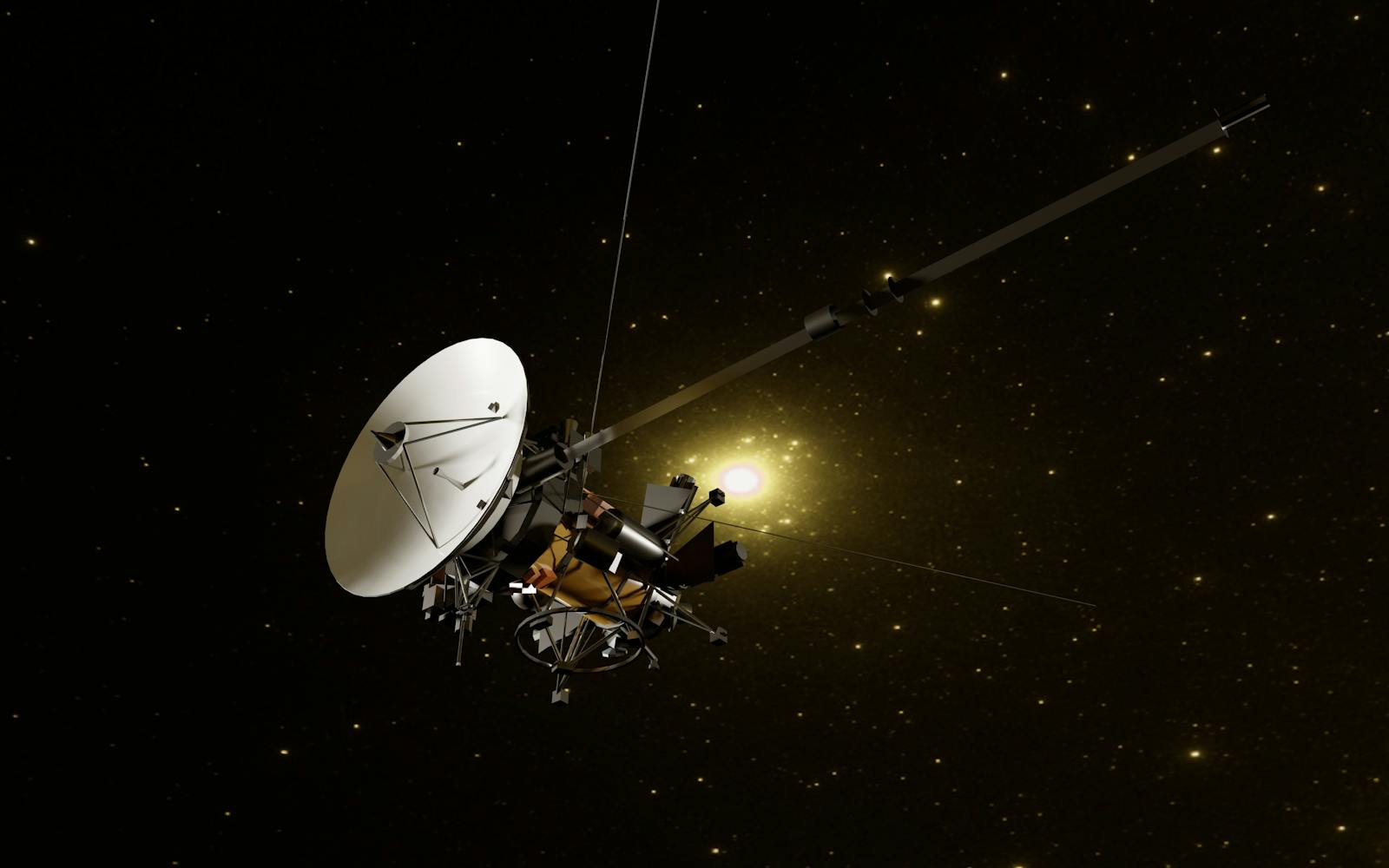
The physical object itself was engineered to survive. Each disk is enclosed in a protective aluminum jacket, together with a cartridge and a needle to play it. Engraved on the cover is a map showing Earth’s position relative to pulsars, the rapidly spinning neutron stars whose unique rotational signatures serve as cosmic landmarks. Instructions for playing the record are etched in symbolic diagrams, along with a representation of a hydrogen atom, the most abundant element in the universe. The assumption was that any civilization sophisticated enough to intercept a spacecraft moving through interstellar space would understand basic physics and could reverse-engineer a phonograph.
That’s a significant assumption, and it reveals a particular kind of optimism about the universality of scientific reasoning. The committee bet that math and physics would be the shared language. Everything else on the record, the music, the greetings, the photographs, was bonus content for a species that could first solve a physics puzzle.
What They Chose: The Sounds
The audio selections fall into three categories: natural sounds of Earth, spoken greetings, and music. The natural sounds include surf, wind, thunder, bird calls, whale songs, and a collection of human-made sounds like footsteps, heartbeats, and laughter. There is the sound of a kiss. There is the EEG pattern of Ann Druyan’s brain waves, recorded shortly after she and Sagan had confessed their love for each other by phone. She later said her thoughts during the recording were about the history of Earth, what it was like to fall in love, and the predicament of human civilization. Those brain waves are now traveling billions of miles from here.
The greetings range from ancient Sumerian to modern Mandarin Chinese, from Akkadian to Wu, representing dozens of languages. A child’s voice says, in English, “Hello from the children of planet Earth.” UN Secretary-General Kurt Waldheim recorded a message. The range of languages was genuinely ambitious for the timeline, though the committee leaned heavily on contacts at Cornell’s linguistics department to source speakers quickly.
Then there’s the music. Approximately ninety minutes of it. Bach’s Brandenburg Concerto No. 2. A selection from Mozart’s The Magic Flute. Beethoven’s Fifth Symphony and his String Quartet No. 13. Stravinsky’s The Rite of Spring. These Western classical selections are well represented, accounting for a substantial portion of the musical runtime. But the committee also included Senegalese percussion, an Australian Aboriginal song, Azerbaijani bagpipes, a Navajo night chant, and Peruvian panpipes. Chuck Berry’s “Johnny B. Goode” made the cut as a rock and roll entry. A piece of Javanese gamelan was included. So was a Georgian chorus and an Indian raga.
What’s missing tells you something too. No Beatles. (The committee reportedly wanted to include the Beatles, but faced rights issues.) No jazz vocalist. No blues. Louis Armstrong was represented, but that’s a loose fit for representing the full breadth of African American musical tradition. No country music. No electronic music, which admittedly was still nascent in 1977. No hip-hop, which didn’t exist yet as a recorded genre.
The committee was constructing a canon under pressure, and canons always exclude. What they included skewed toward what educated American academics in the late 1970s considered representative of global culture. This is not a criticism so much as an observation about how representation works when a small group makes universal claims.
What They Chose: The Images
The photographs encoded on the record were selected to depict human life, Earth’s ecology, and basic scientific concepts. They include mathematical definitions, diagrams of the solar system, images of DNA structure, human anatomy, and photographs of people eating, drinking, and going about daily life in various parts of the world. There are pictures of architecture, transportation, and landscapes. There is an image of a woman nursing a child and a diagram of human reproduction.
The original committee wanted to include a nude photograph of a man and a pregnant woman, a straightforward depiction of the human body for a recipient that would presumably have no frame of reference for what humans look like. NASA vetoed the nude images. This was 1977, shortly after the agency had faced backlash for the nude human figures engraved on the Pioneer plaques (also designed by Sagan and Drake). The compromise was a silhouette and anatomical diagrams.
This is where institutional politics intersected with cosmic messaging. NASA, a federal agency funded by Congress, could not afford another controversy about nudity in space. The people who controlled the budget were not thinking about alien audiences; they were thinking about constituents. I spent five years as a staffer on the Senate Commerce Committee, and I can tell you that this dynamic, the tension between what a mission’s scientific logic demands and what its political sponsors will tolerate, has not changed in fifty years. It shapes every major NASA decision. The Golden Record was no exception.
The photographs also reflect the visual technology of 1977. They were analog-encoded, designed to be reconstructed by an advanced civilization with access to the playback instructions on the record’s cover. The committee had to balance the desire for a rich visual portrait of Earth against the physical storage limitations of a 12-inch copper disk. Every image was a trade-off. Each photograph included meant another photograph excluded.
What the Choices Reveal
The Golden Record has been described by some scientists as representing humanity’s hopes and achievements, a kind of message of what Earth has accomplished. Bethany Ehlmann, a planetary scientist at the California Institute of Technology, in a conversation with National Geographic, has characterized the Golden Record as a testament to humanity’s journey and scientific achievement in being able to send probes to explore the solar system. That framing is generous and accurate, but it’s also worth being precise about what kind of love letter it is.
It is a love letter written by the educated upper-middle class of the late-twentieth-century West, with genuine effort to include voices from outside that circle. The committee tried hard. They reached across cultures for music, across languages for greetings, across time for scientific diagrams that would communicate to any intelligence. But the curatorial voice is unmistakably that of a particular moment in American intellectual life: post-Apollo, pre-Reagan, deeply influenced by the counterculture’s idealism about human unity, and operating within a scientific institution that answered to the United States Congress.
There is no mention of war on the Golden Record. No depiction of poverty, famine, or disease. No religion, except what’s implied by the music. No politics. The committee deliberately omitted conflict and suffering, reasoning that a first contact message should present humanity at its best. This is a defensible choice. It is also a choice, and it produces a picture of Earth that would be unrecognizable to most of the people living on it in 1977.
Sagan acknowledged the idealism of the project, viewing the Golden Record as an expression of hope about humanity’s potential. Hope was the point. The record was never primarily a communication device; it was a symbol. Its real audience was always us.
Every time capsule reveals its makers more than its contents. Sagan’s personal relationships determined the creative direction: Druyan’s brain waves, Ferris’s production choices, Lomberg’s artistic vision. The record is as much a product of Cornell University’s intellectual culture in the 1970s as it is a product of global civilization. That makes it more interesting, not less.
Where the Records Are Now
Both records are still out there, traveling silently through interstellar space. Voyager 1 is more than 15 billion miles from Earth, moving through the cosmos at over 38,000 mph. Voyager 2 trails at about 13 billion miles. Both probes crossed the heliopause, the boundary where the sun’s influence gives way to the interstellar medium. Voyager 1 made that crossing in 2012, Voyager 2 in 2018. They are the only human-made objects to have done so.
The spacecraft themselves are dying. Their plutonium power supplies have been degrading steadily, and NASA engineers have been shutting down instruments one by one to extend their operational lives. As BGR has reported, Voyager 1 is expected to reach one light-day from Earth by late 2026, another milestone in a mission that has been collecting milestones for nearly five decades. Suzanne “Suzy” Dodd, the current Voyager project manager, has said the goal is to keep the missions running to 50 years, which would bring them to 2027.
In May 2025, engineers at NASA’s Jet Propulsion Laboratory successfully revived a set of thrusters aboard Voyager 1 that had been considered inoperable since 2004. They needed backup thrusters because the active set’s fuel tubes were experiencing residue buildup. That is the kind of engineering improvisation that keeps 48-year-old hardware alive 15 billion miles from the nearest repair shop. As Space Daily has reported on the Voyager spacecraft’s ongoing communication challenges, maintaining contact with probes at this distance requires the Deep Space Network’s giant radio antennas, and even then, signals take nearly 23 hours to make the one-way trip.
But the records themselves will outlast the spacecraft by an almost incomprehensible margin. Once the power runs out and the instruments go dark, the probes will become inert objects drifting through the galaxy. The gold-plated copper disks, protected by their aluminum jackets, are designed to survive for billions of years in the vacuum of interstellar space, continuing their journey long after contact with the spacecraft is lost.
It will take approximately 40,000 years for either probe to drift near another star system. Voyager 1 will pass within 1.6 light-years of the star Gliese 445. Voyager 2 will come within 1.7 light-years of Ross 248. Neither approach is particularly close. A light-year is about 5.88 trillion miles. The odds of the records being discovered by another intelligence are, by any honest accounting, functionally zero.
The Record as Policy Artifact
I find myself returning to the Golden Record whenever I write about how institutions make decisions under uncertainty. In my recent piece on SpaceX’s $1.75 trillion valuation, I was tracking how markets price in futures that haven’t been authorized or funded yet. The Golden Record is the inverse of that problem. It was a government-funded mission carrying a message whose intended recipients may not exist, won’t be reached for tens of thousands of years, and probably won’t find the record at all. The entire project was, by rational calculation, pointless.
And yet it became one of the most culturally significant artifacts NASA has ever produced. More people can describe the Golden Record than can explain what scientific instruments the Voyager probes actually carry. It has been the subject of books, albums (Ozma Records pressed a limited-edition vinyl replica that sold out immediately), museum exhibitions, and now a Pixar film called Elio. The record did not succeed as interstellar communication. It succeeded as terrestrial mythology.
That distinction matters for how we think about space policy. Congress funds NASA for many reasons: national prestige, scientific discovery, technological development, economic stimulus for districts with aerospace contractors. But NASA’s cultural power, its ability to make people care about space, has always rested on symbolic gestures as much as on technical achievements. The Golden Record cost almost nothing relative to the Voyager program’s total budget. Its return on investment, measured in public engagement and cultural resonance, has been astronomical.
Ehlmann captured this when she observed that most spacecraft launched after Voyager have included some sort of message from Earth. The Golden Record established a template: you don’t just send instruments into space, you send meaning. That template persists. The plaques on the Mars rovers, the microchips carrying names on deep space missions, the messages encoded on satellites. All of these trace a lineage back to Sagan’s committee and their sprint to define humanity.
What We’d Put on It Now
The obvious question is what a 2026 Golden Record would contain, and the obvious answer is that we’d never be able to agree. The 1977 version was possible because a small committee made unilateral decisions in a short timeframe, shielded from public input by the project’s obscurity and speed. A modern version would face social media scrutiny, geopolitical objections, intellectual property disputes, and the impossible task of representing 8 billion people through a democratic process that would satisfy none of them.
The music selection alone would be a minefield. Would K-pop make the cut? Reggaeton? Which hip-hop track represents the genre? Does the record include AI-generated music, given that it now constitutes a measurable fraction of what humans listen to? Does it include TikTok sounds? The committee in 1977 could select Chuck Berry without worrying about a global social media backlash from fans of artists who were excluded. That world is gone.
The 1977 committee’s exclusion of war and suffering would also face harder questions today. In a world more aware of the politics of representation, the choice to show only humanity’s best face might be read as dishonest rather than hopeful. A committee today would have to reckon with whether sanitizing the human experience is an act of optimism or erasure.
And the gender and racial composition of the committee itself would be scrutinized. Sagan’s team was brilliant and well-intentioned, but it was small and not demographically representative of the planet it claimed to represent. A modern committee would need broader participation, which would require more time, which would produce more disagreement, which would delay decisions, which might prevent the project from being completed at all. This is the paradox of representation: the more inclusive the process, the harder it is to produce a coherent artifact.
Growing up in El Paso, on the border between two countries, I learned early that the question of who gets to represent a culture is never neutral. Every act of representation is also an act of exclusion. The Golden Record’s beauty is that it tried anyway, knowing the attempt was imperfect. Sagan’s committee didn’t pretend they had captured all of humanity. They captured what they could, with who they had, in the time they were given.
The Message That Wasn’t on the Disk
The records are now so far from Earth that the light carrying their last transmissions takes nearly a full day to arrive. Sometime in the next few years, the power will run out and the transmissions will stop. The spacecraft will go silent. And two gold-plated disks will continue their slow drift through the galaxy, carrying Bach and whale songs and the brain waves of a woman falling in love, toward a destination that exists only in the imagination of the species that sent them.
When I started writing this piece, I framed it around a question: what do the Golden Record’s choices reveal about us? The answer, nearly fifty years later, is uncomfortably clear. They reveal that when we tried to explain ourselves to the universe, we sent a version of humanity that was aspirational, incomplete, and shaped by the specific people who happened to be in the room. We omitted our wars, our cruelty, our religions, and our politics. We led with Bach and birdsong and a child’s greeting. We let a woman’s brain waves stand in for the experience of love because we couldn’t figure out how else to encode it.
What the record reveals about us in 2026 is different from what it revealed in 1977. Then, it was a gesture of optimism from a species that had just walked on the moon and believed it might walk among the stars. Now, it reads more like an artifact of a particular kind of innocence — the belief that a small group of smart, well-meaning people could speak for everyone, and that the best way to introduce yourself to the unknown was to leave out the hard parts. We are less sure of both propositions today. We are more aware of who gets left out of the room and what gets left off the record. Whether that awareness would produce a better Golden Record or simply prevent one from being made at all is a question we haven’t answered.
But here is what strikes me most: the impulse itself hasn’t changed. We still want to be known. We still launch messages into voids with no guarantee of a reply. We still engrave our names on microchips headed for Mars, still beam radio signals at distant stars, still argue passionately about what songs should represent us. The Golden Record’s deepest revelation isn’t in its tracklist or its photographs or its map of pulsars. It’s in the fact that we encoded anything at all. We had limited time, a limited budget, and no evidence that anyone would ever listen. We did it anyway. That impulse — the desire to be known by someone we’ll never meet — may be the most human thing the record contains, and it’s the one thing that isn’t actually on it.
Somewhere past the heliopause, two gold disks drift in silence, carrying the sound of a species that couldn’t stop reaching out even when no one was reaching back. That is what 1977 tells us about ourselves. It’s what 2026 confirms.
Photo by Tima Miroshnichenko on Pexels