
image:
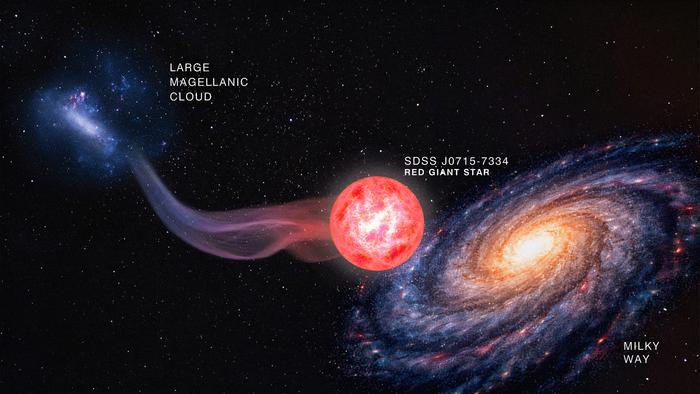
An ancient immigrant: an artist’s conception (not to scale) of the red giant SDSS J0915-7334, which was born near the Large Magellanic Cloud and has now journeyed to reside in the Milky Way.
Credit: Navid Marvi/Carnegie Science
Pasadena, CA—An unusual team of astronomers used Sloan Digital Sky Survey-V (SDSS-V) data and observations on the Magellan telescopes at Carnegie Science’s Las Campanas Observatory in Chile to discover the most pristine star in the known universe, called SDSS J0715-7334. Their work is published in Nature Astronomy.
Led by the University of Chicago’s Alexander Ji—a former Carnegie Observatories postdoctoral fellow—and including Carnegie astrophysicist Juna Kollmeier—who leads SDSS, now in its fifth generation—the research team identified a star from just the second generation of celestial objects in the cosmos, which formed just a few billion years after the universe began.
“These pristine stars are windows into the dawn of stars and galaxies in the universe,” Ji explained. Several of his and Kollmeier’s co-authors on the paper are undergraduate students from UChicago, whom Ji brought to Las Campanas on an observing trip for spring break last year. “My first visit to LCO is where I really fell in love with astronomy, and it was special to share such a formative experience with my students.”
The Big Bang birthed the universe as a hot murky soup of energetic particles. Over time, as this material expanded, it began to cool and coalesce into neutral hydrogen gas. Some patches were denser than others and, after a few hundred million years, their gravity overcame the universe’s outward trajectory and the material collapsed inward. This became the first generation of stars, which were formed from just pristine hydrogen and helium.
These stars burned hot and died young, but not before producing new elements in their stellar forges, which were strewn outward into the cosmos by their end-of-life explosions. And from this detritus, new stars were born, which now comprised a wider array of elements than their predecessors.
“All of the heavier elements in the universe, which astronomers call metals, were produced by stellar processes—from fusion reactions occurring within stars to supernovae explosions to collisions between very dense stars,” said Ji. “So, finding a star with very little metal content in it told this group of students that they’d come across something very special.”
Astronomers like Ji and Kollmeier are interested in finding ancient stars from the second and third generation after the universe first developed structure. This would reveal how star formation has changed over the ensuing eons.
“We have to look in our cosmic backyard to find these objects, because we can’t yet observe individual stars at the dawn of star formation. Since these stars are rare, surveys like SDSS-V are designed to have the statistical power to find these needles in the stellar haystack and test our theories of star formation and explosion,” explained Kollmeier.
Sloan Digital Sky Survey has been one of the most successful and influential surveys in the history of astronomy and its fifth generation, which Kollmeier leads, takes millions of optical and infrared spectra, across the entire sky. This pioneering effort deploys both the du Pont telescope at Las Campanas in the Southern Hemisphere and the Apache Point Observatory in New Mexico in the Northern Hemisphere.
The wealth of SDSS-V data enabled Ji and his students to identify stars with very few heavy elements. Then, at Las Campanas, they used the state-of-the-art Magellan telescopes to take high-resolution spectra of these candidates. Amazingly, the magic occurred in the wee hours of the morning on their first Magellan observing run and SDSS J0715-7334 was confirmed as the new gold-standard of stellar purity.
“The ecosystem of telescopes at Las Campanas was critical to nearly every aspect of this breakthrough work, from the du Pont data collected as part of SDSS-V’s Milky Way mapping efforts to the Magellan observations that showed exactly how special SDSS J0715-7334 really is,” said Michael Blanton, Director and Crawford H. Greenewalt Chair of the Carnegie Science Observatories.
Las Campanas is home to four Carnegie telescopes, and this project made spectacular use of two of them, showcasing how innovations in instrumentation can drive discovery throughout a telescope’s life.
This interconnectedness is driven home by Ji and the student’s itinerary at Las Campanas. The night of their arrival they visited the du Pont telescope to see SDSS-V observers hard at work taking new data that will be added to the project’s enormous volume of resources for amateur and professional astronomers. The very next evening, they made their own observations on the Magellan Clay telescope.
Luckily, after the discovery, Ji was able to reconfigure the rest of the semester so that
the students could spend their time digging deeper into their find—a real-world example for his students of how the ability to pivot is critical to making scientific breakthroughs.
“When I was an undergraduate, I greatly preferred doing research to taking classes. I’m delighted that Alex’s course was transformed into a curriculum of discovery and I’d like to ensure surveys like SDSS-V and Gaia have the power to make that the norm and not the exception,” Kollmeier said.
Deeper analysis of the Magellan spectra showed that it has less than 0.005 percent of the Sun’s metal content. It is twice as metal-poor as the previous record holder for most-pristine star and has particularly low abundances of iron and carbon. In fact, it is 40 times more metal-poor than the most iron-poor known star.
By incorporating data from the European Space Agency’s Gaia mission, the students were also able to determine that SDSS J0715-7334—which exists about 80,000 light-years from Earth—was born elsewhere and got pulled into our Milky Way galaxy over time.
“Training the next generation of astronomers is critical to the future of our field. And building excitement about the practice of science by undertaking projects like this is a great way to ensure that curious-minded young learners can see themselves in astrophysics,” Ji concluded. “My time as a postdoc at Carnegie was pivotal to my professional growth and I am thrilled that I was able to pay that experience forward by bringing my students to Las Campanas.”
Method of Research
Observational study
Subject of Research
Not applicable
Article Title
A nearly pristine star from the Large Magellanic Cloud
Article Publication Date
3-Apr-2026
Disclaimer: AAAS and EurekAlert! are not responsible for the accuracy of news releases posted to EurekAlert! by contributing institutions or for the use of any information through the EurekAlert system.