
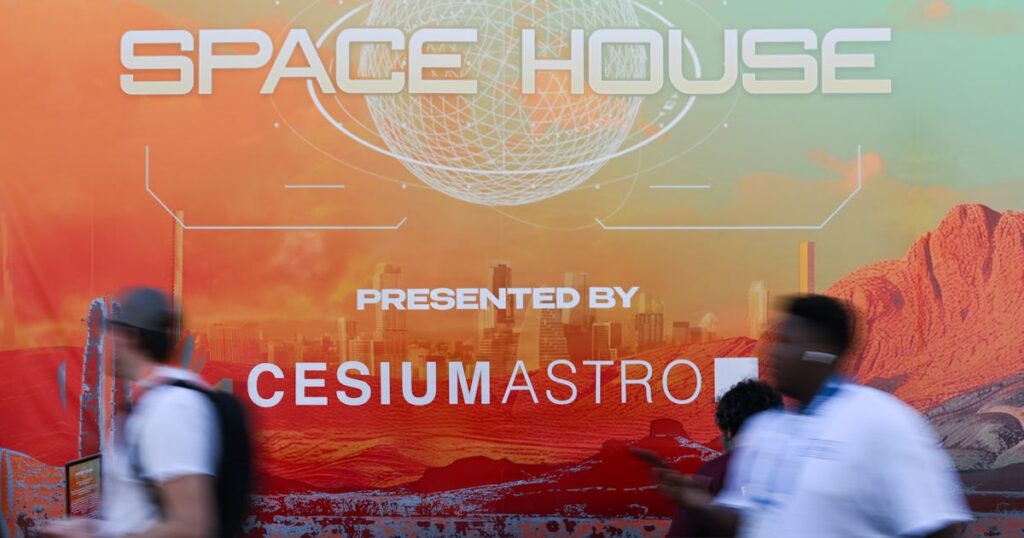
One attends SXSW for many reasons — the music and parties, the tech networking, the movie premieres all loom large. But perhaps the biggest reason this tech conference is so renowned and well-attended by movers and shakers is that it gives you a sense of where the pulse of innovation in our world is right now. You would assume in 2026 that would be in AI, and yes, NVIDIA CEO Jensen Huang took the big stage to make the case. But there was another competing force that drew the attention of many and showed that innovation today isn’t just found in data centers and prompts — but something that’s more out of this world.
The line for Space House.
Kate Armbruster of MWC Photography
It just took walking into a small, almost hidden venue, which many people were using to escape the 80-degree dry heat of Austin’s main drag. Suddenly I’m on board the International Space Station. In my peripheral vision I can see big white boxes floating around lazily, and farther to my right there’s a computer, its screen filled with all kinds of complex data and information. I move — a little awkwardly at first, bumping my head onto the edge of the passageway. But eventually I slowly, clumsily head toward the window, where I can see the vast emptiness of space, right alongside the glorious exterior of the ISS.
Instantly I’m outside the ISS, floating alongside the exterior, bumping up against solar arrays. I feel adrift, untethered, and my stomach does a flip at the possibility that I may float out into the cold vacuum of space… until a voice near my ear tells me, “Toggle the switch to move directions.”
“I don’t think people understand how often they’re interacting with space.”
The voice pulls me back to reality. I’m not adrift in space — I’m sitting on a stool holding two controllers and wearing a VR headset and haptic vest in the crowded Space House at this year’s SXSW Festival. Presented by aerospace engineering company CesiumAstro, this activation rang in its inaugural debut at SXSW with more than 7,000 RSVPs, according to creative agency and collaborator Juice Consulting. Over the course of the two days that it was held at the IMXP Headquarters, Space House hosted dozens of Fireside Chats, roundtables, talks, VR experiences, and even parties featuring trendy DJs. It was the embodiment of something that is already quite clear: 2026 is a year for space innovation — and not just in rocket ships.
“I don’t think people understand how often they’re interacting with space,” CesiumAstro’s Amee Ahiers tells Inverse.
One example of how ordinary people interact with space every day, according to the activation’s science consultant, Leon Vanstone of Space Workforce Incubator for Texas (SWIFT), is 5G internet. 5G internet, and the near-instant send-and-receive times, are possible because of the satellites that provide that connectivity between people’s mobile devices and cell towers. “You couldn’t have 5G, you could not have fast phone internet, even in buildings around here on your cell phone, if it wasn’t for a satellite in orbit today,” Vanstone tells Inverse.
“I think there’s this huge misnomer … that space is somehow outside of this planet,” Vanstone continues. “The technology in the water around us doesn’t care whether it’s in space or not. It’s all just technology, and all of it can be useful. And I think this is a big part that gets missed when somebody says, ‘Well, why should we go to space? Why aren’t we curing cancer?’ They are the same thing.”
NASA
That said, 2026 is a big year for traditional spaceflight, too. Artemis II set the stage this very week (on April 1) to start the process of getting astronauts back on the moon. SpaceX is expected to average a rocket launch every other day in 2026 and just quietly filed for an IPO estimated to be worth $1.25 trillion. India is looking to ramp up its space program by sending astronauts to space, and China has plans to conduct around 140 orbital launches this year. The fact that Apple’s For All Mankind is back and the year’s biggest movie so far is Project Hail Mary is just icing on the cake.
In other words, Space House’s mission — to get folks excited about space — is probably already accomplished, especially at SXSW.
“This is the demographic. This is the kind of people that come. They’re hungry for new ideas. They’re hungry to be inspired,” Juice Consulting CEO Heather Wagner-Reed tells Inverse. “It’s happened for all of us who work in the industry who are around it. We’re all psyched up and excited … I think when they start to understand and break it down, it does light a fire.”
Looking around at the crowded room, as I wait in line for the second of the VR experiences, called Cosmic Perspective, I can certainly spot the variety of palpably excited attendees. There are men and women in business jackets, listening raptly to the speaker on stage in one room. There are young 20-somethings stopping in for a light refreshment, or maybe some shade from the blazing Austin sun, and curiously gazing at the rocket models on display. There’s a dad swinging his young daughter by the arms as she gets antsy waiting behind me in line for the VR experience. The dad, Brian Whittaker, works in Austin’s tech industry, and has always had a passion for space, and wanted to pass on that excitement to his daughter, though the 8-year-old may mostly be interested in playing with the models that he has to tell her are not toys.
“I think it’s really exciting what’s happening right now,” Whittaker tells Inverse. “Artemis, SpaceX. It’s an exciting time.”
A Space House attendee uses VR.
Daniel Stoops
Wagner-Reed hopes that they can make space go viral for the younger generation. “The cosmos has entered the chat,” she jokes. “Rocket launches go viral, satellite imagery shapes global headlines. Astronauts build audiences. Infrastructure most people never see is now influencing what the world watches, shares, and reacts to in real time.”
This isn’t the first time SXSW has mirrored the excitement of space. In 2019, Elon Musk took the SXSW stage to announce that “I can tell you what I know currently is the case is that we are building the first ship, the first Mars interplanetary ship, right now.”
“The cosmos has entered the chat.”
Was he exaggerating? In hindsight, only a little. Now the space race is on another level, and the presence of smaller, more pragmatic space presentations was everywhere at the festival.
Vanstone notes that a big part of space innovation starting to reach the masses is because NASA no longer dominates the flow of information. “Space has changed from this very surgical NASA government ‘watch from afar’ kind of thing. The private industry has come in.”
A packed crowd listens in on one of the many Fireside Chats.
Juice Consulting
Wagner-Reed, Ahiers, and Vanstone aren’t furtive about how they also view Space House as a recruiting tool, hoping to bring in more potential employees into the space industry. “It’s close to 30,000 [jobs available in the space industry],” Wagner-Reed says. “And it’s constantly growing, and these companies need the skills and the trained workers.”
“We have to do the marketing and the branding to get the attention of people who want to do the work,” Ahiers adds.
Whether any new hirings came out of Space House is yet to be seen, but perhaps it made a dent in public perception of space. Vanstone cites the surprise he felt when he would ask people in the wild whether they knew about the launch. “You could be in a restaurant, and you could ask someone, like, ‘Do you know we’re going back to the moon in a week?’ People are like, ‘What?’”
If they don’t know yet, they soon will. The 2026 space race is just beginning. SXSW, as ever, is just a little ahead of the curve.