
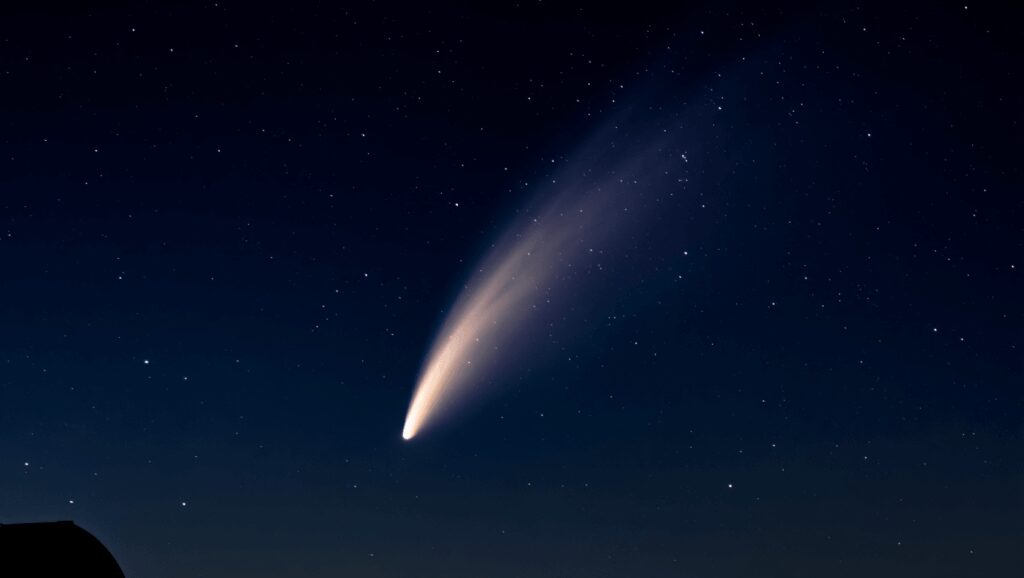
Less than a year after the discovery of the peculiar object known as Oumuamua, scientists are now confident about its true nature. It turns out it is not an asteroid, but rather a comet. Though it may sound odd, researchers claim that this is no ordinary comet.
This “interstellar visitor” made headlines quickly. In October 2017, the PanSTARRS-1 telescope in Hawaii spotted a cigar-shaped celestial object with an unusual trajectory. By November 2017, astronomers had verified that it was an asteroid from outside our solar system and it was named Oumuamua.
In December of the same year, a new theory emerged about Oumuamua’s origins, suggesting that the object might be a fragment of a destroyed planet. At the same time, astronomers tried to “listen” to the asteroid for any extraterrestrial signals.
A recent study published in the journal Nature on June 22, 2018, proposes that Oumuamua is actually a comet! Initially, astronomers suspected it might be a comet, but there was no observable trail of dust and ice, which are typically seen trailing such objects.
American, Israeli, and Italian researchers who participated in this study analyzed over 200 observations made last year by telescopes tracking the object’s movement, which has since left our solar system.
“As it moved away from the Sun, it slowed down slightly less than we expected,” stated Karen Meech of the University of Hawaii (USA).
Thus, its unexpected speed, which was not explained by the gravitational forces of the Sun and other planets, was attributed to cometary activity. It appears to be a unique kind of comet in that as it approached the Sun, its icy core melted, producing outgassing that resulted in a thrust. However, the rate of outgassing and the amount of debris were less than what is typical for other comets.
Researchers believe that the icy core of the comet was covered with dried-out materials and the debris produced during outgassing was too large and heavy to be ejected into space. As a result, a comet tail was not easily observable, which has been a major source of confusion in the case of Oumuamua, a chapter that now seems to be concluded.
Sources: Sciences et Avenir – Numerama