
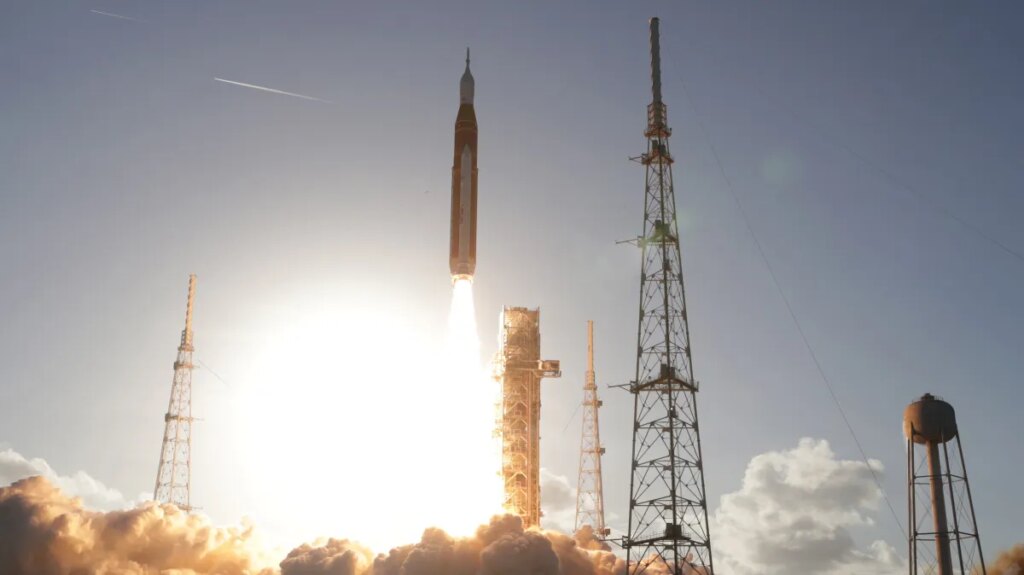
‘I compare it with building cathedrals. It is not short. The person who lays the foundations may not live to see it finished, years later. Like the Sagrada Familia in Barcelona.”
Philippe Berthe, a Frenchman now in his sixties, was there on day one, 21 years ago in 2005, when the foundations were laid for a spacecraft that could take humans back to the moon for the first time since the days of Apollo.
Then aged 40, Berthe worked for EADS, a European aerospace company that later became Airbus, and was part of a team who drew up early plans for the Orion craft that is now propelling four astronauts on a half-a-million-mile round trip.
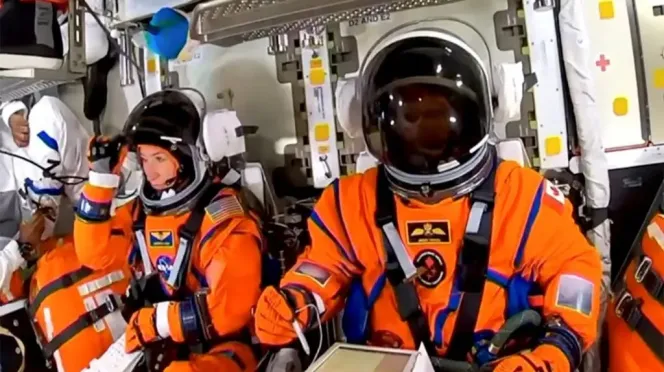 Astronauts inside the Orion capsule before launch
American technology, in the form of the Space Launch System rocket, catapulted the astronauts off the Earth and into space, and the Orion capsule in which the crew will spend ten days was built by the American firm Lockheed Martin.
But it is European technology, in the form of Orion’s European Service Module (ESM), built by Airbus for the European Space Agency (ESA), that will fire its engines to blast the crew on their way to the moon and keep them supplied with oxygen.
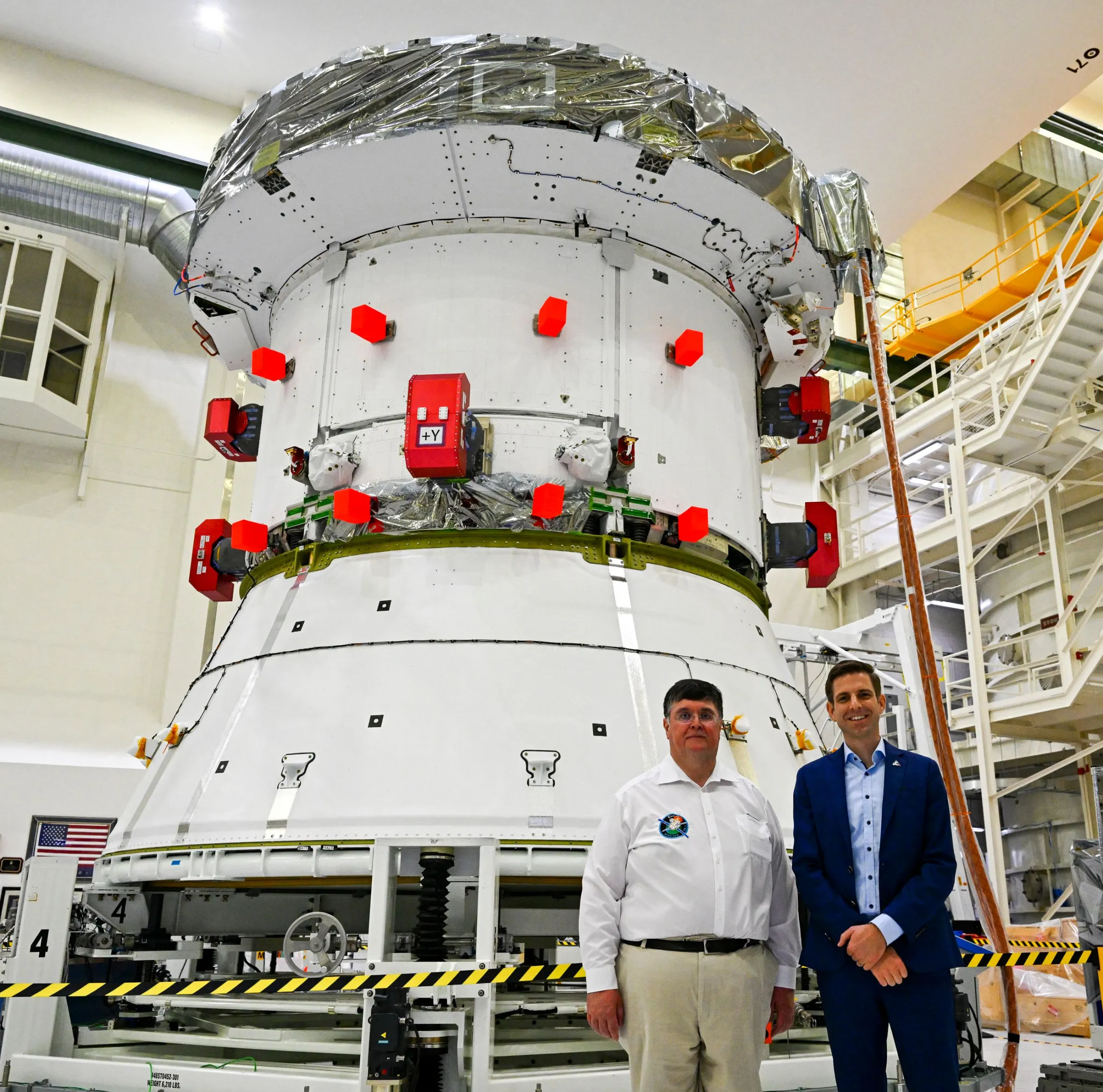 Philippe Berthe and Kai Bergemann, of Airbus, with the module in 2023CHANDAN KHANNA/AFP/Getty Images
The module includes British-made elements in the form of 32 filtration devices to keep dangerous gas bubbles out of the fuel tanks.
Josef Aschbacher, the director-general of the ESA, was in Florida for the launch and said: “The Artemis mission is a truly international endeavour, Europe is at the very core of it. ESA is not just enabling its mission. ESA is powering it.”
At the Kennedy Space Center before the Artemis II launch, he added: “Our team’s job was to write the technical proposal for Orion. The goal [in 2005] was known as ‘spiral development’, ever-increasing capacities ultimately leading to missions to the moon and Mars.”
The Bush administration wanted to return humans to the moon, but under the Obama administration plans changed for the Orion craft, with a proposal for it to deliver astronauts to an asteroid instead, Berthe said.
US newsletter
A balanced, fair and fact-checked take on global news and culture for our US readers.
Sign up with one click
In the original plans, Orion was almost “more like a space plane” and had its own airlock, he recalled.
It seemed in the late 2000s that the dream to build Orion would die, but it was then “resurrected” and Berthe, who is co-ordination manager at ESA for the Orion-ESM craft, has been working solidly on the service module since 2011.
Nasa announced in 2013 that ESA would provide the module and its first iteration was built and delivered by 2018.
It is now in space, sitting beneath the crew capsule and holding the fuel, thrusters, oxygen, water and solar panels for the mission.
The modules for Artemis III and a first moon landing with IV in 2028 have already been delivered, with plans underway for Artemis V and VI.
“It’s extremely exciting,” Berthesaid, looking out over Cape Canaveral. “We are part of it, flying a crew [to the moon] for the first time since 1972. This is what exploration is about. Extending the realm of human activities beyond low-Earth orbit and making lunar space our domain.”
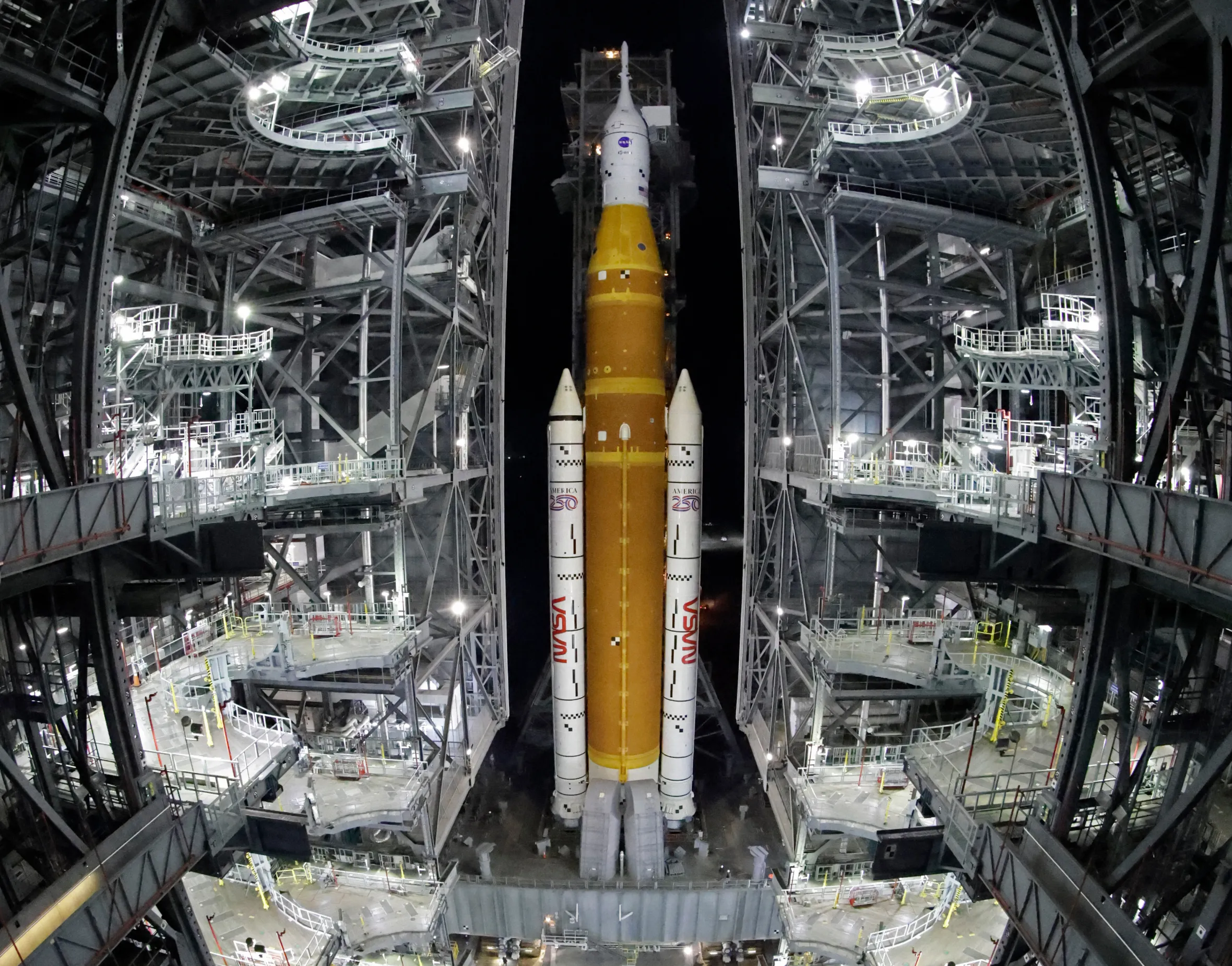 The Artemis II rocket leaving the vehicle assembly building on March 20terry renna/AP
Berthe’s career dream was to have “European spacecraft launching European astronauts from Europe”, he said.
He is not sure he will see this dream come true, but “participating in a US human spacecraft was the next best thing”, he said.
Looking ahead to the launch, he added: “I don’t tend to be nervous. I’m excited. I know that the vehicle is led by excellent people, we have a perfect team in Houston and in Europe, the top of the top in terms of human spacecraft engineering, and the ESM behaved excellently during the [uncrewed] Artemis I mission [in 2022].”
When the astronauts are ready to leave Earth’s orbit and blast away from our planet towards the moon, making humanity’s first trip into deep space in 53 years, the European-made engines will have to perform a “translunar injection” or TLI, a blast of its engines to propel the craft on its way. “It will be ESA and Airbus who will have to say the astronauts are ‘go’ to perform TLI,” Berthe said. “That is a major moment.”
Marc Steckling, the head of Earth observation, science and exploration at Airbus, called the spacecraft a “masterpiece of technology”. He said of the launch: “I don’t know how many times in life you will have such a moment as this.”