
CLEVELAND — NASA just celebrated a successful launch of Artemis II, which brings four astronauts on a 10 day trip around the moon.
In just two years, NASA envisions it will begin yearly moon landings followed by a permanent lunar base. The NASA Glenn Research Center in Northeast Ohio will be instrumental in making that lunar base a reality.
What You Need To Know
NASA Glenn Research Center employees work on a sustainable solution to power a lunar base
In two years, NASA envisions it will begin yearly moon landings
By 2030, NASA aims to establish a permanent base on the moon
In order to live on the moon long-term, astronauts need power.
“The eventual goal for that sustained kind of lunar presence is feeding off the resources that are there,” said Kerrigan Cain, a NASA Glenn lead research engineer.
The sun, which is a powerful energy source, can be harnessed on the moon.
“But there are cases up to two weeks at a time when the sun goes away while you’re on the moon,” Cain said. “And, so you need something to keep that power around when you can’t harness the sun’s power.”
Cain is working on a regenerative fuel cell, which he said is like a rechargeable battery.
A NASA spokesperson described Cain’s project, writing: “A typical fuel cell combines hydrogen and oxygen to produce electricity, leaving water and heat as its only byproducts. A regenerative fuel cell also works in reverse, using electricity to divide the water into hydrogen and oxygen, which are fed back into the fuel cell to produce more electricity. Regenerative fuel cells could power a rover or lunar base — even when sunlight isn’t available — making them useful for exploration of the Moon and beyond.”
“So when the sun is available you can use it for your power, but when the sun goes away and you don’t have something to continue operations into the night, you can use something like a fuel cell,” Cain said.
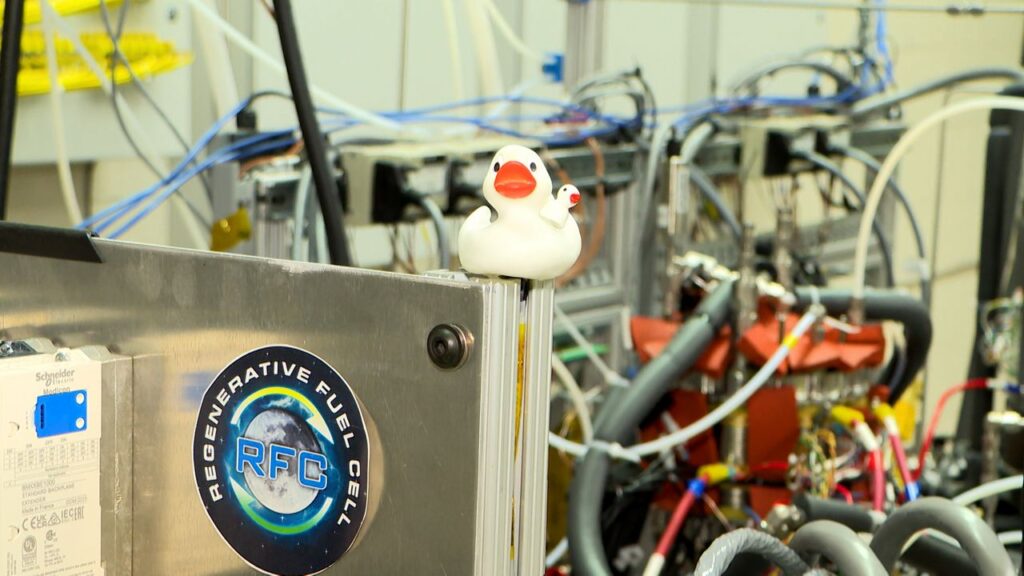
The fuel cell Cain is working on at NASA Glenn is the size of a compact SUV. He said it’s a mock-up, or “breadboard.”
“We are learning how it operates and where we need to make modifications at this kind of research stage,” Cain said.
Researchers troubleshoot the mock-up with the help of a tiny companion: a small, rubber duck.
“This has been nicknamed trouble duck,” Cain said. “So, as I mentioned, this is research hardware. We’re trying to learn all we can about the hardware as we test it. So, it is currently blinking green, indicating that the system is in a safe state.”
When the system isn’t working properly, researchers hear a “quack.”
“In the early stages you get a bunch of quacks,” Cain said. “It just sounds like you’re at a pond with a bunch of ducks.”
It’s a lighthearted feature to the serious research being conducted at Cain’s lab in the NASA Glenn Research Center.